
17-10152

LentiBrite GFP-Vimentin Lentiviral Biosensor
Größe auswählen
| Ihnen/SKU | Verfügbarkeit | Preis |
|---|
Über diesen Artikel
Quality Segment
manufacturer/tradename
Chemicon®, LentiBrite
technique(s)
cell based assay: suitable, immunocytochemistry: suitable, immunofluorescence: suitable, single cell analysis: suitable, transfection: suitable
UniProt accession no.
detection method
fluorometric
shipped in
dry ice
storage temp.
-65 to -96°C
Gene Information
human ... VIM(7431)
mouse ... VIM(22352)
General description
http://www.nature.com/app_notes/nmeth/2012/121007/pdf/an8620.pdf
(Click Here!)
Learn more about the advantages of our LentiBrite Lentiviral Biosensors! Click Here
Biosensors can be used to detect the presence/absence of a particular protein as well as the subcellular location of that protein within the live state of a cell. Fluorescent tags are often desired as a means to visualize the protein of interest within a cell by either fluorescent microscopy or time-lapse video capture. Visualizing live cells without disruption allows researchers to observe cellular conditions in real time.
Lentiviral vector systems are a popular research tool used to introduce gene products into cells. Lentiviral transfection has advantages over non-viral methods such as chemical-based transfection including higher-efficiency transfection of dividing and non-dividing cells, long-term stable expression of the transgene, and low immunogenicity.
EMD Millipore is introducing LentiBrite Lentiviral Biosensors, a new suite of pre-packaged lentiviral particles encoding important and foundational proteins of autophagy, apoptosis, and cell structure for visualization under different cell/disease states in live cell and in vitro analysis.
- Pre-packaged, fluorescently-tagged with GFP & RFP
- Higher efficiency transfection as compared to traditional chemical-based and other non-viral-based transfection methods
- Ability to transfect dividing, non-dividing, and difficult-to-transfect cell types, such as primary cells or stem cells
- Non-disruptive towards cellular function
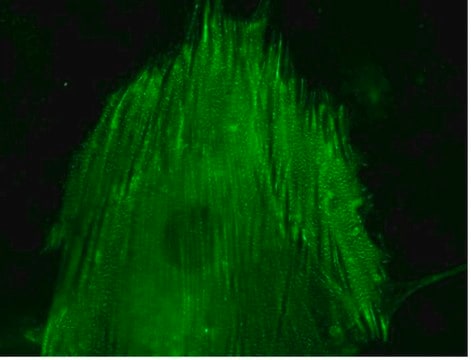
EMD Millipore’s LentiBrite GFP-Vimentin lentiviral particles provide bright fluorescence and precise localization to enable live cell analysis of vimentin IF dynamics in difficult-to-transfect cell types.
EMD Millipore’s LentiBrite GFP-vimentin lentiviral particles provide bright fluorescence and precise localization to enable live cell analysis of vimentin IF dynamics in difficult-to-transfect cell types.
Application
Similar to Figure 1 in the datasheet, HeLa cells were plated in a chamber slide and transduced with lentiviral particles at an MOI of 20 for 24 hours. After 24 hours, media was replaced and cells were then further incubated for 48 hours. Immunocytochemical staining (red) of the same fields of view with a monoclonal antibody against Vimentin (Cat No. MAB3400) reveals similar expression patterns to the GFP-protein (green).
Hard-to-transfect Cell Types:
Primary cell types HUVEC or HuMSC were plated in chamber slides and transduced with lentiviral particles at an MOI of 10 for 24 hours.
Confocal Microscopy Imaging:
HeLa and U2OS cells were treated as in Figure 2A in the datasheet. Images were obtained by oil immersion confocal fluorescence microscopy.
For optimal fluorescent visualization, it is recommended to analyze the target expression level within 24-48 hrs after transfection/infection for optimal live cell analysis, as fluorescent intensity may dim over time, especially in difficult-to-transfect cell lines. Infected cells may be frozen down after successful transfection/infection and thawed in culture to retain positive fluorescent expression beyond 24-48 hrs. Length and intensity of fluorescent expression varies between cell lines. Higher MOIs may be required for difficult-to-transfect cell lines.
Analysis Note
Other Notes
One vial containing 25 µL of lentiviral particles at a minimum of 3 x 10E8 infectious units (IFU) per mL. For lot-specific titer information, please see “Viral Titer” in the datasheet.
Promoter
EF-1 (Elongation Factor-1)
Multiplicty of Infection (MOI)
MOI = Ratio of # of infectious lentiviral particles (IFU) to # of cells being infected.
Typical MOI values for high transduction efficiency and signal intensity are in the range of 20-40. For this target, some cell types may require lower MOIs (e.g., HT-1080, U2OS), while others may require higher MOIs (e.g., human mesenchymal stem cells (HuMSC), human umbilical vein endothelial cells (HUVEC ), HeLa).
NOTE: MOI should be titrated and optimized by the end user for each cell type and lentiviral target to achieve desired transduction efficiency and signal intensity.
Legal Information
1 of 1
Dieser Artikel | |||
|---|---|---|---|
| technique(s) cell based assay: suitable, immunofluorescence: suitable, transfection: suitable, immunocytochemistry: suitable, single cell analysis: suitable | technique(s) cell based assay: suitable, immunocytochemistry: suitable, immunofluorescence: suitable, single cell analysis: suitable, transfection: suitable | technique(s) cell based assay: suitable, immunocytochemistry: suitable, immunofluorescence: suitable, transfection: suitable | technique(s) cell based assay: suitable, immunocytochemistry: suitable, immunofluorescence: suitable, single cell analysis: suitable, transfection: suitable |
| Gene Information human ... VIM(7431) | Gene Information human ... MAPRE3(22924) | Gene Information human ... ACTN1(87) | Gene Information human ... VIM(7431) |
| storage temp. -65 to -96°C | storage temp. -65 to -96°C | storage temp. -65 to -96°C | storage temp. -65 to -96°C |
| shipped in dry ice | shipped in dry ice | shipped in dry ice | shipped in dry ice |
| Quality Level 100 | Quality Level 100 | Quality Level 100 | Quality Level 100 |
| manufacturer/tradename Chemicon®, LentiBrite | manufacturer/tradename Chemicon®, LentiBrite | manufacturer/tradename Chemicon®, LentiBrite | manufacturer/tradename Chemicon®, LentiBrite |



Lagerklasse
10 - Combustible liquids
wgk
WGK 2
Analysenzertifikate (COA)
Suchen Sie nach Analysenzertifikate (COA), indem Sie die Lot-/Chargennummer des Produkts eingeben. Lot- und Chargennummern sind auf dem Produktetikett hinter den Wörtern ‘Lot’ oder ‘Batch’ (Lot oder Charge) zu finden.
Besitzen Sie dieses Produkt bereits?
In der Dokumentenbibliothek finden Sie die Dokumentation zu den Produkten, die Sie kürzlich erworben haben.