Direkt zum Inhalt
Merck

Fortfahren mit

09-456

Anti-AIRE Antibody

Upstate®, from rabbit

Synonym(e):

APECED protein, Autoimmune polyendocrinopathy candidiasis ectodermal dystrophy

protein, autoimmune polyendocrinopathy candidiasis ectodermal dystrophy 2

autoimmune regulator

, autoimmune regulator (APECED protein), autoimmune

Anmelden zur Ansicht der Organisations- und Vertragspreise.

Über diesen Artikel

UNSPSC Code:
12352203
NACRES:
NA.41
eCl@ss:
32160702
Conjugate:
unconjugated
Clone:
polyclonal
Application:
WB
Citations:
16

biological source

rabbit

Quality Level

conjugate

unconjugated

antibody form

affinity purified immunoglobulin

antibody product type

primary antibodies

clone

polyclonal

purified by

affinity chromatography

species reactivity

mouse

manufacturer/tradename

Upstate®

technique(s)

western blot: suitable

Ähnliche Artikel vergleichen

Vollständigen Vergleich anzeigen

Unterschiede anzeigen

1 of 1

Dieser Artikel
04-150MABF235SAB4501439
antibody form

affinity purified immunoglobulin

antibody form

purified immunoglobulin

antibody form

purified immunoglobulin

antibody form

affinity isolated antibody

clone

polyclonal

clone

5H12, monoclonal

clone

Mab155, monoclonal

clone

polyclonal

biological source

rabbit

biological source

rat

biological source

mouse

biological source

rabbit

conjugate

unconjugated

conjugate

unconjugated

conjugate

unconjugated

conjugate

unconjugated

species reactivity

mouse

species reactivity

mouse

species reactivity

human

species reactivity

human

Gene Information

mouse ... Aire(11634)

Gene Information

mouse ... Aire(11634)

Gene Information

human ... AIRE(326)

Gene Information

human ... AIRE(326)

General description

65 kDa
AIRE (Autoimmune Regulator) is a human gene that is expressed primarily in the thymus. It causes transcription of a wide selection of organ-specific genes, reducing the threat of autoimmunity occurring by allowing the elimination of autoreactive T cells via negative selection. Defects in this gene cause the rare autosomal-recessive systemic autoimmune disease termed autoimmune polyendo-crinopathy-candidiasis-ectodermal dystrophy (APECED). Disruption of AIRE results in the development of a range of autoimmune diseases, the most common clinical conditions in the syndrome are hypoparathyroidism, primary adrenocortical failure and chronic mucocutaneous candidiasis. Aire functions through initiating the transcription of a diverse set of self-antigens, such as insulin, in the thymus. This expression then allows maturing thymocytes to become tolerant towards peripheral organs, thereby suppressing autoimmune disease. Aire is atranscriptional regulator protein that binds to DNA as dimer and tetramer, but not as a monomer. It forms nuclear bodies and interacts with the transcriptional coactivator CBP (CREBBP). At least three splice variant mRNAs products have been described including one which results in a premature stop codon and a transcript predicted to be a candidate for nuclear-mediated decay (NMD).

Immunogen

Epitope: a.a. 162-181
KLH-conjugated synthetic peptide corresponding to amino acids 162-181 of mouse AIRE

Application

Suggested dilutions:
Western blot: 1:1000
Detect AIRE using this Anti-AIRE Antibody validated for use in WB.
Research Category
Inflammation & Immunology
Research Sub Category
Developmental Signaling

Transcription Factors

RNA Binding Protein (RBP)

Biochem/physiol Actions

Likely to cross-react with rat, based on sequence homology. Cross-reactivity with other species has not been tested
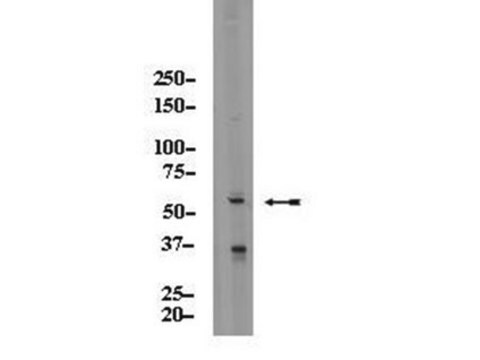
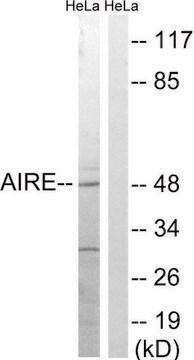
Recognizes murine AIRE, Mr 58 kDa (calculated). Appears at ~65 kDa in Western blots.

Physical form

100 μg of immunoaffinity purified rabbit polyclonal IgG in 173 μl of 0.02M PBS, 0.25M NaCl containing 0.1% sodium azide
ImmunoAffinity Purified

Preparation Note

2 years at -20°C from date of shipment. Upon first thaw, and prior to removing the cap, centrifuge the vial and gently mix the solution. Aliquot into microcentrifuge tubes and store at -20°C. Avoid repeated freeze/thaw cycles, which may damage IgG and affect product performance. Note: Variability in freezer temperatures below -20°C may cause glycerol-containing solutions to become frozen during storage.

Analysis Note

Control
Murine thymus tissue lysate
Routinely evaluated by Western Blot analysis.

Western Blot:
A 1:1000 dilution of this lot detected AIRE in murine thymus lysate

Legal Information

UPSTATE is a registered trademark of Merck KGaA, Darmstadt, Germany

Disclaimer

Unless otherwise stated in our catalog or other company documentation accompanying the product(s), our products are intended for research use only and are not to be used for any other purpose, which includes but is not limited to, unauthorized commercial uses, in vitro diagnostic uses, ex vivo or in vivo therapeutic uses or any type of consumption or application to humans or animals.

Sie haben nicht das passende Produkt gefunden?  

Probieren Sie unser Produkt-Auswahlhilfe. aus.

wgk

WGK 2

flash_point_f

Not applicable

flash_point_c

Not applicable

Lagerklasse

12 - Non Combustible Liquids


Analysenzertifikate (COA)

Suchen Sie nach Analysenzertifikate (COA), indem Sie die Lot-/Chargennummer des Produkts eingeben. Lot- und Chargennummern sind auf dem Produktetikett hinter den Wörtern ‘Lot’ oder ‘Batch’ (Lot oder Charge) zu finden.

Besitzen Sie dieses Produkt bereits?

In der Dokumentenbibliothek finden Sie die Dokumentation zu den Produkten, die Sie kürzlich erworben haben.

Die Dokumentenbibliothek aufrufen

Noriyuki Kuroda et al.
Journal of immunology (Baltimore, Md. : 1950), 174(4), 1862-1870 (2005-02-09)
Autoimmune regulator (AIRE) gene mutation is responsible for the development of organ-specific autoimmune disease with monogenic autosomal recessive inheritance. Although Aire has been considered to regulate the elimination of autoreactive T cells through transcriptional control of tissue-specific Ags in thymic
Mark S Anderson et al.
Science (New York, N.Y.), 298(5597), 1395-1401 (2002-10-12)
Humans expressing a defective form of the transcription factor AIRE (autoimmune regulator) develop multiorgan autoimmune disease. We used aire- deficient mice to test the hypothesis that this transcription factor regulates autoimmunity by promoting the ectopic expression of peripheral tissue- restricted
Adrian Liston et al.
Nature immunology, 4(4), 350-354 (2003-03-04)
Autoimmune polyendocrinopathy syndrome type 1 is a recessive Mendelian disorder resulting from mutations in a novel gene, AIRE, and is characterized by a spectrum of organ-specific autoimmune diseases. It is not known what tolerance mechanisms are defective as a result
Chris Ramsey et al.
Human molecular genetics, 11(4), 397-409 (2002-02-21)
Autoimmune polyendocrinopathy-candidiasis-ectodermal dystrophy (APECED) is a monogenic autosomal recessive disease caused by mutations in the AIRE gene. Here we have produced knock-out mice for the Aire gene. The Aire-/- mice develop normally; however, autoimmune features of APECED in Aire-/- mice
Wenyu Jiang et al.
The Journal of experimental medicine, 202(6), 805-815 (2005-09-21)
Loss of function mutations in the autoimmune regulator (Aire) gene in autoimmune polyendocrinopathy-candidiasis-ectodermal dystrophy patients and mutant mice lead to autoimmune manifestations that segregate as a monogenic trait, but with wide variation in the spectrum of organs targeted. To investigate

Verwandter Inhalt

All eukaryotic organisms require tight regulation of gene expression for complex processes such as development, differentiation, cell specification, and responses to environmental stimuli. Many genes are regulated post-transcriptionally, in addition to transcriptional mechanisms of gene regulation. RNA-binding proteins (RBPs) are essential for post-transcriptional gene regulation, linking transcription and translation in many processes including transcription, splicing, export, rate of translation and turnover. In all of these events, RBPs coordinate regulation of the amount of protein produced from mRNA transcripts.

Global Trade Item Number

SKUGTIN
09-45604053252332722

Questions

Reviews

No rating value

Active Filters

Unser Team von Wissenschaftlern verfügt über Erfahrung in allen Forschungsbereichen einschließlich Life Science, Materialwissenschaften, chemischer Synthese, Chromatographie, Analytik und vielen mehr..

Setzen Sie sich mit dem technischen Dienst in Verbindung