Direkt zum Inhalt
Merck

Fortfahren mit

09-403

Anti-TKS5(SH3 #1)-Antikörper

from rabbit

Synonym(e):

Adaptor protein TKS5, Five SH3 domain-containing protein, SH3 and PX domains 2A, SH3 multiple domains 1, SH3 multiple domains protein 1, five SH3 domains

Anmelden zur Ansicht der Organisations- und Vertragspreise.

Größe auswählen

Ansicht ändern
PackungsgrößeSKUVerfügbarkeitPreis
100 μg
Warenkorb auf Verfügbarkeit prüfen
€ 478,00

Über diesen Artikel

UNSPSC Code:
12352203
NACRES:
NA.41
eCl@ss:
32160702
Conjugate:
unconjugated
Clone:
polyclonal
Application:
ICC, IP, WB
Citations:
6

€ 478,00


Warenkorb auf Verfügbarkeit prüfen

Großbestellung anfragen
Technischer Dienst
Benötigen Sie Hilfe? Unser Team von erfahrenen Wissenschaftlern ist für Sie da.
Unterstützung erhalten


biological source

rabbit

Quality Level

conjugate

unconjugated

antibody form

purified antibody

antibody product type

primary antibodies

clone

polyclonal

species reactivity

mouse, human

technique(s)

immunocytochemistry: suitable, immunoprecipitation (IP): suitable, western blot: suitable

NCBI accession no.

UniProt accession no.

shipped in

wet ice

target post-translational modification

unmodified

Gene Information

human ... SH3PXD2A(9644)
mouse ... Sh3Pxd2A(14218)

General description

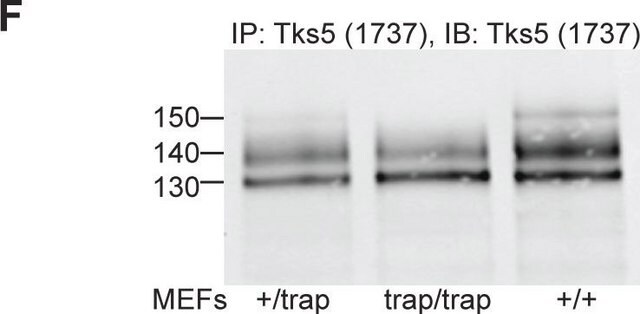
In einigen Zelllysaten können nichtcharakterisierte Banden bei 130–150 kDa auftreten.
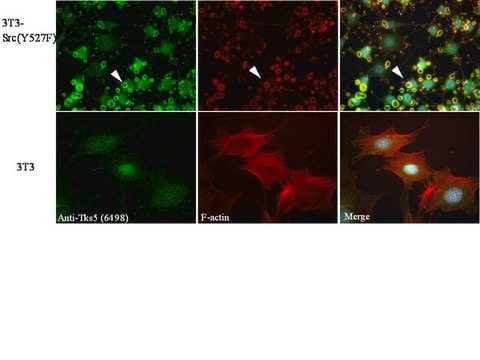
Tks5 (zuvor als Fish bekannt) ist ein großes Gerüstprotein mit einer aminoterminalen PX-Domäne und fünf SH3-Domänen. In normalen Fibroblasten ist es zytoplasmatisch. In Src-transformierten Zellen lokalisiert Tks5 in Podosomen. Die Co-Expression von Tks5 und konstitutiv aktivem Src in Krebsepithelzellen führte zum Auftreten von Podosomen/Invadopodien. Zellen mit einer verringerten Tks5-Expression sind durch Matrigel schwach invasiv. In einigen invasiven humanen Krebszelllinien, insbesondere Brustkrebs und Melanome, wird Tks5 in Podosomen/Invadopodien exprimiert und ist darin lokalisiert. Daher scheint Tks5 für die Bildung von Podosomen/Invadopodien und für die Invasion einiger Krebszellen erforderlich zu sein.

Immunogen

Epitop: A.S. 166–225
Rekombinantes Protein, A.S. 166–225. Homologie: Mensch, Hund, Pferd, Ratte, Rind (100 %, 60/60); Huhn (93 %, 56/60).

Application

Der Anti-Tks5 (SH3 #1)-Antikörper weist Werte von Tks5 (SH3 #1) nach und wurde zur Verwendung in WB, IC und IP publiziert und validiert.
Forschungs-Unterkategorie
Zytoskelettale Signalisierung
Forschungskategorie
Zellstruktur
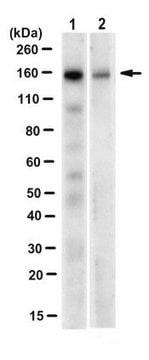
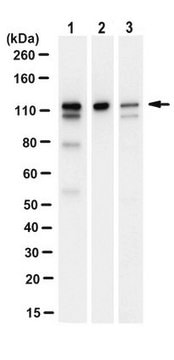
Western-Blot-Analyse: Der Antikörper wies Tks5 in 20 μg NIH/3T3-Lysat (100 % Konfluenz) nach.

Biochem/physiol Actions

Andere Homologien: Mensch, Hund, Pferd, Ratte und Rind (100 % Sequenzhomologie), Huhn (93 % Sequenzhomologie)

Physical form

Aufgereinigt in 0,1 mol/l Tris-Glycin (pH-Wert 7,4), 150 mmol/l NaCl mit 0,05 % NaN3.
Format: Aufgereinigt
Mit Protein A aufgereinigt

Preparation Note

Bei Lagerung bei 2–8 °C in unverdünnten Aliquoten bis zu 1 Jahr nach Erhalt haltbar.

Analysis Note

Kontrolle
Western Blot:
NIH/3T3-Lysat (100 % Konfluenz)
Immunzytochemie:
Maus-3T3-Src(Y527F)-Zellen
Regelmäßig mittels Western Blot an NIH/3T3-Lysat (100 % Konfluenz) beurteilt.

Other Notes

Konzentration: Die chargenspezifische Konzentration entnehmen Sie bitte dem Analysenzertifikat.

Disclaimer

Sofern in unserem Katalog oder anderen Begleitdokumenten unserer Produkte nicht anders angegeben, sind unsere Produkte nur für Forschungszwecke vorgesehen und nicht für andere Zwecke zu verwenden, einschließlich, jedoch nicht beschränkt auf unautorisierte kommerzielle Verwendung, zur In-vitro-Diagnostik, für Ex-vivo- oder In-vivo-Therapiezwecke oder jegliche Art der Einnahme oder Anwendung bei Menschen oder Tieren.

Ähnliche Artikel vergleichen

Vollständigen Vergleich anzeigen

Unterschiede anzeigen

1 of 1

Dieser Artikel
09-268MABT336MABT337
species reactivity

mouse, human

species reactivity

mouse, human

species reactivity

human

species reactivity

human

clone

polyclonal

clone

polyclonal

clone

13H6.3, monoclonal

clone

9H2.1, monoclonal

conjugate

unconjugated

conjugate

unconjugated

conjugate

unconjugated

conjugate

unconjugated

antibody form

purified antibody

antibody form

purified antibody

antibody form

purified antibody

antibody form

purified immunoglobulin

biological source

rabbit

biological source

rabbit

biological source

mouse

biological source

mouse

shipped in

wet ice

shipped in

wet ice

shipped in

ambient

shipped in

ambient


Still not finding the right product?

Probieren Sie unser Produkt-Auswahlhilfe, um Ihre Auswahl einzugrenzen


Lagerklasse

12 - Non Combustible Liquids

wgk

WGK 1

flash_point_f

Not applicable

flash_point_c

Not applicable


Analysenzertifikate (COA)

Suchen Sie nach Analysenzertifikate (COA), indem Sie die Lot-/Chargennummer des Produkts eingeben. Lot- und Chargennummern sind auf dem Produktetikett hinter den Wörtern ‘Lot’ oder ‘Batch’ (Lot oder Charge) zu finden.

Besitzen Sie dieses Produkt bereits?

In der Dokumentenbibliothek finden Sie die Dokumentation zu den Produkten, die Sie kürzlich erworben haben.

Die Dokumentenbibliothek aufrufen


Verwandter Inhalt

QCM™ Gelatin Invadopodia Assays provide optimized materials and protocols to enable reproducible analysis of invadopodia in invasive tumor cells (Catalog No. ECM670 for green fluorescence, Catalogue No. ECM671 for red fluorescence). Reagents are provided for coating glass culture surfaces with fluorescent matrix and for colocalizing the actin cytoskeleton and nuclei with invadopodial degradation sites. This assay may also be used for assessing the activity of inhibitors and promoters of invadopodia formation and function. Furthermore, different cell types and individual cells in heterogeneous populations may be analyzed for invasive potential. Finally, the assay kits provide troubleshooting suggestions, recommendations for coating on multiple substrate formats, and example studies in several assay systems (e.g., various cell types, time-course studies, degradation modulation).


Karla C Williams et al.
Oncogene, 38(19), 3598-3615 (2019-01-18)
Invadopodia are cell protrusions that mediate cancer cell extravasation but the microenvironmental cues and signaling factors that induce invadopodia formation during extravasation remain unclear. Using intravital imaging and loss of function experiments, we determined invadopodia contain receptors involved in chemotaxis
Samuel J Ghilardi et al.
Molecular biology of the cell, 32(18), 1707-1723 (2021-07-01)
Interactions between the actin cytoskeleton and the plasma membrane are important in many eukaryotic cellular processes. During these processes, actin structures deform the cell membrane outward by applying forces parallel to the fiber's major axis (as in migration) or they
Nawal Bendris et al.
Journal of cell science, 129(14), 2804-2816 (2016-06-10)
The ability of cancer cells to degrade the extracellular matrix and invade interstitial tissues contributes to their metastatic potential. We recently showed that overexpression of sorting nexin 9 (SNX9) leads to increased cell invasion and metastasis in animal models, which


Global Trade Item Number

SKUGTIN
09-40304053252620867

Questions

Reviews

No rating value

Active Filters