
07-1436

Anti-PDGF-AA Antibody
from rabbit, purified by affinity chromatography
Synonym(e):
Platelet-derived growth factor alpha, Platelet-derived growth factor alpha chain, Platelet-derived growth factor alpha polypeptide
Größe auswählen
| Packungsgröße | SKU | Verfügbarkeit | Preis |
|---|
Über diesen Artikel
biological source
rabbit
Quality Level
conjugate
unconjugated
antibody form
affinity purified immunoglobulin
antibody product type
primary antibodies
clone
polyclonal
purified by
affinity chromatography
species reactivity
human, mouse
technique(s)
ELISA: suitable, immunohistochemistry: suitable (paraffin), neutralization: suitable, western blot: suitable
isotype
IgG
NCBI accession no.
UniProt accession no.
shipped in
dry ice
target post-translational modification
unmodified
Gene Information
human ... PDGFA(5154)
General description
Immunogen
Application
ELISA: 0.5 μg/mL dilution of a previous lot allowed detection (in direct ELISA) of 0.2-0.4 ng/well when human PDGF-AA is used to coat the plate.
Neutralization: To yield ½ maiximal inhibition (ND50) of the biological activity of hPDGF-AA (5.0 ng/mL), a concentration of 0.05-0.07 μg/mL of a previous lot of this antibody was required.
Optimal working dilutions must be determined by the end user.
Signaling
Growth Factors & Receptors
Biochem/physiol Actions
Physical form
Preparation Note
Handling Recommendations: Upon first thaw, and prior to removing the cap, centrifuge the vial and gently mix the solution. Aliquot into microcentrifuge tubes and store at -20°C. Avoid repeated freeze/thaw cycles, which may damage IgG and affect product performance.
Analysis Note
C2C12 cell lysate
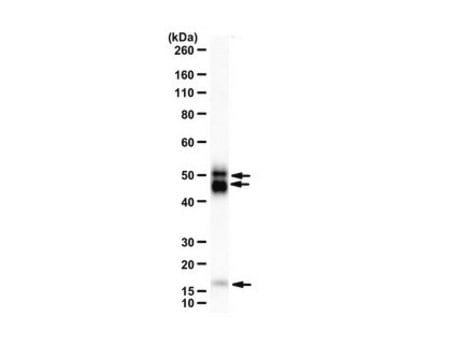
Western Blot Analysis:
1:500 dilution of this lot detected PDGF-AA on 10 μg of C2C12 lysates.
Other Notes
Disclaimer
1 of 1
Dieser Artikel | |||
|---|---|---|---|
| biological source rabbit | biological source rabbit | biological source mouse | biological source rabbit |
| species reactivity human, mouse | species reactivity human | species reactivity human, mouse | species reactivity human |
| clone polyclonal | clone polyclonal | clone CH-3, monoclonal | clone polyclonal |
| conjugate unconjugated | conjugate unconjugated | conjugate unconjugated | conjugate unconjugated |
| antibody form affinity purified immunoglobulin | antibody form affinity purified immunoglobulin | antibody form purified immunoglobulin | antibody form purified antibody |
| UniProt accession no. | UniProt accession no. | UniProt accession no. | UniProt accession no. |

Still not finding the right product?
Probieren Sie unser Produkt-Auswahlhilfe, um Ihre Auswahl einzugrenzen
Lagerklasse
13 - Non Combustible Solids
wgk
WGK 3
flash_point_f
Not applicable
flash_point_c
Not applicable
Analysenzertifikate (COA)
Suchen Sie nach Analysenzertifikate (COA), indem Sie die Lot-/Chargennummer des Produkts eingeben. Lot- und Chargennummern sind auf dem Produktetikett hinter den Wörtern ‘Lot’ oder ‘Batch’ (Lot oder Charge) zu finden.
Besitzen Sie dieses Produkt bereits?
In der Dokumentenbibliothek finden Sie die Dokumentation zu den Produkten, die Sie kürzlich erworben haben.
Global Trade Item Number
| SKU | GTIN |
|---|---|
| 07-1436 | 04053252328589 |