Direkt zum Inhalt
Merck

Fortfahren mit

06-1304

Anti-SETD8 (hPR-SET7) Antibody

from rabbit, purified by affinity chromatography

Synonym(e):

Histone-lysine N-methyltransferase SETD8

Anmelden zur Ansicht der Organisations- und Vertragspreise.

Größe auswählen

Ansicht ändern
PackungsgrößeSKUVerfügbarkeitPreis
100 μL
Warenkorb auf Verfügbarkeit prüfen
€ 545,00

Über diesen Artikel

UNSPSC Code:
12352203
NACRES:
NA.41
eCl@ss:
32160702
Conjugate:
unconjugated
Clone:
polyclonal
Application:
WB
Citations:
10

€ 545,00


Warenkorb auf Verfügbarkeit prüfen
Für Ihr Target ist ein rekombinanter, konservierungsmittelfreier Antikörper verfügbar. Probieren Sie ZRB2754

Großbestellung anfragen
Technischer Dienst
Benötigen Sie Hilfe? Unser Team von erfahrenen Wissenschaftlern ist für Sie da.
Unterstützung erhalten


biological source

rabbit

Quality Level

conjugate

unconjugated

antibody form

affinity isolated antibody

antibody product type

primary antibodies

clone

polyclonal

purified by

affinity chromatography

species reactivity

human

species reactivity (predicted by homology)

mouse (based on 100% sequence homology), rat (based on 100% sequence homology)

technique(s)

western blot: suitable

NCBI accession no.

UniProt accession no.

shipped in

wet ice

target post-translational modification

unmodified

Gene Information

human ... SETD8(387893)

General description

N-lysine methyltransferase KMT5A (UniProt: Q9NQR1; also known as EC: 2.1.1.43, H4-K20-HMTase KMT5A, Histone-lysine N-methyltransferase KMT5A, Lysine N-methyltransferase 5A, Lysine-specific methylase 5A, PR/SET domain-containing protein 07, PR-Set7, PR/SET07, SET domain-containing protein 8) is encoded by the KMT5A (also known as PRSET7, SET07, SET8, SETD8) gene (Gene ID: 387893) in human. SETD8 (hPR-SET7) is a histone methyltransferase that adds a single methyl group to lysine 20 of histone H4 (H4K20me1). H4K20me1 is enriched during mitosis and represents a specific tag for epigenetic transcriptional repression. SETD8 is not detected during the G1 phase. It is first detected during S through G2 phases, and peaks during mitosis. It mainly functions in euchromatin regions, thereby playing a central role in the silencing of euchromatic genes. It is required for cell proliferation, probably by contributing to the maintenance of proper higher-order structure of DNA during mitosis and is also involved in chromosome condensation and proper cytokinesis. It is also reported to mediate mono-methylation of p53/TP53 at lysine 382, leading to repress p53/TP53-target genes. SETD8 has a SET domain in the amino acids 257-378 and this region contains the active site of enzymatic activity. Sequences upstream and downstream of SET domain are also required for its methyltransferase activity. Two isoforms of SETD8 have been described that are produced by alternative splicing.
~43 kDa

Immunogen

GST-tagged recombinant protein corresponding to human SETD8 (hPR-SET7).

Application

Anti-SETD8 (hPR-SET7) Antibody is a Rabbit Polyclonal Antibody for detection of SETD8 (hPR-SET7) also known as Histone-lysine N-methyltransferase SETD8 & has been validated in WB.
Research Category
Epigenetics & Nuclear Function
Research Sub Category
Histones

Biochem/physiol Actions

This rabbit polyclonal antibody detects N-lysine methyltransferase KMT5A (PR-SET7).

Physical form

Affinity purified
Purified rabbit polyclonal in buffer containing 0.1 M Tris-glycine, pH 7.4, 0.150 mM NaCl and 0.05% sodium azide.

Preparation Note

Stable at 2-8°C for 1 year from date of receipt.

Analysis Note

Control
HeLa nuclear extract.
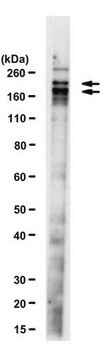
Evaluated by Western Blotting in HeLa cell nuclear extract.

Western Blotting Analysis: 0.05 µg/mL of this antibody detected SETD8 (hPR-SET7) in HeLa cell nucleaar extract.

Other Notes

Replaces: 07-316

Disclaimer

Unless otherwise stated in our catalog or other company documentation accompanying the product(s), our products are intended for research use only and are not to be used for any other purpose, which includes but is not limited to, unauthorized commercial uses, in vitro diagnostic uses, ex vivo or in vivo therapeutic uses or any type of consumption or application to humans or animals.

Ähnliche Artikel vergleichen

Vollständigen Vergleich anzeigen

Unterschiede anzeigen

1 of 1

Dieser Artikel
MABE1067ABE344ABE1337
biological source

rabbit

biological source

mouse

biological source

rabbit

biological source

rabbit

species reactivity

human

species reactivity

mouse

species reactivity

human

species reactivity

human

conjugate

unconjugated

conjugate

unconjugated

conjugate

-

conjugate

unconjugated

antibody form

affinity isolated antibody

antibody form

purified immunoglobulin

antibody form

affinity isolated antibody

antibody form

affinity isolated antibody

clone

polyclonal

clone

F0808, monoclonal

clone

polyclonal

clone

polyclonal

technique(s)

western blot: suitable

technique(s)

ChIP: suitable, immunoprecipitation (IP): suitable, western blot: suitable

technique(s)

dot blot: suitable, inhibition assay: suitable (peptide), western blot: suitable

technique(s)

immunocytochemistry: suitable, western blot: suitable


Still not finding the right product?

Probieren Sie unser Produkt-Auswahlhilfe, um Ihre Auswahl einzugrenzen


Lagerklasse

12 - Non Combustible Liquids

wgk

WGK 1

flash_point_f

Not applicable

flash_point_c

Not applicable


Analysenzertifikate (COA)

Suchen Sie nach Analysenzertifikate (COA), indem Sie die Lot-/Chargennummer des Produkts eingeben. Lot- und Chargennummern sind auf dem Produktetikett hinter den Wörtern ‘Lot’ oder ‘Batch’ (Lot oder Charge) zu finden.

Besitzen Sie dieses Produkt bereits?

In der Dokumentenbibliothek finden Sie die Dokumentation zu den Produkten, die Sie kürzlich erworben haben.

Die Dokumentenbibliothek aufrufen


Mai Nagasaka et al.
Scientific reports, 13(1), 22877-22877 (2023-12-22)
Transforming growth factor β (TGF-β) is a multifunctional cytokine that induces a diverse set of cellular processes principally through Smad-dependent transcription. Transcriptional responses induced by Smads are tightly regulated by Smad cofactors and histone modifications; however, the underlying mechanisms have
Aja Aravamudhan et al.
Physiological reports, 12(7), e15999-e15999 (2024-04-13)
Pulmonary arterial hypertension (PAH) causes pulmonary vascular remodeling, increasing pulmonary vascular resistance (PVR) and leading to right heart failure and death. Matrix stiffening early in the disease promotes remodeling in pulmonary artery smooth muscle cells (PASMCs), contributing to PAH pathogenesis.
Chieh-Tien Shih et al.
Aging cell, 16(4), 797-813 (2017-05-18)
Cellular senescence is a permanent proliferative arrest triggered by genome instability or aberrant growth stresses, acting as a protective or even tumor-suppressive mechanism. While several key aspects of gene regulation have been known to program this cessation of cell growth


Global Trade Item Number

SKUGTIN
06-130404053252622731

Questions

Reviews

No rating value

Active Filters