


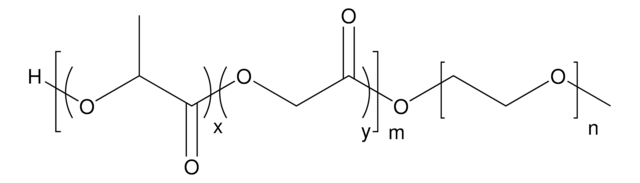
Conjugating PEG to catalase is recognized to improve protein stability, leading to an extended circulatory half-life for the enzyme.
C4963

Catalase−polyethylene glycol
lyophilized powder, ~40,000 units/mg protein
Sinónimos:
PEG-Catalase
Iniciar sesión para ver los precios por organización y contrato.
Seleccione un Tamaño
Cambiar Vistas
| Tamaño de envase | SKU | Disponibilidad | Precio |
|---|---|---|---|
| 2 mg | Comprobar disponibilidad del carrito | $153.000 |
Acerca de este artículo
Specific activity:
~40,000 units/mg protein
Servicio técnico
¿Necesita ayuda? Nuestro equipo de científicos experimentados está aquí para ayudarle.
Permítanos ayudarleform
lyophilized powder
Quality Segment
specific activity
~40,000 units/mg protein
mol wt
PEG 5,000
composition
Protein, ~50% E405
extent of labeling
~40 mol PEG per mol protein
matrix attachment
secondary amine linkage.
storage temp.
−20°C
Application
Pulmonary artery endothelial cells treated with PEG-catalase showed effective inhibition of 20- HETE (hydroxyeicosatetraenoic acid)-induced increase in fluorescence. However, the experiment excludes potential nonspecific fluorescence of DCF (dichlorofluorescein). This experiment studied the effect of 20-HETE on superoxide production and NADPH oxidase activation.[1]
Biochem/physiol Actions
Catalase from bovine liver catalyzes the decomposition of H2O2 into water and oxygen. It is a tetramer consisting of four equal subunits with a molecular weight of 60 kDa each. Each subunit contains iron bound to a protoheme IX group. The enzyme also strongly binds NADP, which is in close proximity to the heme group. Catalase activity is constant over the pH range of 4.0-8.5. The pI is found to be 5.4. The enzyme activity is inhibited by 3-amino-1-H-1,2,4 triazole, cyanide, azide, hydroxylamine, cyanogen bromide, 2-mercaptoethanol, dithiothreitol, dianisidine, and nitrate. Incubation of catalase with ascorbate or ascorbate/Cu2+ results in degradation of the catalase molecule. It does not require any activators.
Packaging
Package size based on protein content
Physical form
Contains PEG plus 5% citrate buffer salts
Other Notes
Catalase from bovine liver coupled to methoxy-polyethylene glycol.
1 of 1
Este artículo | |||
|---|---|---|---|
| specific activity ~40,000 units/mg protein | specific activity ≥1,350 units/mg protein | specific activity - | specific activity - |
| form lyophilized powder | form lyophilized powder | form powder | form powder |
| mol wt PEG 5,000 | mol wt 5000 Da | mol wt PEG average Mn 5,000 | mol wt PEG average Mn 5,000 (by NMR), PLGA average Mn 5,000 (by NMR) |
| storage temp. −20°C | storage temp. −20°C | storage temp. 2-8°C | storage temp. −20°C |
| Quality Level 200 | Quality Level 200, 400 | Quality Level 100 | Quality Level - |
| matrix attachment secondary amine linkage. | matrix attachment - | matrix attachment - | matrix attachment - |
Clase de almacenamiento
11 - Combustible Solids
wgk
WGK 3
flash_point_f
Not applicable
flash_point_c
Not applicable
ppe
Eyeshields, Gloves, type N95 (US)
Elija entre una de las versiones más recientes:
¿Ya tiene este producto?
Encuentre la documentación para los productos que ha comprado recientemente en la Biblioteca de documentos.
Número de artículo de comercio global
| SKU | GTIN |
|---|---|
| C4963-2MG | 04061833494158 |
-
I would like to know the function of PEG with the catalase for this product.
1 answer-
Helpful?
-
-
What is the specific activity of Catalase-polyethylene glycol, Product C4963?
1 answer-
The certificate of analysis on our website will have lot-specific activity information.
Helpful?
-
-
What can I use to solubilize Catalase-polyethylene glycol, Product C4963?
1 answer-
It is soluble in water at a concentration of 1 mg/mL.
Helpful?
-
-
What is the Department of Transportation shipping information for this product?
1 answer-
Transportation information can be found in Section 14 of the product's (M)SDS.To access the shipping information for this material, use the link on the product detail page for the product.
Helpful?
-
-
What is the solution stability of Catalase-polyethylene glycol, Product C4963?
1 answer-
We generally recommend preparing fresh solutions of Catalase-PEG. If stock solutions must be stored, we recommend first dissolving in water, then diluteing with an equal volume of glycerol. This 50% glycerol solution may be kept in the freezer at -20°C. Aqueous solutions held at 37°C were found to lose approximately half of the catalase activity after about 10 days.
Helpful?
-