


The recommended storage temperature for this product is 2-8°C. While freezer storage is not required, storing this solution in frozen aliquots at -20°C will not impact the integrity of the protein. Avoid repeated freeze/thaw cycles. The long term stability of this material when stored frozen has not been evaluated and may not result in extended shelf life.
F1141

Bovine Fibronectin
from bovine plasma, liquid, suitable for cell culture
Sinónimos:
Fibronectina
Iniciar sesión para ver los precios por organización y contrato.
Seleccione un Tamaño
Cambiar Vistas
| Tamaño de envase | SKU | Disponibilidad | Precio |
|---|---|---|---|
| 1 mg | Comprobar disponibilidad del carrito | $210.000 | |
| 2 mg | Comprobar disponibilidad del carrito | $358.000 | |
| 5 mg | Comprobar disponibilidad del carrito | $715.000 |
Acerca de este artículo
Biological source:
bovine plasma
Form:
solution
Technique(s):
cell culture | mammalian: suitable
Servicio técnico
¿Necesita ayuda? Nuestro equipo de científicos experimentados está aquí para ayudarle.
Permítanos ayudarleNombre del producto
Fibronectina plasma bovino, solution, sterile-filtered, BioReagent, suitable for cell culture
biological source
bovine plasma
Quality Level
sterility
sterile-filtered
product line
BioReagent
form
solution
packaging
pkg of 1 mg, pkg of 2 mg, pkg of 5 mg
technique(s)
cell culture | mammalian: suitable
surface coverage
1‑5 μg/cm2
UniProt accession no.
binding specificity
Peptide Source: Collagen
, Peptide Source: Fibrinogen
shipped in
wet ice
storage temp.
2-8°C
Gene Information
bovine ... FN1(280794)
General description
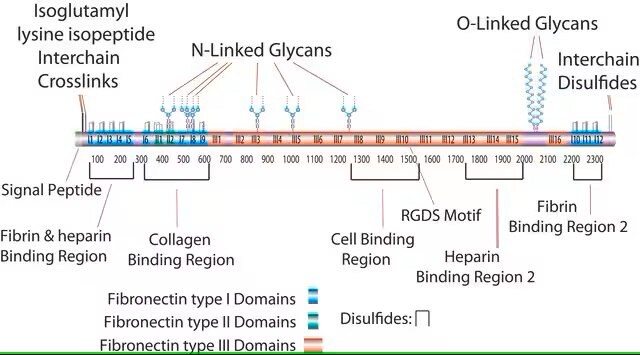
La fibronectina es una proteína ubicua de la matriz extracelular. Es una proteína mosaico compuesta por tres tipos de secuencias de aminoácidos consenso modulares que se repiten. Las fibronectinas pertenecen a una clase de glucoproteínas de elevado peso molecular. La fibronectina celular es expresada por los fibroblastos y la fibronectina plasmática suele ser liberada por los hepatocitos.
Application
La fibronectina (FN) plasmática bovina se ha utilizado en:
- análisis de fibronectina y de adsorción (ELISA (enzimoinmunoanálisis de absorción))
- migración transpocillos
- ensayo de fibronectina
Biochem/physiol Actions
Las fibronectinas participan en la adhesión celular, la organización del citoesqueleto, la transformación oncógena, la migración celular, la fagocitosis, la hemostasia y la diferenciación embrionaria.
Analysis Note
La homogeneidad proteica se evalúa mediante inmunoelectroforesis.
Other Notes
El producto F1141, la fibronectina del plasma bovino es una disolución en TBS 0,05 M a pH 7,5.
1 of 1
Este artículo | |||
|---|---|---|---|
| biological source bovine plasma | biological source bovine plasma | biological source human plasma | biological source human plasma |
| technique(s) cell culture | mammalian: suitable | technique(s) cell culture | mammalian: suitable | technique(s) cell culture | mammalian: suitable | technique(s) cell culture | mammalian: suitable |
| sterility sterile-filtered | sterility sterile | sterility sterile | sterility sterile |
| Quality Level 200 | Quality Level 200 | Quality Level 200 | Quality Level 200 |
| form solution | form powder | form liquid | form lyophilized powder |
| binding specificity Peptide Source: Collagen | binding specificity - | binding specificity Peptide Source: Collagen | binding specificity Peptide Source: Collagen |
Still not finding the right product?
Explore all of our products under Fibronectina plasma bovino
signalword
Danger
hcodes
Hazard Classifications
Resp. Sens. 1 - Skin Sens. 1
Clase de almacenamiento
12 - Non Combustible Liquids
flash_point_f
Not applicable
flash_point_c
Not applicable
ppe
Eyeshields, Gloves
Elija entre una de las versiones más recientes:
¿Ya tiene este producto?
Encuentre la documentación para los productos que ha comprado recientemente en la Biblioteca de documentos.
Protocolos
Dilute fibronectin for cell attachment, varying per cell type. Coating protocol, products, and FAQs provided.
Artículos
Cancer stem cell media, spheroid plates and cancer stem cell markers to culture and characterize CSC populations.
The extracellular matrix (ECM) and its attachment factor components are discussed in this article in relation to their function in structural biology and their availability for in vitro applications.
3D cell culture overview. Learn about 2D vs 3D cell culture, advantages of 3D cell culture, and techniques available to develop 3D cell models
CCL2/CCR2 chemokine signaling coordinates survival and motility of breast cancer cells through Smad3 and p42/44MAPK dependent mechanisms
Fang W B, et al.
The Journal of biological chemistry, jbc-M112 (2012)
Enhanced fibronectin adsorption on carbon nanotube/poly (carbonate) urethane: independent role of surface nano-roughness and associated surface energy
Khang D, et al.
Biomaterials, 28(32), 4756-4768 (2007)
FIBRONECTIN AUTOANTIBODIES
Autoantibodies, 221-251 (2007)
Número de artículo de comercio global
| SKU | GTIN |
|---|---|
| F1141-1MG | 04061835568444 |
| F1141-2MG | 04061833611678 |
| F1141-5MG | 04061835514144 |
-
Can I freeze the aliquoted Fibronectin?
1 answer-
Helpful?
-
-
Hi, I bought a vial with 5mg of Fibronectin (F1141), but so far, I have not been able to find the concentration of this solution. Can you please help me with this info? Thanks a lot in advance!
1 answer-
The concentration of this product is 1 mg/mL. This information is reported in the product Certificate of Analysis. Please see the link below to review a sample or lot-specific Certificate:
https://www.sigmaaldrich.com/product/sigma/f1141#product-documentationHelpful?
-
-
How long can I store fibronectin coated plates, etc?
1 answer-
Fibronectin coated cultureware can be stored for 2-4 weeks at 2-8 °C in a closed sterile container, or in sterile sealable bags.
Helpful?
-
-
What is the procedure for coating culture surfaces with fibronectin?
1 answer-
To coat culture surfaces: 1. Dilute fibronectin in sterile balanced salt solution and coat the culture surface (1-5 μg/cm2) with a minimal volume. 2. Allow to air dry for at least 45 minutes at room temperature. Excess fibronectin may be removed by aspiration, but this is not necessary.
Helpful?
-
-
What is the Department of Transportation shipping information for this product?
1 answer-
Transportation information can be found in Section 14 of the product's (M)SDS.To access the shipping information for this material, use the link on the product detail page for the product.
Helpful?
-
-
How long can I store the fibronectin solution?
1 answer-
The product is good for at least a year at 2-8 °C if kept sterile.
Helpful?
-
-
How do I choose which fibronectin product to use to coat culture surfaces for cell growth?
1 answer-
The species source for the fibronectin used when coating culture surfaces is not important. It is the presence of the RGD binding site that is present in all fibronectins that promotes binding.
Helpful?
-