Saltar al contenido
Merck

Saltar a

A5964

Monoclonal Anti-Phosphotyrosine–Peroxidase antibody produced in mouse

clone PT-66, purified immunoglobulin, lyophilized powder

Sinónimos:

Monoclonal Anti-Phosphotyrosine, Phospho-Tyr, Phospho-tyrosine, p-Tyr

Iniciar sesión para ver los precios por organización y contrato.

Seleccione un Tamaño

Cambiar Vistas
Tamaño de envaseSKUDisponibilidadPrecio

Acerca de este artículo

NACRES:
NA.43
UNSPSC Code:
12352203
Conjugate:
peroxidase conjugate
Clone:
PT-66, monoclonal
Application:
DB, ELISA (d)
Citations:
12
En este momento no podemos mostrarle ni los precios ni la disponibilidad
Servicio técnico
¿Necesita ayuda? Nuestro equipo de científicos experimentados está aquí para ayudarle.
Permítanos ayudarle


biological source

mouse

Quality Level

conjugate

peroxidase conjugate

antibody form

purified immunoglobulin

antibody product type

primary antibodies

clone

PT-66, monoclonal

form

lyophilized powder

packaging

vial of 0.2 mL conjugate

technique(s)

direct ELISA: 1:60,000 using Phosphotyrosine-BSA, dot blot: 1:40,000-1:200,000 using phosphotyrosine-BSA using chromogenic and chemiluminescent substrates, respectively

isotype

IgG1

storage temp.

2-8°C

target post-translational modification

unmodified

General description

As determined by ELISA and competitive ELISA, the antibody reacts specifically with phosphorylated tyrosine, both as free amino acid or conjugated to carriers such as BSA or KLH. No cross-reactivity is observed with non-phosphorylated tyrosine, phosphothreonine, phosphoserine, AMP or ATP.
Monoclonal Anti-Phosphotyrosine (mouse IgG1 isotype) is derived from the PT-66 hybridoma produced by the fusion of mouse myeloma cells and splenocytes from BALB/c mice immunized with a phosphotyrosine-BSA conjugate.

Immunogen

phosphotyrosine conjugated to BSA

Application

Monoclonal Anti-Phosphotyrosine-Peroxidase antibody has been used in
  • enzyme linked immunosorbent assay (ELISA)
  • dot blot
  • Chemiluminescence dot blot
  • kinase assay

Biochem/physiol Actions

Mouse anti-phosphotyrosine-peroxidase antibody reacts specifically with phosphorylated tyrosine coupled to BSA. The product has shown no reactivity for other phosphorylated amino acids like phosphothreonine and phosphoserine.
Reversible phosphorylation of proteins is an important post-translational modification that plays a regulatory role in the expression of most proteins in the cells. Reversible phosphorylation at multiple serine, tyrosine and threonine residues mediates numerous signalling pathways in both prokaryotic and eukaryotic cells . Cellular proteins with phosphorylated tyrosine increase many fold by the activation of tyrosine kinases. Most mitogenic receptor systems such as EGF, PDGF, insulin receptors contain serine/threonine/tyrosine kinase domains that undergo autophosphorylation when receptors bind to the respective ligands. Monoclonal anti-phosphotyrosine–peroxidase antibody can be used in kinase assay to visualize the fraction of phosphorylated substrate.

Physical form

Lyophilized from a solution containing 1% bovine serum albumin and 0.05% MIT in 0.01 M sodium phosphate buffered saline.

Disclaimer

Unless otherwise stated in our catalog or other company documentation accompanying the product(s), our products are intended for research use only and are not to be used for any other purpose, which includes but is not limited to, unauthorized commercial uses, in vitro diagnostic uses, ex vivo or in vivo therapeutic uses or any type of consumption or application to humans or animals.

Comparar elementos similares

Ver comparación completa

Mostrar Diferencias

1 of 1

Este artículo
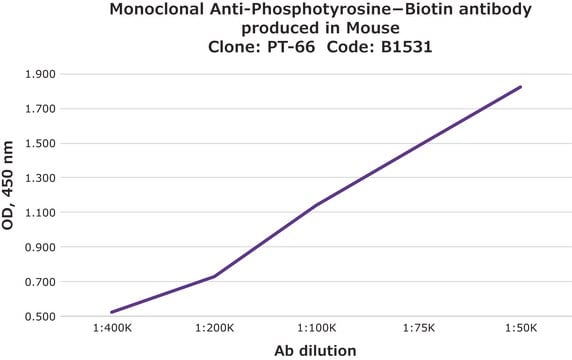
B1531A1806P3555
conjugate

peroxidase conjugate

conjugate

biotin conjugate

conjugate

agarose conjugate

conjugate

unconjugated

clone

PT-66, monoclonal

clone

PT-66, monoclonal

clone

PT-66, monoclonal

clone

PTR-8, monoclonal

antibody form

purified immunoglobulin

antibody form

purified immunoglobulin

antibody form

purified immunoglobulin

antibody form

ascites fluid

biological source

mouse

biological source

mouse

biological source

mouse

biological source

mouse

form

lyophilized powder

form

buffered aqueous solution

form

PBS solution

form

-

Quality Level

200

Quality Level

200

Quality Level

200

Quality Level

200


Still not finding the right product?

Pruebe nuestra Herramienta de selección de productos para limitar sus opciones


Clase de almacenamiento

13 - Non Combustible Solids

wgk

WGK 3

flash_point_f

Not applicable

flash_point_c

Not applicable


Elija entre una de las versiones más recientes:

Certificados de análisis (COA)

Lot/Batch Number

¿No ve la versión correcta?

Si necesita una versión concreta, puede buscar un certificado específico por el número de lote.

¿Ya tiene este producto?

Encuentre la documentación para los productos que ha comprado recientemente en la Biblioteca de documentos.

Visite la Librería de documentos


Contenido relacionado


Bobbi Xayarath et al.
Journal of bacteriology, 189(9), 3369-3381 (2007-02-27)
Extracellular polysaccharides of many bacteria are synthesized by the Wzy polymerase-dependent mechanism, where long-chain polymers are assembled from undecaprenyl-phosphate-linked repeat units on the outer face of the cytoplasmic membrane. In gram-positive bacteria, Wzy-dependent capsules remain largely cell associated via membrane
Identification and biophysical assessment of the molecular recognition mechanisms between the human haemopoietic cell kinase Src homology domain 3 and ALG-2-interacting protein X
Shi X, et al.
The Biochemical Journal, 431(1), 93-102 (2010)
Yuko Naito et al.
Molecular and cellular biology, 27(8), 3008-3022 (2007-02-14)
Sialic acid (Sia) is a family of acidic nine-carbon sugars that occupies the nonreducing terminus of glycan chains. Diversity of Sia is achieved by variation in the linkage to the underlying sugar and modification of the Sia molecule. Here we


Número de artículo de comercio global

SKUGTIN
A5964-1VL04061833376638

Questions

Reviews

No rating value

Active Filters