

Anti-Glutamate Receptor NMDAR2A should be reconstituted with 50 ul of sterile phosphate buffered saline (PBS).
M264

Anti-Glutamate Receptor NMDAR2A (NR2A) antibody produced in rabbit
affinity isolated antibody, lyophilized powder
Synonyme(s) :
NR2A Antibody - Anti-Glutamate Receptor NMDAR2A (NR2A) antibody produced in rabbit, Nr2A Antibody
Se connecter pour consulter les tarifs organisationnels et contractuels.
Sélectionner une taille de conditionnement
Changer de vue
| Conditionnement | Référence | Disponibilité | Prix |
|---|---|---|---|
| 10 μg | Veuillez contacter notre Service Clients pour connaître la disponibilité de ce produit. | 1 120,00 $ |
A propos de cet article
Conjugate:
unconjugated
Clone:
polyclonal
Application:
IHC, IP, WB
Citations:
29
1 120,00 $
Veuillez contacter notre Service Clients pour connaître la disponibilité de ce produit.
Un anticorps recombinant, sans conservateur, est disponible pour votre cible. Essayez ZRB04901
Service technique
Besoin d'aide ? Notre équipe de scientifiques expérimentés est là pour vous.
Laissez-nous vous aiderbiological source
rabbit
Quality Level
conjugate
unconjugated
antibody form
affinity isolated antibody
antibody product type
primary antibodies
clone
polyclonal
form
lyophilized powder
mol wt
antigen 180 kDa
species reactivity
rat, mouse, human
technique(s)
immunohistochemistry: 1:1,000-1:2,000, immunoprecipitation (IP): 3 μL using 200 μg of rat brain, western blot: 1:1,000
UniProt accession no.
storage temp.
−20°C
target post-translational modification
unmodified
Gene Information
human ... GRIN2A(2903)
mouse ... Grin2a(14811)
rat ... Grin2a(24409)
General description
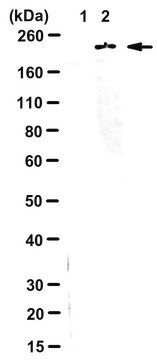
Rabbit polyclonal anti-Glutamate Receptor NMDAR2A (NR2A) antibody labels the 180 kDa NR2A subunit of the NMDA receptor. This labeling is blocked by the preadsorption of the antibody with the immunogen. The antibody does not cross-react with the NR2B or NR2C subunits. It reacts with rat, mouse and human tissues.
The N-Methyl-D-Aspartate (NMDA) receptor complex is comprised of 2 types of subunits, NR1 and NR2. Only one type of NR1 subunits has yet been identified while four distinct subunits have been identified for the NR2 receptor, NR2A, NR2B, NR2C, and NR2D. While the NR2 subunits are not functional alone, they combine with the NR1 subunit to produce a variety of different receptor types. A number have studies have also shown that the functional properties of the receptors complexes formed by the NR1 and NR2 subunits are largely determined by the NR2 components of the complex. NMDA receptors are post-synaptic and play important roles in plasticity in the developing and mature central nervous system (CNS). Agonists and antagonists of NMDA receptors have been proposed to be of therapeutic benefit in a number of CNS disorders, including stroke, head injury, epilepsy, pain, and Alzheimer′s disease.
Immunogen
C-terminal portion of NR2A (amino acids 1253-1391).
Application
Applications in which this antibody has been used successfully, and the associated peer-reviewed papers, are given below.
Western Blotting (1 paper)
Western Blotting (1 paper)
Rabbit polyclonal anti-Glutamate Receptor NMDAR2A (NR2A) antibody is used to tag the 180 kDa NR2A subunit of the NMDA receptor for detection and quantitation by immunocytochemical and immunohistochemical (IHC) techniques such as immunoblotting and immunoprecipitation. It is used as a probe to determine the presence and roles of the 180 kDa NR2A subunit in the assembly and function of N-Methyl-D-Aspartate (NMDA) receptor complexes.
Physical form
Lyophilized from ammonium bicarbonate (5 mM)
Disclaimer
Unless otherwise stated in our catalog or other company documentation accompanying the product(s), our products are intended for research use only and are not to be used for any other purpose, which includes but is not limited to, unauthorized commercial uses, in vitro diagnostic uses, ex vivo or in vivo therapeutic uses or any type of consumption or application to humans or animals.
1 of 1
Cet article | |||
|---|---|---|---|
| Quality Level 100 | Quality Level 200 | Quality Level 200 | Quality Level 200 |
| biological source rabbit | biological source rabbit | biological source rabbit | biological source rabbit |
| conjugate unconjugated | conjugate unconjugated | conjugate unconjugated | conjugate unconjugated |
| antibody form affinity isolated antibody | antibody form affinity isolated antibody | antibody form affinity isolated antibody | antibody form purified antibody |
| technique(s) immunohistochemistry: 1:1,000-1:2,000, western blot: 1:1,000, immunoprecipitation (IP): 3 μL using 200 μg of rat brain | technique(s) immunohistochemistry (frozen sections): 1:1000, immunoprecipitation (IP): 3 μL using 200 μg of rat cerebellum., indirect immunofluorescence: 1:1000 using frozen sections, western blot: 1:1000 using 200 μg cell lysate | technique(s) western blot: 1:2,000 using extract of a rat brain synaptosomal fraction. | technique(s) immunocytochemistry: suitable, western blot: suitable |
| form lyophilized powder | form lyophilized powder | form buffered aqueous solution | form - |
Still not finding the right product?
Essayez notre Outil de sélection de produits pour affiner vos choix.
Classe de stockage
11 - Combustible Solids
wgk
WGK 2
flash_point_f
Not applicable
flash_point_c
Not applicable
ppe
Eyeshields, Gloves, type N95 (US)
Faites votre choix parmi les versions les plus récentes :
Déjà en possession de ce produit ?
Retrouvez la documentation relative aux produits que vous avez récemment achetés dans la Bibliothèque de documents.
Contenu apparenté
Instructions
L Addis et al.
Scientific reports, 7(1), 66-66 (2017-03-01)
Mutations in the N-methyl-D-aspartate receptor (NMDAR) gene GRIN2A cause epilepsy-aphasia syndrome (EAS), a spectrum of epileptic, cognitive and language disorders. Using bioinformatic and patient data we shortlisted 10 diverse missense mutations for characterisation. We used high-throughput calcium-flux assays and patch
Sighild Lemarchant et al.
International journal of molecular sciences, 23(16) (2022-08-27)
NX210c is a disease-modifying dodecapeptide derived from the subcommissural organ-spondin that is under preclinical and clinical development for the treatment of neurological disorders. Here, using whole-cell patch-clamp recordings, we demonstrate that NX210c increased α-amino-3-hydroxy-5-methyl-4-isoxazolepropionic acid receptor (AMPAR)- and GluN2A-containing N-methyl-D-aspartate
Baris Alten et al.
British journal of pharmacology, 175(24), 4450-4463 (2018-09-18)
Children and adolescents are the top consumers of high-fructose corn syrup (HFCS) sweetened beverages. Even though the cardiometabolic consequences of HFCS consumption in adolescents are well known, the neuropsychiatric consequences have yet to be determined. Adolescent rats were fed for
Numéro d'article de commerce international
| Référence | GTIN |
|---|---|
| M264-10UG | 04061833385050 |
-
In which volume should I reconstitute the 10 ug antibody?
1 answer-
Helpful?
-