Accéder au contenu
MilliporeSigma

Passer à

C4606

Anti-Calreticulin antibody produced in rabbit

IgG fraction of antiserum, buffered aqueous solution

Se connecter pour consulter les tarifs organisationnels et contractuels.

Sélectionner une taille de conditionnement

Changer de vue
ConditionnementRéférenceDisponibilitéPrix
0.2 mL
Veuillez contacter notre Service Clients pour connaître la disponibilité de ce produit.
761,00 $

A propos de cet article

UNSPSC Code:
12352203
NACRES:
NA.43
MDL number:
Conjugate:
unconjugated
Clone:
polyclonal
Application:
ARR, IF, IP, WB
Citations:
25

761,00 $


Veuillez contacter notre Service Clients pour connaître la disponibilité de ce produit.
Un anticorps recombinant, sans conservateur, est disponible pour votre cible. Essayez ZRB1681

Demander une commande groupée
Service technique
Besoin d'aide ? Notre équipe de scientifiques expérimentés est là pour vous.
Laissez-nous vous aider


biological source

rabbit

Quality Level

conjugate

unconjugated

antibody form

IgG fraction of antiserum

antibody product type

primary antibodies

clone

polyclonal

form

buffered aqueous solution

mol wt

antigen 50 kDa

species reactivity

human, canine

technique(s)

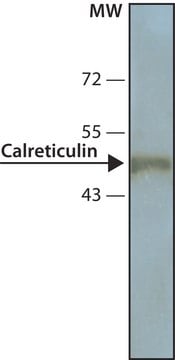
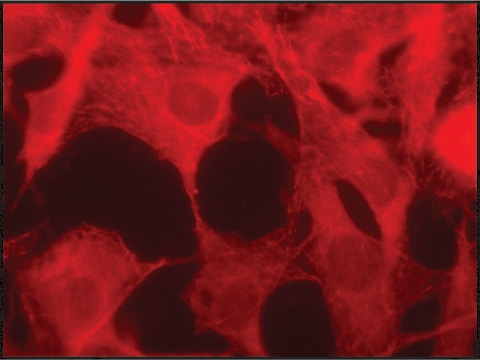
immunoprecipitation (IP): suitable using whole cell RIPA lysate of the human epitheloid carcinoma HeLa cell line, indirect immunofluorescence: 1:100 using 3% paraformaldehyde-fixed, 0.5% Triton X-100 treated, Madin Darby canine kidney MDCK cell line, microarray: suitable, western blot: 1:2,000 using whole cell RIPA lysate of the human epitheloid carcinoma HeLa cell line

UniProt accession no.

shipped in

dry ice

storage temp.

−20°C

target post-translational modification

unmodified

Gene Information

human ... CALR(811)

General description

The gene for calreticulin (CALR) is located on the human chromosome 19p13.13. The encoded protein is a predominantly conserved calcium-binding chaperone, which is localized primarily to the lumen of the endoplasmic reticulum (ER). Calreticulin comprises three domains, a globular N-domain, a proline-rich P-domain, and a highly acidic C-domain.

Immunogen

synthetic peptide corresponding to the C-terminus of human calreticulin (amino acids 401-417).

Application

Anti-Calreticulin antibody produced in rabbit has been used in:
  • immunoblotting[1]
  • immunofluorescence[2]
  • immunocytochemistry{91
  • immunoprecipitation

Biochem/physiol Actions

Anti-Calreticulin recognizes human and dog calreticulin (55-60 kDa).
Calreticulin facilitates transient interaction with newly synthesized cellular and extracellular proteins for folding and assembling in the endoplasmic reticulum (ER) before its localization to the cytosol or cell surface. Calreticulin acts as a lectin-like chaperone binding oligosaccharide residues of newly synthesized N-linked glycoproteins and misfolded proteins. It is believed to play a critical role in quality control processes during protein synthesis and folding and calcium (Ca2+) homeostasis. Increased expression of calreticulin increases the Ca2+ storage capacity of the ER. It also appears to modulate store-operated Ca2+-influx and to alter Ca2+ transport by the sarcoplasmic/ER Ca2+-adenosine triphosphatase (ATPase) (SERCA). Overexpression of calreticulin results in increased sensitivity of HeLa cells to drug-induced apoptosis. However, increased resistance to apoptosis has been observed in calreticulin-deficient cells.

Physical form

Solution in 0.01 M phosphate buffered saline, pH 7.4, containing 15 mM sodium azide.

Preparation Note

Store at -20 °C. For continuous use, the product maybe stored at 2-8 °C for up to one month. For prolonged storage, freeze in working aliquots at-20 °C. Repeated freezing and thawing, or storage in “frost-free” freezers, is not recommended. If slight turbidity occurs upon prolonged storage, clarify the solution by centrifugation before use. Working dilution samples should be discarded ifnot used within 12 hours.

Disclaimer

Unless otherwise stated in our catalog or other company documentation accompanying the product(s), our products are intended for research use only and are not to be used for any other purpose, which includes but is not limited to, unauthorized commercial uses, in vitro diagnostic uses, ex vivo or in vivo therapeutic uses or any type of consumption or application to humans or animals.

Comparer avec des articles similaires

Voir la comparaison complète

Montrer les différences

1 of 1

Cet article
C7492C4731E3406
Quality Level

200

Quality Level

200

Quality Level

200

Quality Level

200

biological source

rabbit

biological source

mouse

biological source

rabbit

biological source

rabbit

conjugate

unconjugated

conjugate

unconjugated

conjugate

unconjugated

conjugate

unconjugated

antibody form

IgG fraction of antiserum

antibody form

tissue culture supernatant

antibody form

IgG fraction of antiserum

antibody form

affinity isolated antibody

species reactivity

human, canine

species reactivity

human

species reactivity

canine, rat, mouse, human

species reactivity

rat, mouse, bovine, pig, canine, human

technique(s)

immunoprecipitation (IP): suitable using whole cell RIPA lysate of the human epitheloid carcinoma HeLa cell line, microarray: suitable, indirect immunofluorescence: 1:100 using 3% paraformaldehyde-fixed, 0.5% Triton X-100 treated, Madin Darby canine kidney MDCK cell line, western blot: 1:2,000 using whole cell RIPA lysate of the human epitheloid carcinoma HeLa cell line

technique(s)

flow cytometry: suitable, immunocytochemistry: suitable, immunohistochemistry: suitable, indirect ELISA: suitable, western blot: 1:50-1:100 using total cell extract of HeLa cells

technique(s)

immunoprecipitation (IP): 1:2,000 using whole cell RIPA lysate of the human epitheloid carcinoma HeLa cell line, indirect immunofluorescence: 1:200 using 3% paraformaldehyde-fixed, 0.5% Triton X-100 treated, Madin Darby canine kidney MDCK cell line, microarray: suitable, western blot: 1:2,000 using whole cell RIPA lysate of the human hepatocytoma HepG2 cell line

technique(s)

immunoprecipitation (IP): 10-20 μg using cell lysate of the human epitheloid carcinoma HeLa cell line, indirect immunofluorescence: 1-2 μg/mL using rat fibroblast Rat1 cells, indirect immunofluorescence: suitable, western blot: 0.5-1 μg/mL using cell lysate of the rat fibroblast cell line Rat1 or Rat 2


Still not finding the right product?

Explore all of our products under

ou

Essayez notre Outil de sélection de produits pour affiner vos choix.


Classe de stockage

10 - Combustible liquids

wgk

nwg

flash_point_f

Not applicable

flash_point_c

Not applicable


Faites votre choix parmi les versions les plus récentes :

Certificats d'analyse (COA)

Lot/Batch Number

Vous ne trouvez pas la bonne version ?

Si vous avez besoin d'une version particulière, vous pouvez rechercher un certificat spécifique par le numéro de lot.

Déjà en possession de ce produit ?

Retrouvez la documentation relative aux produits que vous avez récemment achetés dans la Bibliothèque de documents.

Consulter la Bibliothèque de documents


Daniel Helbling et al.
Blood, 106(4), 1369-1375 (2005-04-28)
The pericentric inversion of chromosome 16, inv(16)(p13q22), is associated with acute myeloid leukemia (AML) subtype M4Eo that is characterized by the presence of myelomonocytic blasts and atypical eosinophils. This rearrangement fuses the CBFB and MYH11 genes, with the latter encoding
Eleonora Di Gregorio et al.
American journal of human genetics, 95(2), 209-217 (2014-07-30)
Spinocerebellar ataxias (SCAs) are a heterogeneous group of autosomal-dominant neurodegenerative disorders involving the cerebellum and 23 different genes. We mapped SCA38 to a 56 Mb region on chromosome 6p in a SCA-affected Italian family by whole-genome linkage analysis. Targeted resequencing
Marek Michalak et al.
The Biochemical journal, 417(3), 651-666 (2009-01-13)
Calreticulin is an ER (endoplasmic reticulum) luminal Ca2+-buffering chaperone. The protein is involved in regulation of intracellular Ca2+ homoeostasis and ER Ca2+ capacity. The protein impacts on store-operated Ca2+ influx and influences Ca2+-dependent transcriptional pathways during embryonic development. Calreticulin is


Numéro d'article de commerce international

RéférenceGTIN
C4606-.2ML04061838104335

Questions

Reviews

No rating value

Active Filters