Accéder au contenu
Merck

Passer à

09-271

Anti-Rac1b Antibody

Upstate®, from rabbit

Synonyme(s) :

Ras-related C3 botulinum toxin substrate 1, Cell migration-inducing gene 5 protein, Ras-like protein TC25, p21-Rac1

Se connecter pour consulter les tarifs organisationnels et contractuels.

Sélectionner une taille de conditionnement

Changer de vue
ConditionnementRéférenceDisponibilitéPrix

A propos de cet article

UNSPSC Code:
12352203
NACRES:
NA.41
eCl@ss:
32160702
Conjugate:
unconjugated
Clone:
polyclonal
Application:
IF, IHC, WB
Citations:
26
Le tarif et la disponibilité ne sont pas disponibles actuellement.
Service technique
Besoin d'aide ? Notre équipe de scientifiques expérimentés est là pour vous.
Laissez-nous vous aider


biological source

rabbit

Quality Level

conjugate

unconjugated

antibody form

affinity purified immunoglobulin

antibody product type

primary antibodies

clone

polyclonal

purified by

affinity chromatography

species reactivity

mouse, human

manufacturer/tradename

Upstate®

technique(s)

immunofluorescence: suitable, immunohistochemistry: suitable (paraffin), western blot: suitable

NCBI accession no.

UniProt accession no.

shipped in

wet ice

target post-translational modification

unmodified

Gene Information

human ... RAC1(5879)

General description

Ras-related C3 botulinum toxin substrate 1 (UniProt: P63000; also known as Cell migration-inducing gene 5 protein, Ras-like protein TC25, p21-Rac1) is encoded by the RAC1 (also known as TC25, MIG5) gene (Gene ID: 5879) in human. Rac1 is a plasma membrane-associated small GTPase that cycles between active GTP-bound and inactive GDP-bound states. In its active state, it binds to a variety of effector proteins to regulate cellular responses. Two isoforms of Rac1 have been described that are produced by alternative splicing. Rac1b differs from Rac1a in that it has an additional 19 amino acids and is found in various tumors, such as breasts and colorectal. Rac1b has an accelerated GEF-independent GDP/GTP exchange and an impaired GTP hydrolysis, which is restored partially by GTPase-activating proteins. It can bind to the GTPase-binding domain of PAK, but not full-length PAK in a GTP-dependent manner, suggesting that the insertion does not completely abolish effector interaction. Isoform B is predominantly identified in skin and epithelial tissues from the intestinal tract. Its expression is elevated in colorectal tumors at various stages of neoplastic progression, as compared to their respective adjacent tissues.
~17 kDa observed; 23.47 kDa calculated. Uncharacterized bands may be observed in some lysate(s).

Immunogen

KLH-conjugated linear peptide corresponding to 15 amino acids from the N-terminal half of human Rac1b.

Application

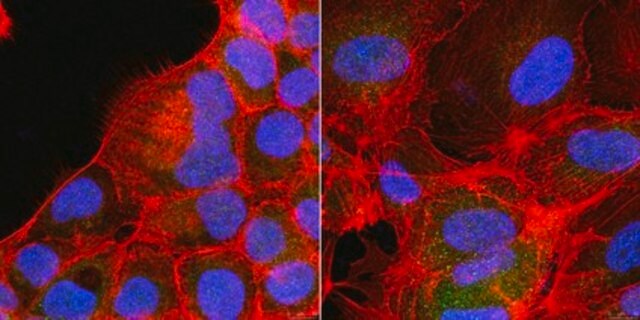
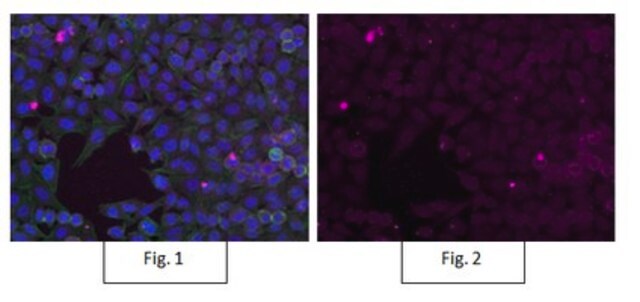
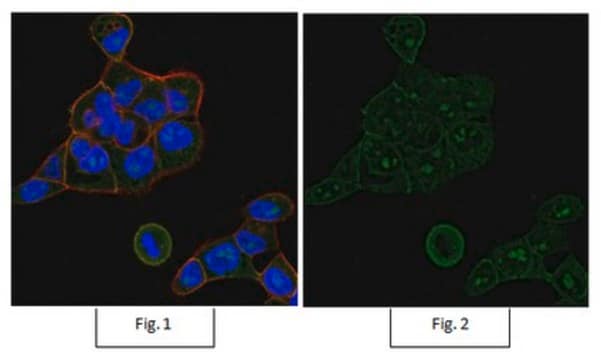
Immunocytochemistry Analysis: A 1:500 dilution from a representative lot detected Rac1b in HeLa, A431, HUVEC, and NIH/3T3 cells.

Immunohistochemistry (Paraffin) Analysis: A 1:250 dilution from a representative detected Rac1b in human colon cancer and human prostate cancer tissue sections.
Anti-Rac1b Antibody, Cat. No. 09-271, is a rabbit polyclonal antibody that detects Ras-related C3 botulinum toxin substrate 1 (Rac1b) and has been tested for use in Immunocytochemistry, Immunohistochemistry (Paraffin), and Western Blotting.

Biochem/physiol Actions

This rabbit polyclonal antibody specifically detects Rac1b in human and murine cells.

Physical form

Purified rabbit polyclonal antibody in PBS with 0.05% sodium azide and 30% glycerol.

Analysis Note

Evaluated by Western Blotting in MCF7 cell lysate.

Western Blotting Analysis: A 1:1,000 dilution of this antibody detected Rac1b in MCF7 cell lysate.

Other Notes

Concentration: Please refer to the Certificate of Analysis for the lot-specific concentration.

Legal Information

UPSTATE is a registered trademark of Merck KGaA, Darmstadt, Germany

Comparer avec des articles similaires

Voir la comparaison complète

Montrer les différences

1 of 1

Cet article
05-389-AF64705-389-AF48816-319
clone

polyclonal

clone

23A8, monoclonal

clone

23A8, monoclonal

clone

23A8, monoclonal

species reactivity

mouse, human

species reactivity

mouse, rat, human

species reactivity

rat, mouse, human

species reactivity

human, rat, mouse

antibody form

affinity purified immunoglobulin

antibody form

affinity isolated antibody

antibody form

purified antibody

antibody form

purified antibody

conjugate

unconjugated

conjugate

ALEXA FLUOR 647

conjugate

ALEXA FLUOR 488

conjugate

magnetic beads conjugate

biological source

rabbit

biological source

mouse

biological source

mouse

biological source

mouse

UniProt accession no.

P63000

UniProt accession no.

P63000

UniProt accession no.

P63000

UniProt accession no.

P63000


Still not finding the right product?

Essayez notre Outil de sélection de produits pour affiner vos choix.


Classe de stockage

10 - Combustible liquids

wgk

WGK 1


Certificats d'analyse (COA)

Recherchez un Certificats d'analyse (COA) en saisissant le numéro de lot du produit. Les numéros de lot figurent sur l'étiquette du produit après les mots "Lot" ou "Batch".

Déjà en possession de ce produit ?

Retrouvez la documentation relative aux produits que vous avez récemment achetés dans la Bibliothèque de documents.

Consulter la Bibliothèque de documents


Matrix metalloproteinase induction of Rac1b, a key effector of lung cancer progression.
Stallings-Mann, ML; Waldmann, J; Zhang, Y; Miller, E; Gauthier, ML; Visscher, DW; Downey et al.
Science Translational Medicine null
Hannah Otterbein et al.
Cancers, 11(8) (2019-08-23)
The small GTPase RAC1B functions as a powerful inhibitor of transforming growth factor (TGF)-β1-induced epithelial-mesenchymal transition, cell motility, and growth arrest in pancreatic epithelial cells. Previous work has shown that RAC1B downregulates the TGF-β type I receptor ALK5, but the
Hendrik Ungefroren et al.
Cancers, 13(6) (2021-04-04)
Autocrine transforming growth factor β (aTGFβ) has been implicated in the regulation of cell invasion and growth of several malignant cancers such as pancreatic ductal adenocarcinoma (PDAC) or triple-negative breast cancer (TNBC). Recently, we observed that endogenous TGFB1 can inhibit


Numéro d'article de commerce international

RéférenceGTIN
09-27104053252272967

Questions

Reviews

No rating value

Active Filters