Saltar al contenido
MilliporeSigma
Get 22% off for Pi Day through March 31.Save Now

Saltar a

C6344

Monoclonal Anti-Connexin-32 antibody produced in mouse

clone CXN-32, ascites fluid, buffered aqueous solution

Iniciar sesión para ver los precios por organización y contrato.

Seleccione un Tamaño

Cambiar Vistas
Tamaño de envaseSKUDisponibilidadPrecio
0.2 mL
Comprobar disponibilidad del carrito
$845.00

Acerca de este artículo

UNSPSC Code:
12352203
NACRES:
NA.41
MDL number:
Conjugate:
unconjugated
Clone:
CXN-32, monoclonal
Application:
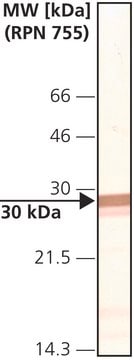
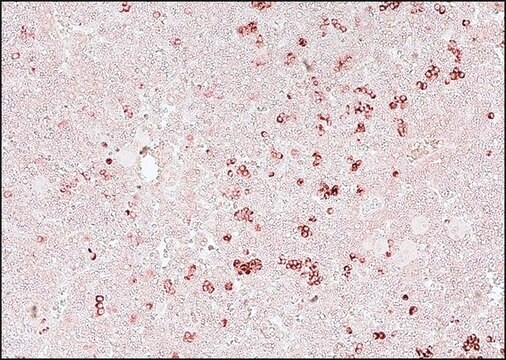
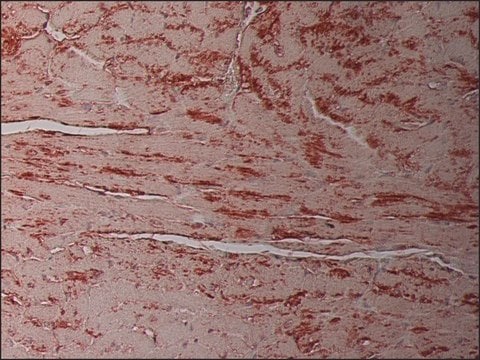
ARR, ELISA (i), IHC (f), WB
Citations:
10

$845.00


Comprobar disponibilidad del carrito

Solicite una orden a granel
Servicio técnico
¿Necesita ayuda? Nuestro equipo de científicos experimentados está aquí para ayudarle.
Permítanos ayudarle

biological source

mouse

Quality Level

conjugate

unconjugated

antibody form

ascites fluid

antibody product type

primary antibodies

clone

CXN-32, monoclonal

form

buffered aqueous solution

mol wt

antigen 27 kDa

contains

15 mM sodium azide

species reactivity

human, rat, mouse

Comparar elementos similares

Ver comparación completa

Mostrar Diferencias

1 of 1

Este artículo
C3595C8093C6219
Gene Information

human ... GJB1(2705), GJB2(2706)
mouse ... Gjb1(14618)
rat ... Gja1(24392), Gjb1(29584)

Gene Information

human ... GJB1(2705)
mouse ... Gjb1(14618)
rat ... Gjb1(29584)

Gene Information

human ... GJA1(2697), GJA1P1(2698)
mouse ... Gja1(14609)
rat ... Gja1(24392)

Gene Information

human ... GJA1(2697)
mouse ... Gja1(14609)
rat ... Gja1(24392)

clone

CXN-32, monoclonal

clone

polyclonal

clone

CXN-6, monoclonal

clone

polyclonal

biological source

mouse

biological source

rabbit

biological source

mouse

biological source

rabbit

species reactivity

human, rat, mouse

species reactivity

mouse, human, rat

species reactivity

rat, hamster, bovine, mouse, human

species reactivity

mammals, human

antibody form

ascites fluid

antibody form

affinity isolated antibody

antibody form

ascites fluid

antibody form

affinity isolated antibody

conjugate

unconjugated

conjugate

unconjugated

conjugate

unconjugated

conjugate

unconjugated

General description

Monoclonal Anti-Connexin-32 (mouse IgG1 isotype) is derived from the CXN-32 hybridoma produced by the fusion of mouse myeloma cells and splenocytes from an immunized mouse. The 27 kDa connexin protein (Connexin-32, Cx32), belongs to the connexion family of proteins. It is expressed in most tissues, even though the pattern of expression may differ in various cell types including peripheral and central nervous system.

Immunogen

synthetic connexin-32 peptide (amino acids 105-123).

Application

Monoclonal Anti-Connexin-32 antibody produced in mouse has been used in:
  • enzyme linked immunosorbent assay (ELISA)
  • immunoblotting
  • epifuorescent microscopy

Biochem/physiol Actions

Connexin-32 low expression levels is observed in common bile duct ligation (CBDL). In addition, a combination of myelin disruption and axonal degeneration has been shown to occur with Cx32 mutations in Charcot-Marie-Tooth disease (CMTX). Monoclonal antibodies reacting specifically with Cx32, may be used in diverse cellular and molecular approaches to the study of gap junctions and their properties, and to correlate their expression pattern with physiological functions or pathological conditions.
Connexins belong to the gap junction protein family. In humans, connexin is encoded by GJB1 (gap junction protein, β 1) gene. The gap junction proteins connexin32 (Cx32), Cx37, Cx40 and Cx43 are expressed in endothelial cells and regulate vascular functions involving inflammation. The endothelial Cx32 positively regulates angiogenesis by enhancing endothelial cell tube formation and cell migration. CX32 mutation is associated with cognitive impairment and a differential degree of peripheral nerve involvement.

Disclaimer

Unless otherwise stated in our catalog or other company documentation accompanying the product(s), our products are intended for research use only and are not to be used for any other purpose, which includes but is not limited to, unauthorized commercial uses, in vitro diagnostic uses, ex vivo or in vivo therapeutic uses or any type of consumption or application to humans or animals.

¿No encuentra el producto adecuado?  

Pruebe nuestro Herramienta de selección de productos.

Clase de almacenamiento

10 - Combustible liquids

wgk

WGK 3

flash_point_f

Not applicable

flash_point_c

Not applicable


Elija entre una de las versiones más recientes:

Certificados de análisis (COA)

Lot/Batch Number

¿No ve la versión correcta?

Si necesita una versión concreta, puede buscar un certificado específico por el número de lote.

¿Ya tiene este producto?

Encuentre la documentación para los productos que ha comprado recientemente en la Biblioteca de documentos.

Visite la Librería de documentos

Connexins modulate autophagosome biogenesis
Bejarano E, et al.
Nature Cell Biology, 16(5), 401-401 (2014)
Three-dimensional binding of epidermal growth factor peptides in colonic tissues produced from rotating bioreactor
Kaeffer B, et al.
In Vitro Cellular & Developmental Biology. Animal, 38(8), 436-439 (2002)
Takayuki Okamoto et al.
Experimental cell research, 321(2), 133-141 (2013-12-18)
The gap junction proteins connexin32 (Cx32), Cx37, Cx40, and Cx43 are expressed in endothelial cells, and regulate vascular functions involving inflammation, vasculogenesis and vascular remodeling. Aberrant Cxs expression promotes the development of atherosclerosis which is modulated by angiogenesis; however the
Yuksel Batir et al.
Archives of biochemistry and biophysics, 608, 8-19 (2016-07-06)
Alterations in gap junctions underlie the etiologies of syndromic deafness (KID) and Charcot-Marie Tooth disease (CMTX). Functional gap junctions are composed of connexin molecules with N-termini containing a flexible turn around G12, inserting the N-termini into the channel pore allowing
What?s the function of connexin 32 in the peripheral nervous system?
Bortolozzi M
Frontiers in Molecular Neuroscience, 11 (2018)

Artículos

Cancer research has revealed that the classical model of carcinogenesis, a three step process consisting of initiation, promotion, and progression, is not complete.

Contenido relacionado

Número de artículo de comercio global

SKUGTIN
C6344-.2ML04061837873195

Questions

Reviews

No rating value

Active Filters

Nuestro equipo de científicos tiene experiencia en todas las áreas de investigación: Ciencias de la vida, Ciencia de los materiales, Síntesis química, Cromatografía, Analítica y muchas otras.

Póngase en contacto con el Servicio técnico