

The reconstituted product is stable for 1 month at –20 °C and for at least 2 months at –70 °C. Product 528205, a prepared solution, also stored at -70°C, is assigned a retest schedule of every two years. See the link below to review this product page:
https://www.sigmaaldrich.com/US/en/product/mm/528205
A8111

Plasminogen activator inhibitor 1 (PAI-1)
≥200,000 units/mg protein, lyophilized powder, ≥90% (SDS-PAGE)
Sinónimos:
PAIE, PLANH1, Plasminogen activator inhibitor, β-migrating endothelial cell-derived type, Serpin E1 PAI-1, Serpine 1
Iniciar sesión para ver los precios por organización y contrato.
Seleccione un Tamaño
Cambiar Vistas
| Tamaño de envase | SKU | Disponibilidad | Precio |
|---|---|---|---|
| 25 μg | Disponible para enviar HOYdesdeMILWAUKEE | $308.00 |
Acerca de este artículo
$308.00
Disponible para enviar HOYDetalles
Servicio técnico
¿Necesita ayuda? Nuestro equipo de científicos experimentados está aquí para ayudarle.
Permítanos ayudarleNombre del producto
Plasminogen activator inhibitor 1 (PAI-1) human, recombinant, expressed in E. coli, ≥90% (SDS-PAGE)
recombinant
expressed in E. coli
Quality Segment
assay
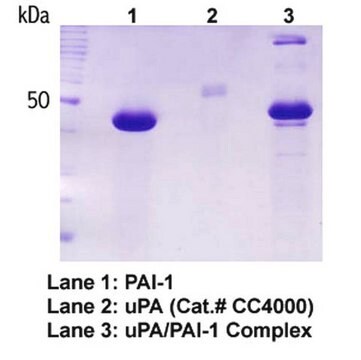
≥90% (SDS-PAGE)
form
lyophilized powder
specific activity
≥200,000 units/mg protein
mol wt
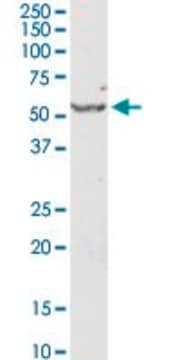
~43 kDa
solubility
water: 0.1 mL, clear, colorless
UniProt accession no.
shipped in
dry ice
storage temp.
−20°C
Gene Information
human ... SERPINE1(5054)
General description
Application
Plasminogen activator inhibitor 1 (PAI-1) human has been used:
- as an inhibitor of pro-brain-derived neurotrophic factor (proBDNF) in radioimmunoprecipitation assay (RIPA) in peripheral blood and lymphocytes[3]
- to block plasmin activation in mice infected with C. albicans hyphae[4]
- to test its effect on neurite growth in neurons[5]
Biochem/physiol Actions
Plasminogen Activator Inhibitor 1 (PAI-1) protein belongs to the Serpin superfamily of serine protease inhibitors. It is the principal inhibitor of tissue plasminogen activator (tPA) and urokinase (uPA), the activators of plasminogen and therefore inhibits the fibrinolysis process. PAI is involved in extracellular matrix remodeling and has been implicated in processes like angiogenesis, chemotaxis, ovulation, and embryogenesis. PAI-1 is present in increased levels in various disease states such as a number of cancer forms, obesity and the metabolic syndrome.
Plasminogen activator inhibitor 1 (PAI-1), a member of the Serpin superfamily of serine protease inhibitors, is involved in extracellular matrix remodeling and implicated in processes like angiogenesis, chemotaxis, ovulation, and embryogenesis.
Physical form
Supplied as a lyophilized powder from a solution containing 0.5 M sodium chloride, 20 mM sodium acetate, and 50 mg/mL trehalose.
Preparation Note
Reconstitute to 0.25 mg/ml with ultrapure water. The reconstituted product contains 0.25 mgP/mL in 0.5 M sodium chloride, 20 mM sodium acetate, and 50 mg/mL trehalose.
Analysis Note
The product is the active human PAI-1 protein with a molecular weight of 43 kDa.
Other Notes
1 unit irreversibly inhibits (100% inhibition) 1 unit of tissue plasminogen activator (tPA) under physiological conditions (neutral pH and 37 ºC).
1 of 1
Este artículo | |||
|---|---|---|---|
| assay ≥90% (SDS-PAGE) | assay - | assay - | assay ≥98% (SDS-PAGE) |
| Gene Information human ... SERPINE1(5054) | Gene Information human ... SERPINE1(5054) | Gene Information human ... SERPINE1(5054) | Gene Information - |
| Quality Level 200 | Quality Level - | Quality Level 100 | Quality Level 100 |
| form lyophilized powder | form buffered aqueous solution | form buffered aqueous solution | form liquid |
| solubility water: 0.1 mL, clear, colorless | solubility - | solubility - | solubility - |
| shipped in dry ice | shipped in dry ice | shipped in wet ice | shipped in dry ice |
Clase de almacenamiento
10 - Combustible liquids
wgk
WGK 1
flash_point_f
Not applicable
flash_point_c
Not applicable
Elija entre una de las versiones más recientes:
¿Ya tiene este producto?
Encuentre la documentación para los productos que ha comprado recientemente en la Biblioteca de documentos.
Artículos
Lipid Induced Insulin Resistance
Contenido relacionado
Número de artículo de comercio global
| SKU | GTIN |
|---|---|
| A8111-25UG | 04061833228463 |
-
Once it has been reconstituted, what is the recommended storage temperature? Will the reconstituted liquid be stable at 4 C for short-term storage (e.g. <24 hrs)?
1 answer-
Helpful?
-