Saltar al contenido
Merck

Saltar a

D1262

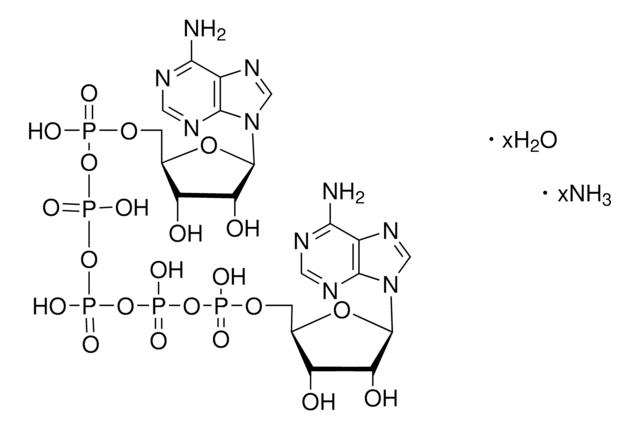
P1,P4-Di(adenosine-5′) tetraphosphate ammonium salt

≥95% (HPLC), pancreatic second messenger, powder

Sinónimos:

A(5′)p4(5′)A, Diadenosine tetraphosphate ammonium salt

Iniciar sesión para ver los precios por organización y contrato.

Seleccione un Tamaño

Cambiar Vistas
Tamaño de envaseSKUDisponibilidadPrecio
10 mg
Comprobar disponibilidad del carrito
US$ 139,00
50 mg
Comprobar disponibilidad del carrito
US$ 432,00

Acerca de este artículo

Fórmula empírica (notación de Hill):
C20H28N10O19P4 · xNH3
Número CAS:
Peso molecular:
836.39 (free acid basis)
UNSPSC Code:
41106305
eCl@ss:
32160414
PubChem Substance ID:
NACRES:
NA.77
MDL number:
Assay:
≥95% (HPLC)
Form:
powder
Quality level:

US$ 139,00

PRECIOS SIN IMPUESTOS NACIONALES

Comprobar disponibilidad del carrito

Solicite una orden a granel
Servicio técnico
¿Necesita ayuda? Nuestro equipo de científicos experimentados está aquí para ayudarle.
Permítanos ayudarle


Nombre del producto

P1,P4-Di(adenosine-5′) tetraphosphate ammonium salt, ≥95% (HPLC), powder

Quality Level

assay

≥95% (HPLC)

form

powder

color

white to off-white

solubility

H2O: 50 mg/mL

storage temp.

−20°C

SMILES string

N.Nc1ncnc2n(cnc12)[C@@H]3O[C@H](COP(O)(=O)OP(O)(=O)OP(O)(=O)OP(O)(=O)OC[C@H]4O[C@H]([C@H](O)[C@@H]4O)n5cnc6c(N)ncnc56)[C@@H](O)[C@H]3O

InChI

1S/C20H28N10O19P4.H3N/c21-15-9-17(25-3-23-15)29(5-27-9)19-13(33)11(31)7(45-19)1-43-50(35,36)47-52(39,40)49-53(41,42)48-51(37,38)44-2-8-12(32)14(34)20(46-8)30-6-28-10-16(22)24-4-26-18(10)30;/h3-8,11-14,19-20,31-34H,1-2H2,(H,35,36)(H,37,38)(H,39,40)(H,41,42)(H2,21,23,25)(H2,22,24,26);1H3/t7-,8-,11-,12-,13-,14-,19-,20-;/m1./s1

InChI key

JTLRVYSRZSPJKJ-AHKIGRPSSA-N

Application

P1,P4-Di(adenosine-5′) tetraphosphate ammonium salt has been used as a substrate for nudix hydrolyse. It has also been used as a ATP analog and nudix substrate for cleavage factor II Im25 subunit.

Biochem/physiol Actions

Diadenosine polyphosphate (Ap4A) functions as a second messenger in pancreatic cells. Diadenosine polyphosphate is majorly stored in neuronal cells, thrombocytes and chromaffin. It stimulates phospholipase D, fluctuates intracellular calcium levels, induces nitric oxide release, activates 5′-nucleotidase, and inhibits adenosine kinase activity in vitro. The membrane-bound ectoenzymes in endothelial cells in blood plasma and smooth muscle cell metabolize Ap4A.

Comparar elementos similares

Ver comparación completa

Mostrar Diferencias

1 of 1

Este artículo
D8013D6392D4022
assay

≥95% (HPLC)

assay

≥95% (HPLC)

assay

≥95%

assay

≥95% (HPLC)

form

powder

form

powder

form

powder

form

powder

Quality Level

200

Quality Level

200

Quality Level

200

Quality Level

200

storage temp.

−20°C

storage temp.

−20°C

storage temp.

−20°C

storage temp.

−20°C

solubility

H2O: 50 mg/mL

solubility

H2O: 50 mg/mL

solubility

H2O: 50 mg/mL

solubility

H2O: 50 mg/mL

color

white to off-white

color

white to off-white

color

white to off-white

color

white to yellow-white


Clase de almacenamiento

11 - Combustible Solids

wgk

WGK 3

flash_point_f

Not applicable

flash_point_c

Not applicable

ppe

Eyeshields, Gloves, type N95 (US)


Elija entre una de las versiones más recientes:

Certificados de análisis (COA)

Lot/Batch Number

¿No ve la versión correcta?

Si necesita una versión concreta, puede buscar un certificado específico por el número de lote.

¿Ya tiene este producto?

Encuentre la documentación para los productos que ha comprado recientemente en la Biblioteca de documentos.

Visite la Librería de documentos


A Ogilvie et al.
Journal of autonomic pharmacology, 16(6), 325-328 (1996-12-01)
1. Adenine dinucleotides (Ap3A, Ap4A, Ap5A, Ap6A) are stored in secretory granules of thrombocytes, chromaffin cells and neuronal cells. After release into the extracellular space, the dinucleotides exhibit divergent biological effects on a variety of target cells and organs. The
E J Verspohl et al.
Diabetes, 47(11), 1727-1734 (1998-10-29)
A role of diadenosine polyphosphates as second messengers was suggested for insulin-secreting cells. It has not yet been investigated whether specific receptors for these compounds exist and how these extracellular compounds and their degradation products may contribute to insulin release.
M Edgecombe et al.
Cellular signalling, 10(7), 505-509 (1998-10-01)
Diadenosine polyphosphates (ApnAs) can, through interaction with appropriate purinoceptors, affect a range of cellular activities. Ap4A, the most prominent naturally occurring diadenosine polyphosphate, stimulates alterations in intracellular calcium homeostasis and subsequent activation of glycogen breakdown in isolated liver cells. Here


Número de artículo de comercio global

SKUGTIN
D1262-50MG04061832081878
D1262-10MG04061832081861

Questions

Reviews

No rating value

Active Filters