Saltar al contenido
MilliporeSigma

Saltar a

P0071

Anti-PDCD4 antibody produced in rabbit

~1 mg/mL, affinity isolated antibody, buffered aqueous solution

Sinónimos:

Anti-Neoplastic transformation inhibitor, Anti-Nuclear antigen H731, Anti-Programmed cell death 4, Anti-Protein 197/15a

Iniciar sesión para ver los precios por organización y contrato.

Acerca de este artículo

NACRES:
NA.41
UNSPSC Code:
12352203
Conjugate:
unconjugated
Clone:
polyclonal
Application:
IP, WB
Citations:
6


biological source

rabbit

conjugate

unconjugated

antibody form

affinity isolated antibody

antibody product type

primary antibodies

clone

polyclonal

form

buffered aqueous solution

mol wt

antigen ~51 kDa

species reactivity

human, mouse (predicted), rat (predicted)

concentration

~1 mg/mL

technique(s)

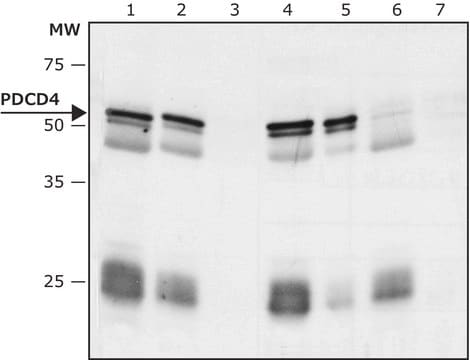
immunoprecipitation (IP): 5-10 μg using HEK-293T cell lysates, western blot: 2-4 μg/mL using K562 cell lysates

UniProt accession no.

shipped in

dry ice

storage temp.

−20°C

target post-translational modification

unmodified

Gene Information

human ... PDCD4(272250)
mouse ... Pdcd4(18569)
rat ... SELP(6403)

General description

Programmed Cell Death 4 (PDCD4 ) is present in the nucleus. PDCD4 gene is mapped to human chromosome 10q25.2. PDCD4 protein consists of two basic domains at the N-terminus and C-terminus and two conserved α-helical MA-3 domains.

Application

Anti-PDCD4 antibody produced in rabbit has been used in immunoblotting[1] and immunoprecipitation.

Biochem/physiol Actions

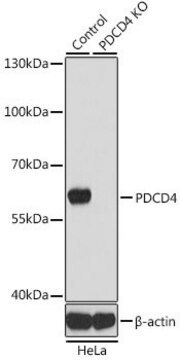
Anti-PDCD4 specifically recognizes human, mouse, and rat PDCD4.
Programmed Cell Death 4 (PDCD4) is a neoplastic transformation inhibitor protein that functions as a tumor suppressor in ovarian carcinoma. The levels of PDCD4 are depleted in progressed carcinomas of the lung, breast, colon, and prostate. MA-3 domain of PDCD4 aids protein-protein interactions in eukaryotic translation initiation factor 4GI(eIF4GI) and eIF4GII with the ATP-dependent RNA helicase eIF4A. PDCD4 suppresses translation initiation by specifically inhibiting the helicase activity of eukaryotic translation initiation factor 4A (eIF4A), a component of the translation initiation complex. In response to mitogens, PDCD4 is rapidly phosphorylated on Ser67 by the protein kinase ribosomal protein S6 kinase 1 (S6K1), and subsequently degraded via the ubiquitin ligase skp, cullin, f-box containing complex beta-transducin repeat-containing protein ((SCF)βTRCP ). It also shows that the protein is specifically phosphorylated on Ser76 and Ser457 by p90 ribosomal S6 kinase (RSK).

Physical form

Solution in 0.01 M phosphate buffered saline, pH 7.4, containing 15 mM sodium azide.

Preparation Note

For continuous use, store at 2–8 °C for up to one month. For extended storage, freeze in working aliquots. Repeated freezing and thawing, or storage in “frost-free” freezers, is not recommended. If slight turbidity occurs upon prolonged storage, clarify the solution by centrifugation before use. Working dilutions should be discarded if not used within 12 hours.

Disclaimer

Unless otherwise stated in our catalog or other company documentation accompanying the product(s), our products are intended for research use only and are not to be used for any other purpose, which includes but is not limited to, unauthorized commercial uses, in vitro diagnostic uses, ex vivo or in vivo therapeutic uses or any type of consumption or application to humans or animals.

Comparar elementos similares

Ver comparación completa

Mostrar Diferencias

1 of 1

Este artículo
SAB5700186HPA027214SAB1411521
antibody form

affinity isolated antibody

antibody form

affinity isolated antibody

antibody form

affinity isolated antibody

antibody form

purified immunoglobulin

biological source

rabbit

biological source

rabbit

biological source

rabbit

biological source

rabbit

conjugate

unconjugated

conjugate

unconjugated

conjugate

unconjugated

conjugate

unconjugated

form

buffered aqueous solution

form

buffered aqueous solution

form

buffered aqueous glycerol solution

form

buffered aqueous solution

UniProt accession no.

Q53EL6

UniProt accession no.

Q53EL6

UniProt accession no.

Q53EL6

UniProt accession no.

Q9BRC7

species reactivity

human, mouse (predicted), rat (predicted)

species reactivity

human, mouse

species reactivity

human

species reactivity

human


Still not finding the right product?

Explore all of our products under

o

Pruebe nuestra Herramienta de selección de productos para limitar sus opciones


Clase de almacenamiento

10 - Combustible liquids

wgk

WGK 2

flash_point_f

Not applicable

flash_point_c

Not applicable

ppe

Eyeshields, Gloves, multi-purpose combination respirator cartridge (US)


Elija entre una de las versiones más recientes:

Certificados de análisis (COA)

Lot/Batch Number

¿No ve la versión correcta?

Si necesita una versión concreta, puede buscar un certificado específico por el número de lote.

¿Ya tiene este producto?

Encuentre la documentación para los productos que ha comprado recientemente en la Biblioteca de documentos.

Visite la Librería de documentos


Contenido relacionado

Instructions


Sachiko Matsuhashi et al.
International journal of molecular sciences, 20(9) (2019-05-12)
PDCD4 is a novel tumor suppressor to show multi-functions inhibiting cell growth, tumor invasion, metastasis, and inducing apoptosis. PDCD4 protein binds to the translation initiation factor eIF4A, some transcription factors, and many other factors and modulates the function of the
Xialian Xu et al.
Kidney international, 82(11), 1167-1175 (2012-07-13)
Delayed ischemic preconditioning effectively protects kidneys from ischemia-reperfusion injury but the mechanism underlying renal protection remains poorly understood. Here we examined the in vivo role of microRNA miR-21 in the renal protection conferred by delayed ischemic preconditioning in mice. A
Brigitte Lankat-Buttgereit et al.
Biology of the cell, 101(6), 309-317 (2009-04-10)
Pdcd4 (programmed cell death 4) has been known as a tumour suppressor gene and potential target for anticancer therapies for several years. Initially, Pdcd4 was identified as a gene that is up-regulated during apoptosis, but its precise role still remains


Número de artículo de comercio global

SKUGTIN
P0071-200UL04061838173492

Questions

Reviews

No rating value

Active Filters