Saltar al contenido
MilliporeSigma

Saltar a

M0325

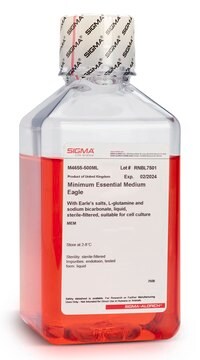
Medio esencial mínimo Eagle

With Earle′s salts, non-essential amino acids, ʟ-glutamine and sodium bicarbonate, liquid, sterile-filtered, suitable for cell culture

Sinónimos:

MEM

Iniciar sesión para ver los precios por organización y contrato.

Seleccione un Tamaño

Cambiar Vistas
Tamaño de envaseSKUDisponibilidadPrecio
500 mL
Comprobar disponibilidad del carrito
$46.20

Acerca de este artículo

UNSPSC Code:
12352207
NACRES:
NA.75

$46.20


Comprobar disponibilidad del carrito

Solicite una orden a granel
Servicio técnico
¿Necesita ayuda? Nuestro equipo de científicos experimentados está aquí para ayudarle.
Permítanos ayudarle


Nombre del producto

Medio esencial mínimo Eagle, With Earle′s salts, non-essential amino acids, L-glutamine and sodium bicarbonate, liquid, sterile-filtered, suitable for cell culture

Quality Segment

sterility

sterile-filtered

form

liquid

technique(s)

cell culture | mammalian: suitable

impurities

Endotoxin, tested

components

glucose: 1.0 g/L (Dextro)
L-glutamine: 0.292 g/L
phenol red: 0.011 g/L
Earle’s salts (5% CO2): yes
NaHCO3: 2.2 g/L

shipped in

ambient

storage temp.

2-8°C

General description

Minimum Essential Medium Eagle (MEM) is a synthetic cell culture media, developed by Harry Eagle. It is used for the cultivation of a wide variety of cells grown in monolayers. MEM includes higher concentrations of amino acids so the medium more closely approximates the protein composition of cultured mammalian cells. May be preferred for the growth of adherent cells in the presence of reduced serum or as a base for the development of a serum-free medium.

Application

Minimum Essential Medium Eagle has been used as a culture medium for:
  • thyroid cancer cell lines
  • macrophage-like DH82 cells
  • vero CCL-81 cells


Comparar elementos similares

Ver comparación completa

Mostrar Diferencias

1 of 1

Este artículo
M4655M2414FG0325
technique(s)

cell culture | mammalian: suitable

technique(s)

cell culture | mammalian: suitable

technique(s)

cell culture | mammalian: suitable

technique(s)

cell culture | mammalian: suitable

form

liquid

form

liquid

form

liquid

form

liquid

sterility

sterile-filtered

sterility

sterile-filtered

sterility

sterile-filtered

sterility

sterile-filtered

components

glucose: 1.0 g/L (Dextro)
L-glutamine: 0.292 g/L
phenol red: 0.011 g/L
Earle’s salts (5% CO2): yes
NaHCO3: 2.2 g/L

components

sodium pyruvate: no
phenol red: yes
Earle’s salts (5% CO2): yes
HEPES: no
NaHCO3: yes
L-glutamine: yes

components

phenol red: 0.011 g/L
NaHCO3: 0.85 g/L
glucose: 1.0 g/L
L-glutamine: no

components

stable glutamine: yes
L-glutamine: no
phenol red: yes
sodium pyruvate: no
Earle’s salts (5% CO2): yes
HEPES: no
Hanks’ salts (2% CO2): no
glucose: yes
NaHCO3: yes

storage temp.

2-8°C

storage temp.

2-8°C

storage temp.

2-8°C

storage temp.

2-8°C

shipped in

ambient

shipped in

ambient

shipped in

ambient

shipped in

ambient


Still not finding the right product?

Explore all of our products under Medio esencial mínimo Eagle


Clase de almacenamiento

12 - Non Combustible Liquids

wgk

WGK 1

flash_point_f

Not applicable

flash_point_c

Not applicable


Elija entre una de las versiones más recientes:

Certificados de análisis (COA)

Lot/Batch Number

¿No ve la versión correcta?

Si necesita una versión concreta, puede buscar un certificado específico por el número de lote.

¿Ya tiene este producto?

Encuentre la documentación para los productos que ha comprado recientemente en la Biblioteca de documentos.

Visite la Librería de documentos


Sharanjeet Atwal et al.
mBio, 12(4), e0134221-e0134221 (2021-07-28)
Peptidoglycan (PG) is a highly cross-linked peptide-glycan mesh that confers structural rigidity and shape to most bacterial cells. Polymerization of new PG is usually achieved by the concerted activity of two membrane-bound machineries, class-A penicillin binding proteins (aPBPs) and class-B
Sharanjeet Atwal et al.
Journal of microbiological methods, 169, 105812-105812 (2019-12-22)
Despite their clinical and biological importance, the cell biology of obligate intracellular bacteria is less well understood than that of many free-living model organisms. One reason for this is that they are mostly genetically intractable. As a consequence, it is
Jose Manuel Condor Capcha et al.
Frontiers in cardiovascular medicine, 7, 618651-618651 (2021-02-02)
The COVID-19 pandemic caused by the SARS-CoV-2 coronavirus requires reliable assays for studying viral entry mechanisms which remains poorly understood. This knowledge is important for the development of therapeutic approaches to control SARS-CoV-2 infection by permitting the screening for neutralizing


Número de artículo de comercio global

SKUGTIN
M0325-500ML04061837847264

Questions

Reviews

No rating value

Active Filters