Saltar al contenido
MilliporeSigma

Saltar a

J4750

Anti-JNK, Activated (Diphosphorylated JNK) antibody, Mouse monoclonal

clone JNK-PT48, purified from hybridoma cell culture

Sinónimos:

Monoclonal Anti-JNK, Activated (Diphosphorylated JNK) antibody produced in mouse

Iniciar sesión para ver los precios por organización y contrato.

Acerca de este artículo

NACRES:
NA.44
UNSPSC Code:
12352203
Conjugate:
unconjugated
Clone:
JNK-PT48, monoclonal
Application:
ARR, ELISA (i), ICC, WB
Citations:
12


biological source

mouse

conjugate

unconjugated

antibody form

purified from hybridoma cell culture

antibody product type

primary antibodies

clone

JNK-PT48, monoclonal

form

buffered aqueous solution

mol wt

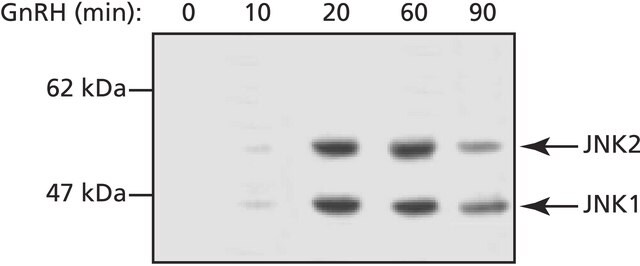
antigen 46 kDa, antigen 54 kDa

species reactivity

mouse, human, rat

concentration

~2 mg/mL

technique(s)

immunocytochemistry: suitable, indirect ELISA: suitable, microarray: suitable, western blot: 4-20 μg/mL using extract of human Jurkat cells activated with anisomycin

isotype

IgG1

UniProt accession no.

shipped in

dry ice

storage temp.

−20°C

target post-translational modification

unmodified

Gene Information

human ... MAPK8(5599)
mouse ... Mapk8(26419)
rat ... Mapk8(116554)

General description

Monoclonal Anti-JNK, Activated (Diphosphorylated JNK) (mouse IgG1 isotype) is derived from the JNK-PT48 hybridoma produced by the fusion of mouse myeloma cells and splenocytes from BALB/c mice immunized with a synthetic peptide corresponding to the phosphorylated form of JNK activation loop, conjugated to KLH. JNK (c-Jun N terminal protein kinase) belongs to the mitogen-activated protein kinase (MAPK) superfamily of enzymes. The kinases in the MAPK level are activated by phosphorylation of both tyrosine (Y) and threonine (T) residues organized in a TXY motif. The residue in between the two phosphorylated residue determines the specificity of activation of the MAPKs and is proline for JNK. JNK1-3 of molecular weights 46, 54, and 52 kDa respectively.

Immunogen

synthetic peptide sequence containing amino acids pTPpYVVTRYYR, corresponding to the phosphorylated form of JNK-activation loop.

Application

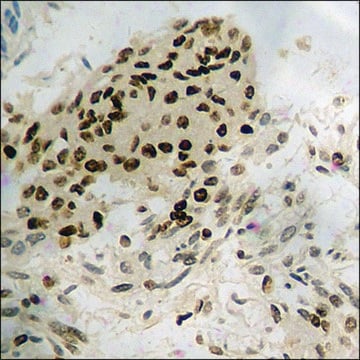
Monoclonal Anti-JNK, Activated (Diphosphorylated JNK) antibody has been used in immunoblotting, enzyme linked immunosorbent assay (ELISA), immunocytochemistry, western blotting, immunohistochemistry.

Biochem/physiol Actions

The antibody reacts specifically with the activated diphosphorylated form of JNK. The epitope recognized by the antibody contains the regulatory site of JNK (Thr183 and Tyr185). Weak cross-reaction is observed with the monophosphorylated threonine peptide, but not with the non-phosphorylated or monophosphorylated tyrosine peptides of JNK. It does not recognize any form of p38-MAPK or ERK-MAPK.
c-Jun N terminal protein kinase (JNK) is mostly stress-responsive kinase and have been implicated in cell death in several cellular systems. The JNK cascade is triggered by small GTPases that are Rac and Cell division control protein 42 (CDC42). After activation, JNKs translocate to the nucleus where they physically associate with and activate their target transcription factors (cJun, AMP-dependent transcription factor (ATF) etc.).

Physical form

Solution in phosphate buffered saline, pH 7.4, containing 15 mM sodium azide.

Disclaimer

Unless otherwise stated in our catalog or other company documentation accompanying the product(s), our products are intended for research use only and are not to be used for any other purpose, which includes but is not limited to, unauthorized commercial uses, in vitro diagnostic uses, ex vivo or in vivo therapeutic uses or any type of consumption or application to humans or animals.

Comparar elementos similares

Ver comparación completa

Mostrar Diferencias

1 of 1

Este artículo
SAB4200176M3682SAB4504450
species reactivity

mouse, human, rat

species reactivity

mouse, rat, human

species reactivity

rat, human

species reactivity

mouse, rat, human

antibody form

purified from hybridoma cell culture

antibody form

purified immunoglobulin

antibody form

purified from hybridoma cell culture

antibody form

affinity isolated antibody

conjugate

unconjugated

conjugate

unconjugated

conjugate

unconjugated

conjugate

unconjugated

Gene Information

human ... MAPK8(5599)
mouse ... Mapk8(26419)
rat ... Mapk8(116554)

Gene Information

human ... MAPK8(5599)
mouse ... Mapk8(26419)
rat ... Mapk8(116554)

Gene Information

human ... MAPK1(5594), MAPK3(5595)
rat ... Mapk1(116590), Mapk3(50689)

Gene Information

human ... MAPK10(5602), MAPK8(5599), MAPK9(5601)

clone

JNK-PT48, monoclonal

clone

1C2, monoclonal

clone

ERK-PY193, monoclonal

clone

polyclonal

biological source

mouse

biological source

mouse

biological source

mouse

biological source

rabbit


Still not finding the right product?

Pruebe nuestra Herramienta de selección de productos para limitar sus opciones


Clase de almacenamiento

12 - Non Combustible Liquids

wgk

nwg

flash_point_f

Not applicable

flash_point_c

Not applicable


Elija entre una de las versiones más recientes:

Certificados de análisis (COA)

Lot/Batch Number

¿No ve la versión correcta?

Si necesita una versión concreta, puede buscar un certificado específico por el número de lote.

¿Ya tiene este producto?

Encuentre la documentación para los productos que ha comprado recientemente en la Biblioteca de documentos.

Visite la Librería de documentos


JNK signaling: regulation and functions based on complex protein-protein partnerships
Zeke A, et al.
Microbiology and Molecular Biology Reviews, 80(3), 793-835 (2016)
Pigment Epithelium-Derived Factor Alleviates Tamoxifen-Induced Endometrial Hyperplasia
Goldberg K, et al.
Molecular Cancer Therapeutics, 14(12), 2840-2849 (2015)
JNK-signaling: a multiplexing hub in programmed cell death
Dhanasekaran, Danny N and Reddy, E Premkumar
Genes & cancer, 8(9-10), 682-682 (2017)


Número de artículo de comercio global

SKUGTIN
J4750-.2ML04061837913808

Questions

Reviews

No rating value

Active Filters