
D7571

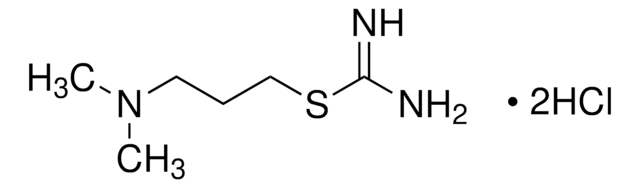
Dimaprit dihydrochloride
≥98% (NMR)
Sinónimos:
Carbamimidothioic acid, 3-(dimethylamino)propyl ester, hydrochloride (1:2), Dimaprit-2HCl
Seleccione un Tamaño
| Tamaño de envase | SKU | Disponibilidad | Precio |
|---|---|---|---|
| 5 mg | Comprobar disponibilidad del carrito | $113.00 | |
| 25 mg | Disponible para enviar HOYdesdeMILWAUKEE | $410.00 |
Acerca de este artículo
Quality Level
assay
≥98% (NMR)
form
powder
color
white to off-white
solubility
H2O: ≥50 mg/mL
originator
Roche
storage temp.
−20°C
SMILES string
Cl.Cl.CN(C)CCCSC(N)=N
InChI
1S/C6H15N3S.2ClH/c1-9(2)4-3-5-10-6(7)8;;/h3-5H2,1-2H3,(H3,7,8);2*1H
InChI key
DFWCPLGXFMSUCW-UHFFFAOYSA-N
Biochem/physiol Actions
Features and Benefits
1 of 1
Este artículo | |||
|---|---|---|---|
| assay ≥98% (NMR) | assay ≥99% (TLC) | assay ≥98% (HPLC) | assay ≥98% (HPLC) |
| form powder | form powder | form powder | form powder |
| Quality Level 100 | Quality Level 200 | Quality Level 100 | Quality Level - |
| storage temp. −20°C | storage temp. - | storage temp. −20°C | storage temp. 2-8°C |
| solubility H2O: ≥50 mg/mL | solubility H2O: 50 mg/mL | solubility DMSO: 2 mg/mL, clear | solubility DMSO: 2 mg/mL, clear |
| color white to off-white | color off-white | color white to beige | color white to beige |


signalword
Warning
hcodes
Hazard Classifications
Eye Irrit. 2 - Skin Irrit. 2 - STOT SE 3
target_organs
Respiratory system
Clase de almacenamiento
11 - Combustible Solids
wgk
WGK 3
flash_point_f
Not applicable
flash_point_c
Not applicable
Elija entre una de las versiones más recientes:
¿Ya tiene este producto?
Encuentre la documentación para los productos que ha comprado recientemente en la Biblioteca de documentos.
Artículos
We offers many products related to histamine receptors for your research needs.
Número de artículo de comercio global
| SKU | GTIN |
|---|---|
| D7571-5MG | 04061833588567 |
| D7571-25MG | 04061832081991 |