
C4606

Anti-Calreticulin antibody produced in rabbit
IgG fraction of antiserum, buffered aqueous solution
Seleccione un Tamaño
| Tamaño de envase | SKU | Disponibilidad | Precio |
|---|---|---|---|
| 0.2 mL | Comprobar disponibilidad del carrito | $583.00 $495.55 |
Acerca de este artículo
$495.55
Precio de catálogo$583.00Ahorre 15 %biological source
rabbit
Quality Segment
conjugate
unconjugated
antibody form
IgG fraction of antiserum
antibody product type
primary antibodies
clone
polyclonal
form
buffered aqueous solution
mol wt
antigen 50 kDa
species reactivity
human, canine
technique(s)
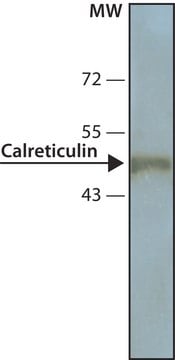
immunoprecipitation (IP): suitable using whole cell RIPA lysate of the human epitheloid carcinoma HeLa cell line, indirect immunofluorescence: 1:100 using 3% paraformaldehyde-fixed, 0.5% Triton X-100 treated, Madin Darby canine kidney MDCK cell line, microarray: suitable, western blot: 1:2,000 using whole cell RIPA lysate of the human epitheloid carcinoma HeLa cell line
UniProt accession no.
shipped in
dry ice
storage temp.
−20°C
target post-translational modification
unmodified
Gene Information
human ... CALR(811)
General description
Immunogen
Application
Biochem/physiol Actions
Physical form
Preparation Note
Disclaimer
1 of 1
Este artículo | |||
|---|---|---|---|
| Quality Level 200 | Quality Level 200 | Quality Level 200 | Quality Level 200 |
| biological source rabbit | biological source mouse | biological source rabbit | biological source rabbit |
| conjugate unconjugated | conjugate unconjugated | conjugate unconjugated | conjugate unconjugated |
| antibody form IgG fraction of antiserum | antibody form tissue culture supernatant | antibody form IgG fraction of antiserum | antibody form affinity isolated antibody |
| species reactivity human, canine | species reactivity human | species reactivity canine, rat, mouse, human | species reactivity rat, mouse, bovine, pig, canine, human |
| technique(s) immunoprecipitation (IP): suitable using whole cell RIPA lysate of the human epitheloid carcinoma HeLa cell line, microarray: suitable, indirect immunofluorescence: 1:100 using 3% paraformaldehyde-fixed, 0.5% Triton X-100 treated, Madin Darby canine kidney MDCK cell line, western blot: 1:2,000 using whole cell RIPA lysate of the human epitheloid carcinoma HeLa cell line | technique(s) flow cytometry: suitable, immunocytochemistry: suitable, immunohistochemistry: suitable, indirect ELISA: suitable, western blot: 1:50-1:100 using total cell extract of HeLa cells | technique(s) immunoprecipitation (IP): 1:2,000 using whole cell RIPA lysate of the human epitheloid carcinoma HeLa cell line, indirect immunofluorescence: 1:200 using 3% paraformaldehyde-fixed, 0.5% Triton X-100 treated, Madin Darby canine kidney MDCK cell line, microarray: suitable, western blot: 1:2,000 using whole cell RIPA lysate of the human hepatocytoma HepG2 cell line | technique(s) immunoprecipitation (IP): 10-20 μg using cell lysate of the human epitheloid carcinoma HeLa cell line, indirect immunofluorescence: 1-2 μg/mL using rat fibroblast Rat1 cells, indirect immunofluorescence: suitable, western blot: 0.5-1 μg/mL using cell lysate of the rat fibroblast cell line Rat1 or Rat 2 |



Still not finding the right product?
Explore all of our products under Anti-Calreticulin antibody produced in rabbit
— o —
Pruebe nuestra Herramienta de selección de productos para limitar sus opciones
Clase de almacenamiento
10 - Combustible liquids
wgk
nwg
flash_point_f
Not applicable
flash_point_c
Not applicable
Elija entre una de las versiones más recientes:
¿Ya tiene este producto?
Encuentre la documentación para los productos que ha comprado recientemente en la Biblioteca de documentos.
Número de artículo de comercio global
| SKU | GTIN |
|---|---|
| C4606-.2ML | 04061838104335 |