Saltar al contenido
MilliporeSigma

Saltar a

C0371

Anti-Cullin-4A antibody produced in rabbit

~1.5 mg/mL, affinity isolated antibody, buffered aqueous solution

Sinónimos:

Anti-Cul4A

Iniciar sesión para ver los precios por organización y contrato.

Acerca de este artículo

NACRES:
NA.41
UNSPSC Code:
12352203
Conjugate:
unconjugated
Clone:
polyclonal
Application:
IF, WB
Citations:
11


biological source

rabbit

conjugate

unconjugated

antibody form

affinity isolated antibody

antibody product type

primary antibodies

clone

polyclonal

form

buffered aqueous solution

mol wt

antigen ~89 kDa

species reactivity

human

enhanced validation

recombinant expression
Learn more about Antibody Enhanced Validation

concentration

~1.5 mg/mL

technique(s)

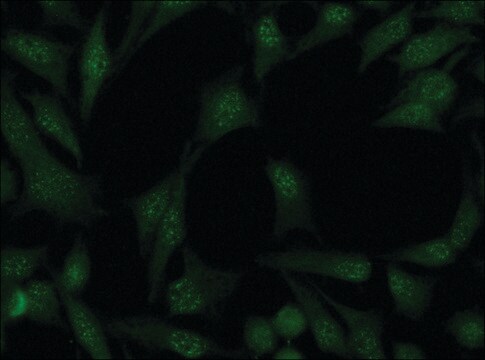
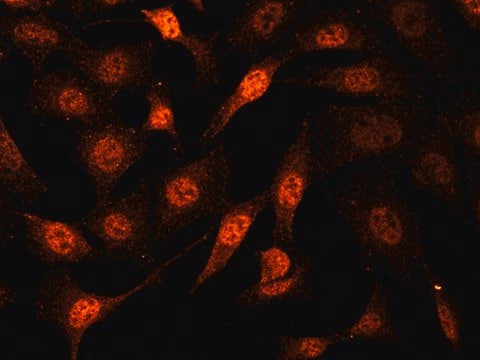
indirect immunofluorescence: 10-20 μg/mL using HeLa cells, western blot: 1-2 μg/mL using HEK-293T cells expressing human Cullin-4A

UniProt accession no.

shipped in

dry ice

storage temp.

−20°C

target post-translational modification

unmodified

Gene Information

human ... CUL4A(8451)

General description

Cullin-4 (Cul4) proteins are the core components of ubiquitin E3 ligases. Mammalian cells express two distinct but highly homologous cullin-4 proteins, cullin-4A and cullin-4B.
Cullin-4A is a protein encoded by CUL4A gene in humans.

Application

Anti-Cullin-4A antibody produced in rabbit is used for Immunofluorescence at a concentration of 10-20mg/mL using HeLa cells and is also used for western blotting at a concentration of 1-2μg/mL using HEK-293T cells expressing human Cullin-4A.

Biochem/physiol Actions

Cullin-4 (Cul4) proteins are components of ubiquitin E3 ligases that regulate cell cycle, genome stability, DNA replication and transcription. CUL4-based E3 ligase plays an important role for the repression of photomorphogenesis in plants (like Arabidopsis thaliana).
Cullin-4A (Cul4A) is involved in identifying specific targets for ubiquitylation. The Cul4A gene is known to be amplified and up-regulated in breast carcinoma and many other tumor types. Cul4A associates with damage-specific DNA binding proteins (DDB1 and DDB2). It functions as substrate recruiting factors for Cul4A-Roc1 ligases. Cul4A is known to ubiquitylate several target proteins including DDB1/DDB2, CDT1 (chromatin licensing and dna replication factor 1), DNA repair protein complementing XP-C cells (XPC), histone H2A, H3 and H4. In response to DNA damage Cul4A complex regulates protein stability of p53 and mouse double minute 2 homolog (MDM2)/ human double minute 2 homolog (HDM2).

Physical form

solution in 0.01 M phos­phate buffered saline, pH 7.4, containing 15 mM sodium azide.

Disclaimer

Unless otherwise stated in our catalog or other company documentation accompanying the product(s), our products are intended for research use only and are not to be used for any other purpose, which includes but is not limited to, unauthorized commercial uses, in vitro diagnostic uses, ex vivo or in vivo therapeutic uses or any type of consumption or application to humans or animals.

Comparar elementos similares

Ver comparación completa

Mostrar Diferencias

1 of 1

Este artículo
ABS1584MABC554C0871
antibody form

affinity isolated antibody

antibody form

affinity isolated antibody

antibody form

purified immunoglobulin

antibody form

affinity isolated antibody

biological source

rabbit

biological source

rabbit

biological source

mouse

biological source

rabbit

conjugate

unconjugated

conjugate

unconjugated

conjugate

unconjugated

conjugate

unconjugated

storage temp.

−20°C

storage temp.

-

storage temp.

-

storage temp.

−20°C

form

buffered aqueous solution

form

-

form

-

form

buffered aqueous solution

technique(s)

indirect immunofluorescence: 10-20 μg/mL using HeLa cells, western blot: 1-2 μg/mL using HEK-293T cells expressing human Cullin-4A

technique(s)

western blot: suitable

technique(s)

western blot: suitable

technique(s)

immunoprecipitation (IP): 5-10 μg using lysate of rat brain, indirect immunofluorescence: 5-10 μg/mL using mouse 3T3 cells, western blot: 1-2 μg/mL using whole extract of HEK-293T cells expressing human Cullin 3


Still not finding the right product?

Explore all of our products under

o

Pruebe nuestra Herramienta de selección de productos para limitar sus opciones


flash_point_f

Not applicable

flash_point_c

Not applicable

ppe

Eyeshields, Gloves, multi-purpose combination respirator cartridge (US)

wgk

nwg

Clase de almacenamiento

12 - Non Combustible Liquids


Elija entre una de las versiones más recientes:

Certificados de análisis (COA)

Lot/Batch Number

¿No ve la versión correcta?

Si necesita una versión concreta, puede buscar un certificado específico por el número de lote.

¿Ya tiene este producto?

Encuentre la documentación para los productos que ha comprado recientemente en la Biblioteca de documentos.

Visite la Librería de documentos


The human homologue for the Caenorhabditis elegans cul-4 gene is amplified and overexpressed in primary breast cancers
Chen LC, et al.
Cancer Research, 58(16), 3677-3683 (1998)
DNA damage binding protein component DDB1 participates in nucleotide excision repair through DDB2 DNA-binding and cullin 4A ubiquitin ligase activity
Li J, et al.
Cancer Research, 66(17), 8590-8597 (2006)
Haodong Chen et al.
The Plant cell, 18(8), 1991-2004 (2006-07-18)
Repression of photomorphogenesis in Arabidopsis thaliana requires activity of the COP9 signalosome (CSN), CDD, and COP1 complexes, but how these three complexes work in concert to accomplish this important developmental switch has remained unknown. Here, we demonstrate that Arabidopsis CULLIN4


Número de artículo de comercio global

SKUGTIN
C0371-200UL04061838030252

Questions

Reviews

No rating value

Active Filters