
B3687

Biliverdin Reductase A human
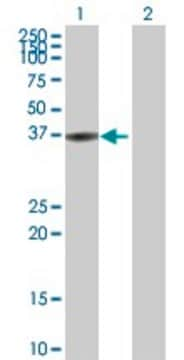
recombinant, expressed in E. coli, ≥90% (SDS-PAGE), buffered aqueous solution
Sinónimos:
BLVRA, BVRA, Bilirubin: NAD(P)+ oxidoreductase
Iniciar sesión para ver los precios por organización y contrato.
Seleccione un Tamaño
Cambiar Vistas
| Tamaño de envase | SKU | Disponibilidad | Precio |
|---|---|---|---|
| 50 μg | Comprobar disponibilidad del carrito | $568.00 |
Acerca de este artículo
NACRES:
NA.32
UNSPSC Code:
12352200
Specific activity:
≥700 units/mg protein
Assay:
≥90% (SDS-PAGE)
Recombinant:
expressed in E. coli
Servicio técnico
¿Necesita ayuda? Nuestro equipo de científicos experimentados está aquí para ayudarle.
Permítanos ayudarlerecombinant
expressed in E. coli
Quality Level
assay
≥90% (SDS-PAGE)
form
buffered aqueous solution
specific activity
≥700 units/mg protein
shipped in
dry ice
storage temp.
−20°C
Gene Information
human ... BLVRA(644)
General description
Research area: IMMUNO AND CKS. Biliverdinreductase A (BVRA) is an isozyme of the biliverdin reductase. It is a cellsurface membrane receptor. BVRA consists of two major regions, theregulatory/DNA interaction domain and catalytic domain.[1]
Application
Biochem/physiol Actions
Biliverdin reductase catalyzes the transformation of the blue-green pigment biliverdin IX to the yellow-orange bile pigment bilirubin IX by converting a double-bond between the second and third pyrrole ring into a single-bond.[4] This enzyme has two distinct cofactor-dependent pH optima. In the acidic range of pH 6.0-6.7, NADH is utilized, whereas in the alkaline range of pH 8.5-8.7, NADPH is utilized.[5] Biliverdin reductase is considered a major physiologic cytoprotectant. Biliverdin reductase suppresses experimental autoimmune encephalomyelitis in rats.[6] Depletion of biliverdin reductase leads to accumulation of cellular oxidants and augmented cell death.[7]Biliverdin reductase (BVR)modulates the functions of insulin via the insulin-like growth factor 1 (IGF-1)pathway. It shows dual specificity kinases where it phosphorylates tyrosineapart from serine and threonine. BVR acts as a biomarker in certain cancers.[8]
Physical form
Solution containing 20 mM potassium phosphate buffer, 10% glycerol, 0.2% Igepal CA630, 1 mM EDTA, and 0.1 mM DTT.
Other Notes
1 unit of biliverdin reductase will transform 1 nanomole of biliverdin to bilirubin per minute in an NADPH dependent reaction at pH 8.5 using 100 mM K-phosphate buffer at 37 °C.
1 of 1
Este artículo | |||
|---|---|---|---|
| assay ≥90% (SDS-PAGE) | assay - | assay - | assay - |
| specific activity ≥700 units/mg protein | specific activity - | specific activity - | specific activity - |
| Gene Information human ... BLVRA(644) | Gene Information human ... BLVRA(644) | Gene Information human ... BLVRA(644) | Gene Information human ... BLVRA(644) |
| form buffered aqueous solution | form buffered aqueous solution | form buffered aqueous solution | form buffered aqueous solution |
| recombinant expressed in E. coli | recombinant - | recombinant - | recombinant - |
| storage temp. −20°C | storage temp. −20°C | storage temp. −20°C | storage temp. −20°C |


Clase de almacenamiento
12 - Non Combustible Liquids
wgk
WGK 2
flash_point_f
Not applicable
flash_point_c
Not applicable
signalword
Danger
hcodes
Hazard Classifications
ED ENV 1
Elija entre una de las versiones más recientes:
¿Ya tiene este producto?
Encuentre la documentación para los productos que ha comprado recientemente en la Biblioteca de documentos.
Kristin A Kirkby et al.
American journal of physiology. Renal physiology, 290(3), F563-F571 (2006-02-08)
Heme oxygenase 1 (HO-1) is induced in response to cellular stress and is responsible for converting the prooxidant heme molecule into equimolar quantities of biliverdin (BV), carbon monoxide (CO), and iron. BV is then converted to bilirubin (BR) by the
Peter E M Gibbs et al.
Frontiers in pharmacology, 6, 119-119 (2015-06-20)
Biliverdin reductase (BVR) is a multifunctional protein that is the primary source of the potent antioxidant, bilirubin. BVR regulates activities/functions in the insulin/IGF-1/IRK/PI3K/MAPK pathways. Activation of certain kinases in these pathways is/are hallmark(s) of cancerous cells. The protein is a
Luke O'Brien et al.
Trends in endocrinology and metabolism: TEM, 26(4), 212-220 (2015-03-03)
The biliverdin reductase (BVR) isozymes BVRA and BVRB are cell surface membrane receptors with pleiotropic functions. This review compares, for the first time, the structural and functional differences between the isozymes. They reduce biliverdin, a byproduct of heme catabolism, to
Número de artículo de comercio global
| SKU | GTIN |
|---|---|
| B3687-50UG | 04061838029782 |