Saltar al contenido
MilliporeSigma

Saltar a

A5512

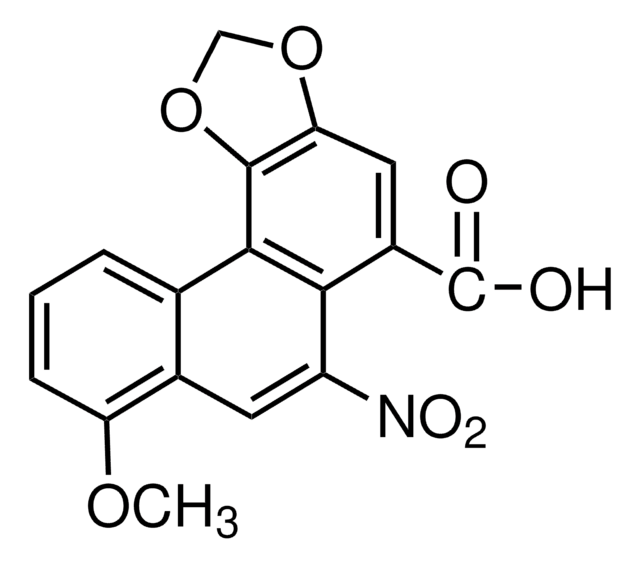
Aristolochic acid I

≥90% (HPLC), powder, phospholipase A₂ inhibitor

Sinónimos:

TR 1736

Iniciar sesión para ver los precios por organización y contrato.

Seleccione un Tamaño

Cambiar Vistas
Tamaño de envaseSKUDisponibilidadPrecio
25 mg

Fecha estimada de envío11 de mayo de 2026desdeMILWAUKEE

$105.00
100 mg

Fecha estimada de envío11 de mayo de 2026desdeMILWAUKEE

$347.00

Acerca de este artículo

Fórmula empírica (notación de Hill):
C17H11NO7
Número CAS:
Peso molecular:
341.27
NACRES:
NA.77
PubChem Substance ID:
UNSPSC Code:
41106300
EC Number:
206-238-3
MDL number:
Assay:
≥90% (HPLC)
Form:
powder

$105.00


Fecha estimada de envío11 de mayo de 2026Detalles


Solicite una orden a granel
Servicio técnico
¿Necesita ayuda? Nuestro equipo de científicos experimentados está aquí para ayudarle.
Permítanos ayudarle


Nombre del producto

Aristolochic acid I, powder

assay

≥90% (HPLC)

form

powder

color

yellow

mp

269-270 °C

solubility

DMSO: soluble, ethanol: soluble

storage temp.

2-8°C

SMILES string

COc1cccc2c1cc([N+]([O-])=O)c3c(cc4OCOc4c23)C(O)=O

InChI

1S/C17H11NO7/c1-23-12-4-2-3-8-9(12)5-11(18(21)22)14-10(17(19)20)6-13-16(15(8)14)25-7-24-13/h2-6H,7H2,1H3,(H,19,20)

InChI key

BBFQZRXNYIEMAW-UHFFFAOYSA-N

General description

Aristolochic acid is a naturally occurring plant metabolite found in Aristolochia sp, Bragantia sp. or Asarum sp. plants.[1] It comprises a mixture of nitrophenanthrene carboxylic acids such as aristolochic acid I and II.[2]

Application

Aristolochic acid I have been used:

  • as a standard for the analysis of Aristolochia sprucei crude extract by high-performance liquid chromatography[3]
  • to study its effects on histone deacetylase 3 (HDAC3) aberration and renal fibrosis[4]
  • to induce acute aristolochic acid nephropathy and to study its impact on miRNA and mRNA expression in mice[5]

Biochem/physiol Actions

Aristolochic acid is a potent inhibitor of phospholipase A2 (PLA2), hyaluronidase, and acetylcholinesterase plasma proteases from snake venoms.[6] Aristolochic acid is considered a herbal medicine and shows therapeutic effects against obstetrics, snake bites, gout, and rheumatism.[2] It exhibits anti-inflammatory and anti-malarial properties.[7] In addition, it is also considered a genotoxic mutagen[2] and causes aristolochic acid nephropathy (AAN), characterized by interstitial fibrosis and urothelial cancer.[2]
Potent phospholipase A2 inhibitor, including calcium ionophore-induced phospholipase A2 activity in neutrophils. Kidney tumor initiator in experimental animal model.

Comparar elementos similares

Ver comparación completa

Mostrar Diferencias

1 of 1

Este artículo
PHL89565Y0001185Y0001323
form

powder

form

-

form

-

form

-

assay

≥90% (HPLC)

assay

≥90.0% (HPLC)

assay

-

assay

-

storage temp.

2-8°C

storage temp.

2-8°C

storage temp.

-

storage temp.

2-8°C

solubility

DMSO: soluble, ethanol: soluble

solubility

-

solubility

-

solubility

-

color

yellow

color

-

color

-

color

-

mp

269-270 °C

mp

-

mp

-

mp

-


Still not finding the right product?

Explore all of our products under


pictograms

Skull and crossbonesHealth hazard

signalword

Danger

Hazard Classifications

Acute Tox. 3 Oral - Carc. 1A - Muta. 1B

Clase de almacenamiento

6.1C - Combustible acute toxic Cat.3 / toxic compounds or compounds which causing chronic effects

wgk

WGK 3

flash_point_f

Not applicable

flash_point_c

Not applicable

ppe

Eyeshields, Faceshields, Gloves, type P2 (EN 143) respirator cartridges


Elija entre una de las versiones más recientes:

Certificados de análisis (COA)

Lot/Batch Number

¿No ve la versión correcta?

Si necesita una versión concreta, puede buscar un certificado específico por el número de lote.

¿Ya tiene este producto?

Encuentre la documentación para los productos que ha comprado recientemente en la Biblioteca de documentos.

Visite la Librería de documentos


Artículos

Cancer research has revealed that the classical model of carcinogenesis, a three step process consisting of initiation, promotion, and progression, is not complete.

Discover Bioactive Small Molecules for Lipid Signaling Research


Jie Wei et al.
Journal of chromatography. A, 1246, 129-136 (2012-04-10)
A novel silica-based reversed-phase/strong anion-exchange mixed-mode stationary phase named C18SAX was synthesized based on the polar-copolymerized approach. C18SAX stationary phase showed excellent compatibility with 100% aqueous mobile phase and comparable performance with commercial SunFire™ C18 column in terms of column
Ching-Chin Yang et al.
Toxicology, 312, 63-73 (2013-08-14)
Studies have found that ingestion of aristolochic acid (AA) causes nephropathy first by inducing renal tubular cell apoptosis acutely. It is currently unknown whether crosstalk between autophagy and apoptosis orchestrates the fate of tubular cells in acute AA nephropathy. We
Ziqiang Zhu et al.
Molecular medicine reports, 22(4), 3367-3377 (2020-09-19)
In acute aristolochic acid nephropathy (AAN), aristolochic acid (AA) induces renal injury and tubulointerstitial fibrosis. However, the roles of microRNAs (miRNAs/miRs) and mRNAs involved in AAN are not clearly understood. The aim of the present study was to examine AA‑induced


Número de artículo de comercio global

SKUGTIN
A5512-100MG04061833258194
A5512-25MG04061833375969

Questions

Reviews

No rating value

Active Filters