Saltar al contenido
MilliporeSigma

Saltar a

MABC86

Anti-Nesprin-2 Antibody, clone K20-478

clone K20-478, from mouse

Sinónimos:

Nesprin-2, Nuclear envelope spectrin repeat protein 2, Nucleus and actin connecting element protein, Protein NUANCE, Synaptic nuclear envelope protein 2, Syne-2

Iniciar sesión para ver los precios por organización y contrato.

Seleccione un Tamaño

Cambiar Vistas
Tamaño de envaseSKUDisponibilidadPrecio
100 μg
Comprobar disponibilidad del carrito
$490.00

Acerca de este artículo

UNSPSC Code:
12352203
NACRES:
NA.41
eCl@ss:
32160702
Conjugate:
unconjugated
Clone:
K20-478, monoclonal
Application:
ICC, IP, WB
Citations:
5

$490.00


Comprobar disponibilidad del carrito

Solicite una orden a granel
Servicio técnico
¿Necesita ayuda? Nuestro equipo de científicos experimentados está aquí para ayudarle.
Permítanos ayudarle


biological source

mouse

Quality Level

conjugate

unconjugated

antibody form

purified immunoglobulin

antibody product type

primary antibodies

clone

K20-478, monoclonal

species reactivity

human, mouse

technique(s)

immunocytochemistry: suitable, immunoprecipitation (IP): suitable, western blot: suitable

isotype

IgG2bκ

NCBI accession no.

UniProt accession no.

shipped in

wet ice

target post-translational modification

unmodified

Gene Information

human ... SYNE2(23224)

General description

Nesprin-2 (SYNE-2) is also known as Nuclear envelope spectrin repeat protein 2 or Nucleus and actin connecting element protein, and it functions to network organelles and the actin cytoskeleton in order maintain subcellular spatial organization. Nesprin-2 connects nuclei to the cytoskeleton by interacting with the nuclear envelope and cytoplasmic F-actin, and is required for centrosome migration to the apical cell surface during early ciliogenesis. Nesprin-2 is widely expressed, with high levels seen in kidney, adult and fetal liver, stomach and placenta. Defects in SYNE2 are responsible for Emery-Dreifuss muscular dystrophy type 5 (EDMD5).
~250 kDa observed. Uncharacterized band(s) may be observed in some cell lysates.

Immunogen

His-tagged recombinant protein corresponding to human Nesprin-2.

Application

Detect Nesprin-2 using this mouse monoclonal antibody, Anti-Nesprin-2 Antibody, clone K20-478 validated for use in western blotting, ICC & IP.
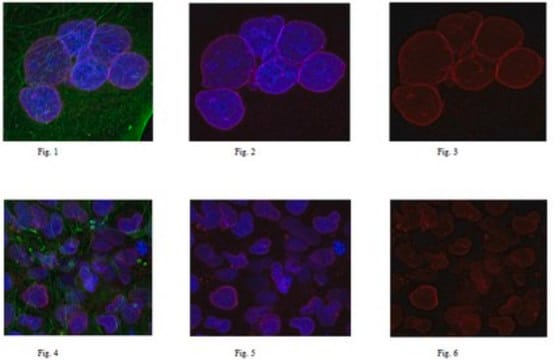
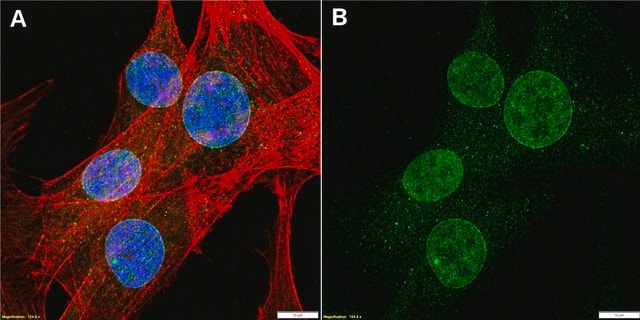
Immunocytochemistry Analysis: A 1:50 dilution of this antibody detected Nesprin-2 in HepG2 and COS-7 cells.

Immunoprecipitation Analysis: A representative lot from an independent laboratory immunoprecipitated Nesprin-2 in HA-MKS3 transfected HEK293 whole cell extracts. Immunoprecipitated sample was then subjected to Western Blotting using the same representative lot of antibody (Dawe, H. R., et al. (2009). J Cell Sci. 122(Pt 15): 2716-2626.).

Western Blotting Analysis: A representative lot from an independent laboratory detected Nesperin-2 in IMCDE whole cell extracts. High levels of a 25 kDa ABD-containing isoform was observed only at post-confluence (+72 hours); however, a second major ABD-containing isoform was observed at 55 kDa before and after confluence (Dawe, H. R., et al. (2009). J Cell Sci. 122(Pt 15): 2716-2626.).

Dylight® is a registered trademark of Thermo Fisher Scientific. Alexa Fluor is a registered trademark of Molecular Probes, Inc.
Research Category
Cell Structure
Research Sub Category
Cytoskeleton

Physical form

Format: Purified
Protein G Purified
Purified mouse monoclonal IgG2bκ in buffer containing 0.1 M Tris-Glycine (pH 7.4), 150 mM NaCl with 0.05% sodium azide.

Preparation Note

Stable for 1 year at 2-8°C from date of receipt.

Analysis Note

Evaluated by Western Blotting in COS-7 cell lysate.

Western Blotting Analysis: 0.5 µg/mL of this antibody detected Nesprin-2 in 10 µg of COS-7 cell lysate.

Other Notes

Concentration: Please refer to the Certificate of Analysis for the lot-specific concentration.

Legal Information

DyLight is a registered trademark of Pierce Biotechnology, Inc.

Disclaimer

Unless otherwise stated in our catalog or other company documentation accompanying the product(s), our products are intended for research use only and are not to be used for any other purpose, which includes but is not limited to, unauthorized commercial uses, in vitro diagnostic uses, ex vivo or in vivo therapeutic uses or any type of consumption or application to humans or animals.

Comparar elementos similares

Ver comparación completa

Mostrar Diferencias

1 of 1

Este artículo
ABN2288HPA003435HPA050204
biological source

mouse

biological source

rabbit

biological source

rabbit

biological source

rabbit

species reactivity

human, mouse

species reactivity

mouse

species reactivity

human

species reactivity

human

conjugate

unconjugated

conjugate

unconjugated

conjugate

unconjugated

conjugate

unconjugated

antibody form

purified immunoglobulin

antibody form

purified antibody

antibody form

affinity isolated antibody

antibody form

affinity isolated antibody

Gene Information

human ... SYNE2(23224)

Gene Information

mouse ... Syne2(319565)

Gene Information

human ... SYNE2(23224)

Gene Information

human ... SYNE2(23224)

clone

K20-478, monoclonal

clone

N/A, polyclonal

clone

polyclonal

clone

polyclonal


Still not finding the right product?

Pruebe nuestra Herramienta de selección de productos para limitar sus opciones


Clase de almacenamiento

12 - Non Combustible Liquids

wgk

WGK 1

flash_point_f

Not applicable

flash_point_c

Not applicable


Certificados de análisis (COA)

Busque Certificados de análisis (COA) introduciendo el número de lote del producto. Los números de lote se encuentran en la etiqueta del producto después de las palabras «Lot» o «Batch»

¿Ya tiene este producto?

Encuentre la documentación para los productos que ha comprado recientemente en la Biblioteca de documentos.

Visite la Librería de documentos


Yasunao Kamikawa et al.
Cell death discovery, 7(1), 152-152 (2021-07-07)
The nuclear envelope (NE) safeguards the genome and is pivotal for regulating genome activity as the structural scaffold of higher-order chromatin organization. NE had been thought as the stable during the interphase of cell cycle. However, recent studies have revealed
Aravindh Subramani et al.
Cells, 12(13) (2023-07-14)
The spread of tumor cells and the formation of distant metastasis remain the main causes of mortality in cancer patients. However, the mechanisms governing the release of cells from micro-environmental constraints remain unclear. E-cadherin negatively controls the invasion of epithelial
Maria Chiara Lionetti et al.
Biophysical journal, 118(9), 2319-2332 (2020-04-23)
The nuclear morphology of eukaryotic cells is determined by the interplay between the lamina forming the nuclear skeleton, the chromatin inside the nucleus, and the coupling with the cytoskeleton. Nuclear alterations are often associated with pathological conditions as in Hutchinson-Gilford


Número de artículo de comercio global

SKUGTIN
MABC8604053252935954

Questions

Reviews

No rating value

Active Filters