Saltar al contenido
MilliporeSigma

Saltar a

MABC547

Anti-Poly ADP-ribose Antibody, clone 10H

clone 10H, from mouse

Sinónimos:

Anti-PAR antibody

Iniciar sesión para ver los precios por organización y contrato.

Seleccione un Tamaño

Cambiar Vistas
Tamaño de envaseSKUDisponibilidadPrecio
50 μg
Comprobar disponibilidad del carrito
$561.00

Acerca de este artículo

UNSPSC Code:
12352203
NACRES:
NA.41
eCl@ss:
32160702
Clone:
10H, monoclonal
Species reactivity:
human
Application:
IF, IP, WB
Citations:
16

$561.00


Comprobar disponibilidad del carrito

Solicite una orden a granel
Servicio técnico
¿Necesita ayuda? Nuestro equipo de científicos experimentados está aquí para ayudarle.
Permítanos ayudarle


biological source

mouse

Quality Level

antibody form

purified immunoglobulin

antibody product type

primary antibodies

clone

10H, monoclonal

species reactivity

human

technique(s)

immunofluorescence: suitable, immunoprecipitation (IP): suitable, western blot: suitable

isotype

IgG3κ

shipped in

wet ice

target post-translational modification

unmodified

Gene Information

human ... PARP1(142)

General description

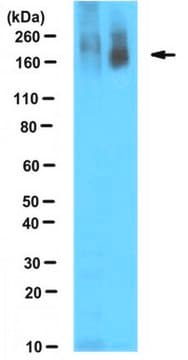
Observed molecular weight is the result of poly(ADP-ribose) polymer on protein receptors (such as histones and transcription factors).
Poly(ADP-ribose) polymerase is an abundant nuclear enzyme that catalyses the synthesis of poly(ADP-ribose) from nicotinamide adenine dinucleotide (NAD+). Poly(ADP-ribose) has an N-terminal DNA-binding domain containing two zinc-fingers, which is linked to the C-terminal NAD+-binding domain by a short region containing several glutamic acid residues that are sites of auto-poly (ADP-ribosyl) ation. Production of poly(ADP-ribose) within the cell is initiated by agents that generate DNA strand interruptions. The branched homopolymer chains may reach a length of 200–300 residues but are rapidly degraded after synthesis. The function of poly(ADP-ribose) synthesis is not clear, although it seems to be required for DNA repair.

Immunogen

Corresponding to human Poly ADP-ribose chain.

Application

Detect PARP using this mouse monoclonal antibody, Anti-Poly ADP-ribose Antibody, clone 10H validated for use in western blotting, IP & Immunofluorescence.
Immunoprecipitation Analysis: A representative lot was used by an an independent laboratory to immunoprecipitate Poly ADP-ribose in cultured supernatents from mouse erythrocytes coated with Poly ADP-ribose (Kawamitsu, H., et al. (1984). American Chemical Society. 3771-3777).
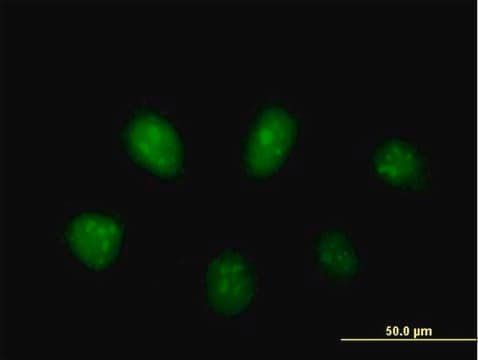
Immunofluorescence Analysis: A representative lot was used by an an independent laboratory to detect Poly (ADP-ribose) synthesis on transfected CV-1 cells via indirect immunofluorescence (J.H. Kupper, et al. J. Biol. Chem. (1990) 265:18721).
Research Category
Apoptosis & Cancer
Research Sub Category
Apoptosis - Additional

Physical form

Format: Purified
Protein G Purified
Purified mouse monoclonal IgG3κ in buffer containing 0.1 M Tris-Glycine (pH 7.4), 150 mM NaCl with 0.05% sodium azide.

Preparation Note

Stable for 1 year at 2-8°C from date of receipt.

Analysis Note

Evaluated by Western Blotting in untreated and UV treated HeLa cells.

Western Blotting Analysis: 1.0 µg/mL of this antibody detected UV treated HeLa cells. Little or no signal observed in untreated HeLa cells.

Other Notes

Concentration: Please refer to the Certificate of Analysis for the lot-specific concentration.
Replaces: MAB3192

Disclaimer

Unless otherwise stated in our catalog or other company documentation accompanying the product(s), our products are intended for research use only and are not to be used for any other purpose, which includes but is not limited to, unauthorized commercial uses, in vitro diagnostic uses, ex vivo or in vivo therapeutic uses or any type of consumption or application to humans or animals.

Comparar elementos similares

Ver comparación completa

Mostrar Diferencias

1 of 1

Este artículo
SAB5700016SAB1406914MABE1016
antibody form

purified immunoglobulin

antibody form

affinity isolated antibody

antibody form

purified immunoglobulin

antibody form

purified antibody

Gene Information

human ... PARP1(142)

Gene Information

human ... PARP1(142)

Gene Information

human ... PARP3(10039)

Gene Information

-

species reactivity

human

species reactivity

rat, human, mouse

species reactivity

human

species reactivity

human, mouse

biological source

mouse

biological source

rabbit

biological source

mouse

biological source

Escherichia coli

clone

10H, monoclonal

clone

polyclonal

clone

polyclonal

clone

-

isotype

IgG3κ

isotype

-

isotype

-

isotype

-


Still not finding the right product?

Pruebe nuestra Herramienta de selección de productos para limitar sus opciones


Clase de almacenamiento

12 - Non Combustible Liquids

wgk

WGK 1

flash_point_f

Not applicable

flash_point_c

Not applicable


Certificados de análisis (COA)

Busque Certificados de análisis (COA) introduciendo el número de lote del producto. Los números de lote se encuentran en la etiqueta del producto después de las palabras «Lot» o «Batch»

¿Ya tiene este producto?

Encuentre la documentación para los productos que ha comprado recientemente en la Biblioteca de documentos.

Visite la Librería de documentos


Jing Xu et al.
Cancer chemotherapy and pharmacology, 89(5), 683-695 (2022-04-15)
Although the use of PARP inhibitor has received considerable amount of attention in ovarian cancer, PARP inhibitor resistance still emerges with disease progression. PI3K/AKT pathway inhibitors have been proposed to synergize with PARP inhibition to slow tumor growth, but the
Umeshkumar Vekariya et al.
Nature communications, 15(1), 5822-5822 (2024-07-11)
DNA polymerase theta (Polθ)-mediated end-joining (TMEJ) repairs DNA double-strand breaks and confers resistance to genotoxic agents. How Polθ is regulated at the molecular level to exert TMEJ remains poorly characterized. We find that Polθ interacts with and is PARylated by
Christina Andronikou et al.
The EMBO journal, 43(6), 1015-1042 (2024-02-16)
Targeting poly(ADP-ribose) glycohydrolase (PARG) is currently explored as a therapeutic approach to treat various cancer types, but we have a poor understanding of the specific genetic vulnerabilities that would make cancer cells susceptible to such a tailored therapy. Moreover, the


Número de artículo de comercio global

SKUGTIN
MABC54704053252923883

Questions

Reviews

No rating value

Active Filters