Saltar al contenido
MilliporeSigma

Saltar a

ABE2901

Anti-Dcp2

serum, from rabbit

Sinónimos:

m7GpppN-mRNA hydrolase, EC:3.6.1.62, Nucleoside diphosphate-linked moiety X motif 20, Nudix motif 20, mRNA-decapping enzyme 2, hDpc

Iniciar sesión para ver los precios por organización y contrato.

Acerca de este artículo

UNSPSC Code:
12352203
NACRES:
NA.41
eCl@ss:
32160702
Conjugate:
unconjugated
Clone:
polyclonal
Application:
WB
Citations:
1


biological source

rabbit

conjugate

unconjugated

antibody form

serum

antibody product type

primary antibodies

clone

polyclonal

species reactivity

mouse, human

packaging

antibody small pack of 25 μL

technique(s)

western blot: suitable

isotype

IgG

NCBI accession no.

UniProt accession no.

target post-translational modification

unmodified

Gene Information

human ... DCP2(167227)

General description

m7GpppN-mRNA hydrolase (UniProt: Q8IU60; also known as EC:3.6.1.62, Nucleoside diphosphate-linked moiety X motif 20, Nudix motif 20, mRNA-decapping enzyme 2, hDpc) is encoded by the DCP2 (also known as NUDT20) gene (Gene ID: 167227) in human. Dcp2 is a manganese-dependent decapping metalloenzyme that catalyzes the cleavage of the cap structure on mRNAs. It removes the 7-methyl guanine cap structure from mRNA molecules, yielding a 5′-phosphorylated mRNA fragment and 7m-GDP. Dcp2 contains a functional Nudix (nucleotide diphosphate linked to an X moiety) motif (aa 95-226) that is essential for its decapping activity. Two isoforms of Dcp2 have been described that are produced by alternative splicing. Dcp2 is reported to play a role in replication-dependent histone mRNA degradation. It has higher activity towards mRNAs that lack a poly(A) tail and does not display any activity towards a cap structure lacking an RNA moiety. Dcp2 is predominantly cytoplasmic, however, a small amount may also be found in the nucleus. Higher expression of Dcp2 has been reported in subjects with celiac disease with higher levels in the nuclear fraction. (Ref.: Wang, Z., et al. (2002). Proc. Natl. Acad. Sci. USA 99(20); 12663-12668; Castellanos-Rubio, A., et al. (2016). Science 352(6281); 91-95).
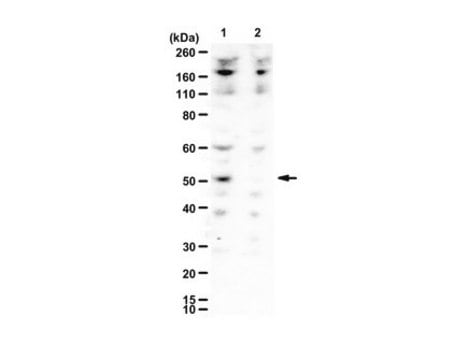
~51 kDa observed; 48.46 kDa calculated. Uncharacterized bands may be observed in some lysate(s).

Immunogen

Epitope: unknown
His-tagged full length recombinant human m7GpppN-mRNA hydrolase (Dcp2).

Application

Anti-Dcp2, Cat. No. ABE2901, is a highly specific rabbit polyclonal antibody that targets m7GpppN-mRNA hydrolase / NUDT20 (Dcp2) and has been tested for use in Western Blotting.
Research Category
Epigenetics & Nuclear Function
Western Blotting Analysis: A representative lot detected Dcp2 in 293T KO, K562, 293T and MEF DCP 2 lysates (Courtesy of Dr. Mike Kiledjian at Rutgers University).

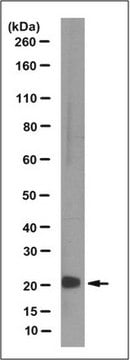
Western Blotting Analysis: A representative lot detected Dcp2 in Western Blotting applications (Castellanos-Rubio, A., et. al. (2016). Science. 352(6281):91-5; Li, Y., et. al. (2012). Mol Cell Biol. 32(6):1164-72; Jiao, X., et. al. (2006). Mol Cell. 24(5):713-22; Li, Y., et. al. (2008). Mol Cell Biol. 28(3):939-48; Song, M.G., et. al. (2010). Mol Cell. 40(3):423-32; Li, Y., et. al. (2012). Mol Cell Biol. 32(6):1164-72).

Biochem/physiol Actions

This rabbit polyclonal antibody detects m7GpppN-mRNA hydrolase (Dcp2) in human and murine cells.

Physical form

Rabbit polyclonal antibody in serum with 0.05% sodium azide.
Unpurified

Preparation Note

Stable for 1 year at -20°C from date of receipt. Handling Recommendations: Upon receipt and prior to removing the cap, centrifuge the vial and gently mix the solution. Aliquot into microcentrifuge tubes and store at -20°C. Avoid repeated freeze/thaw cycles, which may damage IgG and affect product performance.

Analysis Note

Evaluated by Western Blotting in 293T control KO cell lysate.

Western Blotting Analysis: A 1:500 dilution of this antibody detected Dcp2 (NUDT20) in lysate from 293T control knockout cells, but did not react with Dcp2 knockout 293T cell lysate.

Other Notes

Concentration: Please refer to lot specific datasheet.

Disclaimer

Unless otherwise stated in our catalog or other company documentation accompanying the product(s), our products are intended for research use only and are not to be used for any other purpose, which includes but is not limited to, unauthorized commercial uses, in vitro diagnostic uses, ex vivo or in vivo therapeutic uses or any type of consumption or application to humans or animals.

Comparar elementos similares

Ver comparación completa

Mostrar Diferencias

1 of 1

Este artículo
PLA0262MABC1040WH0083594M1
antibody form

serum

antibody form

affinity purified immunoglobulin

antibody form

purified immunoglobulin

antibody form

purified immunoglobulin

biological source

rabbit

biological source

rabbit

biological source

mouse

biological source

mouse

conjugate

unconjugated

conjugate

unconjugated

conjugate

unconjugated

conjugate

unconjugated

technique(s)

western blot: suitable

technique(s)

immunoprecipitation (IP): 5-15 μg/mg, western blot: 1:1,000-1:5,000

technique(s)

western blot: suitable

technique(s)

indirect ELISA: suitable, western blot: 1-5 μg/mL

clone

polyclonal

clone

polyclonal

clone

11A3.2, monoclonal

clone

3F7, monoclonal

UniProt accession no.

Q8IU60

UniProt accession no.

Q8IU60

UniProt accession no.

P36639

UniProt accession no.

Q9BQG2


Still not finding the right product?

Pruebe nuestra Herramienta de selección de productos para limitar sus opciones


Certificados de análisis (COA)

Busque Certificados de análisis (COA) introduciendo el número de lote del producto. Los números de lote se encuentran en la etiqueta del producto después de las palabras «Lot» o «Batch»

¿Ya tiene este producto?

Encuentre la documentación para los productos que ha comprado recientemente en la Biblioteca de documentos.

Visite la Librería de documentos


Número de artículo de comercio global

SKUGTIN
ABE2901-25UL04054839460043
ABE2901-100UL04054839460036

Questions

Reviews

No rating value

Active Filters