Saltar al contenido
MilliporeSigma

Saltar a

06-735

Anti-Caspase 3 Antibody

Upstate®, from rabbit

Sinónimos:

Anti-CASP-3, Anti-Caspase-3

Iniciar sesión para ver los precios por organización y contrato.

Seleccione un Tamaño

Cambiar Vistas
Tamaño de envaseSKUDisponibilidadPrecio
200 μg
Comprobar disponibilidad del carrito
$490.00

Acerca de este artículo

UNSPSC Code:
12352203
NACRES:
NA.41
eCl@ss:
32160702
Conjugate:
unconjugated
Clone:
polyclonal
Application:
IHC, WB
Citations:
27

$490.00


Comprobar disponibilidad del carrito
Está disponible un anticuerpo recombinante y sin conservantes para su diana. Pruebe ZRB1221

Solicite una orden a granel
Servicio técnico
¿Necesita ayuda? Nuestro equipo de científicos experimentados está aquí para ayudarle.
Permítanos ayudarle


biological source

rabbit

Quality Segment

conjugate

unconjugated

antibody form

purified immunoglobulin

antibody product type

primary antibodies

clone

polyclonal

species reactivity

mouse, human, rat

manufacturer/tradename

Upstate®

technique(s)

immunohistochemistry: suitable, western blot: suitable

isotype

IgG

NCBI accession no.

UniProt accession no.

shipped in

wet ice

target post-translational modification

unmodified

Gene Information

human ... CASP3(836)

General description

32 kDa
Caspase-3 (UniProt: P42574; also known as EC:3.4.22.56, CASP-3, Apopain, Cysteine protease CPP32, CPP-32, Protein Yama, SREBP cleavage activity 1, SCA-1) is encoded by the CASP3 (also known as CPP32) gene (Gene ID: 836) in human. Cysteine-aspartic proteases or Caspases play essential roles in apoptosis, necrosis, and inflammation. Historically, caspases were numbered in the order in which they were identified. Caspase-3 is a heterotetrameric enzyme that consists of two anti-parallel arranged heterodimers, each one formed by a 17 kDa (p17) and a 12 kDa (p12) subunit. Caspase-3 is initially produced with a propeptide sequence (aa 1-9), the removal of which yields the 268 aa. caspase-3 proenzyme. Upon activation, the proenzyme is proteolytically cleaved first between Asp175-Ser176 to generate a p20 (aa 10-175) fragment and the p12 (aa 176-277) subunit. Further cleavage of the p20 fragment between Asp28-Ser29 produces the p17 (aa 29-175) subunit. The p17 and p12 subunits dimerize and forms the active caspase-3 enzyme. Caspase-3 has a strict requirement for an Asp residue at positions P1 and P4. It has a preferred cleavage sequence of Asp-Xaa-Xaa-Asp-|- with a hydrophobic amino-acid residue at P2 and a hydrophilic amino-acid residue at P3, although Val or Ala are also accepted at this position. Caspase-3 is involved in the activation cascade of caspases responsible for apoptosis execution. At the onset of apoptosis, it proteolytically cleaves poly(ADP-ribose) polymerase (PARP) at a Asp216-|-Gly217 bond. Caspase-3 mediates the proteolytic activation of caspases-6 and -7, while caspase-3 itself is processed and activated by caspase-8, -9, or -10.

Immunogen

Human full-length Caspase 3 fusion protein containing a histidine-6 tag

Application

This Anti-Caspase 3 Antibody is validated for use in Immunihistochmistry and Western Blotting for the detection of Caspase 3.
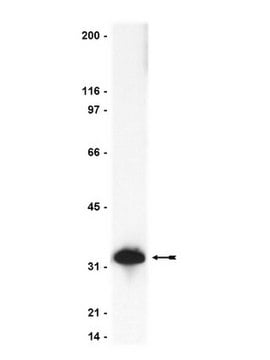
Western Blotting Analysis: 1μg/mL of this antibody detects Caspase-3 in A431 cell lysate.

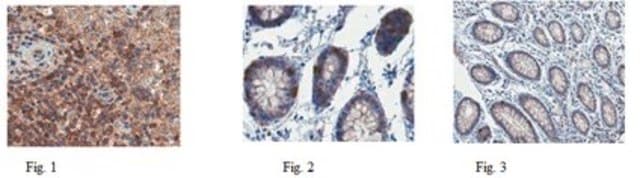
Immunohistochemistry (Paraffin) Analysis: A 1:250 dilution of this antibody detected Caspase-3 in Human tonsil tissue sections.

Biochem/physiol Actions

Recognizes full-length Caspase 3 (Yama/Apopain) and proteolytic fragments.

Physical form

Format: Purified
Protein A purified IgG in of 0.1M Tris-glycine, pH 7.4, 0.15M NaCl,and 0.05% sodium azide.

Preparation Note

Stable for 2 years at 2-8°C from date of shipment. For maximum recovery of product, centrifuge the original vial prior to removing the cap.

Analysis Note

Control
Positive Antigen Control: Catalog #12-301, non-stimulated A431 cell lysate. Add 2.5µL of 2-mercaptoethanol/100µL of lysate and boil for 5 minutes to reduce the preparation. Load 20µg of reduced lysate per lane for mingels.
routinely evaluated by immunoblot on RIPA lysates from non-stimulated human A431 cells, mouse 3T3/A31 or rat PC12 cells

Other Notes

Replaces: 04-1090; 04-439

Legal Information

UPSTATE is a registered trademark of Merck KGaA, Darmstadt, Germany

Comparar elementos similares

Ver comparación completa

Mostrar Diferencias

1 of 1

Este artículo
ABC495AB187106-503-I
biological source

rabbit

biological source

rabbit

biological source

rabbit

biological source

rabbit

clone

polyclonal

clone

polyclonal

clone

polyclonal

clone

polyclonal

antibody form

purified immunoglobulin

antibody form

affinity isolated antibody

antibody form

affinity purified immunoglobulin

antibody form

affinity isolated antibody

conjugate

unconjugated

conjugate

unconjugated

conjugate

unconjugated

conjugate

unconjugated

species reactivity

mouse, human, rat

species reactivity

human, mouse

species reactivity

human, rat, mouse

species reactivity

human

technique(s)

immunohistochemistry: suitable, western blot: suitable

technique(s)

immunocytochemistry: suitable, western blot: suitable

technique(s)

immunofluorescence: suitable, immunoprecipitation (IP): suitable, western blot: suitable

technique(s)

immunohistochemistry: suitable (paraffin), western blot: suitable


Still not finding the right product?

Explore all of our products under Anti-Caspase 3 Antibody

o

Pruebe nuestra Herramienta de selección de productos para limitar sus opciones


Clase de almacenamiento

10 - Combustible liquids

wgk

WGK 1


Certificados de análisis (COA)

Busque Certificados de análisis (COA) introduciendo el número de lote del producto. Los números de lote se encuentran en la etiqueta del producto después de las palabras «Lot» o «Batch»

¿Ya tiene este producto?

Encuentre la documentación para los productos que ha comprado recientemente en la Biblioteca de documentos.

Visite la Librería de documentos


Questions

Reviews

No rating value

Active Filters