Saltar al contenido
Merck

Saltar a

C8115

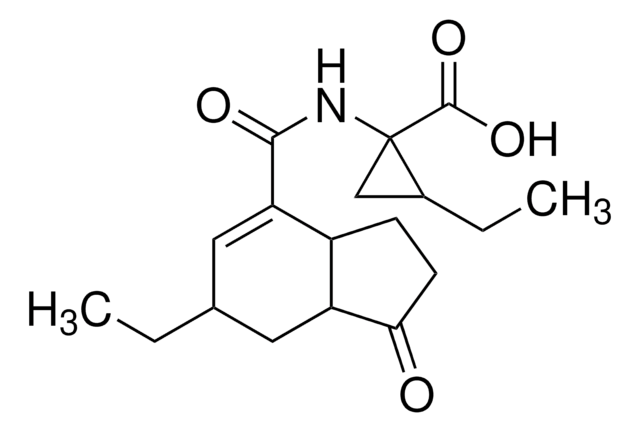
Coronatine

from Pseudomonas syringae pv Glycinea, >95% (HPLC)

Sinónimos:

COR, Cyclopropanecarboxylic acid,2-ethyl-1-[[(6-ethyl-2,3,3a,6,7a-hexahydro-1-oxo-1H-inden-4-yl)carbonyl] amino]

Iniciar sesión para ver los precios por organización y contrato.

Seleccione un Tamaño

Cambiar Vistas
Tamaño de envaseSKUDisponibilidadPrecio
1 mg
Comprobar disponibilidad del carrito
US$ 405,00

Acerca de este artículo

Fórmula empírica (notación de Hill):
C18H25NO4
Peso molecular:
319.40
NACRES:
NA.85
PubChem Substance ID:
UNSPSC Code:
51102829
MDL number:

US$ 405,00

PRECIOS SIN IMPUESTOS NACIONALES

Comprobar disponibilidad del carrito

Solicite una orden a granel
Servicio técnico
¿Necesita ayuda? Nuestro equipo de científicos experimentados está aquí para ayudarle.
Permítanos ayudarle


biological source

Pseudomonas syringae pv Glycinea

Quality Level

assay

>95% (HPLC)

form

powder

solubility

H2O: soluble 0.2 mg/mL, DMSO: soluble 20 mg/mL, methanol: soluble 20 mg/mL

mode of action

enzyme | interferes

storage temp.

−20°C

SMILES string

CCC1CC2C(CCC2=O)C(=C1)C(=O)NC3(CC3CC)C(O)=O

InChI

1S/C18H25NO4/c1-3-10-7-13-12(5-6-15(13)20)14(8-10)16(21)19-18(17(22)23)9-11(18)4-2/h8,10-13H,3-7,9H2,1-2H3,(H,19,21)(H,22,23)

InChI key

FMGBNISRFNDECK-UHFFFAOYSA-N

Application

Coronatine is a polyketide phytotoxin produced by several members of the Pseudomonas syringae group of pathovars such as atropurpurea, glycinea, maculicola,morsprunorum and tomato. Coronatine was used to study the regulatory genes: corP, corS and corR.[1] It was used to study the stimulation of ethylene synthesis in Nicotiana tabacum leaves.[2]

Biochem/physiol Actions

Coronatine is a polyketide phytotoxin produced by several members of the Pseudomonas syringae group of pathovars. It consists of two distinct structural components that function as biosynthetic intermediates: coronafacic acid (CFA) and coronamic acid (CMA). It is known to induce hypertrophy and chlorosis, inhibit root elongation, and stimulate ethylene production.
Coronatine is a polyketide phytotoxin produced by several members of the Pseudomonas syringae group of pathovars. It is known to induce hypertrophy and chlorosis, inhibit root elongation, and stimulate ethylene production.

Other Notes

Keep container tightly closed in a dry and well-ventilated place.

Comparar elementos similares

Ver comparación completa

Mostrar Diferencias

1 of 1

Este artículo
SML2080SML1680SML2692
mode of action

enzyme | interferes

mode of action

-

mode of action

-

mode of action

-

Quality Level

200

Quality Level

-

Quality Level

100

Quality Level

-

form

powder

form

powder

form

powder

form

powder

assay

>95% (HPLC)

assay

≥98% (HPLC)

assay

≥98% (HPLC)

assay

≥98% (HPLC)

solubility

H2O: soluble 0.2 mg/mL, methanol: soluble 20 mg/mL, DMSO: soluble 20 mg/mL

solubility

DMSO: 2 mg/mL, clear

solubility

DMSO: 25 mg/mL, clear

solubility

DMSO: 2 mg/mL, clear

biological source

Pseudomonas syringae pv Glycinea

biological source

-

biological source

-

biological source

-


Clase de almacenamiento

11 - Combustible Solids

wgk

WGK 3

flash_point_f

Not applicable

flash_point_c

Not applicable

ppe

Eyeshields, Gloves, type N95 (US)


Elija entre una de las versiones más recientes:

Certificados de análisis (COA)

Lot/Batch Number

¿No ve la versión correcta?

Si necesita una versión concreta, puede buscar un certificado específico por el número de lote.

¿Ya tiene este producto?

Encuentre la documentación para los productos que ha comprado recientemente en la Biblioteca de documentos.

Visite la Librería de documentos


Contenido relacionado

Product Information Sheet


Nathalie H P Claessens et al.
The Journal of thoracic and cardiovascular surgery, 158(3), 867-877 (2019-04-16)
The aim of this study was to evaluate postoperative indices of cerebral oxygenation and autoregulation in infants with critical congenital heart disease in relation to new postoperative ischemic brain injury. This prospective, clinical cohort included 77 infants with transposition of
Román Manuel Vásquez-Elizondo et al.
Photosynthesis research, 132(3), 311-324 (2017-05-12)
The analysis of the variation of the capacity and efficiency of photosynthetic tissues to collect solar energy is fundamental to understand the differences among species in their ability to transform this energy into organic molecules. This analysis may also help
Shahnaj Parvin et al.
Plant, cell & environment, 41(10), 2418-2434 (2018-06-03)
Increased biomass and yield of plants grown under elevated [CO2 ] often corresponds to decreased grain N concentration ([N]), diminishing nutritional quality of crops. Legumes through their symbiotic N2 fixation may be better able to maintain biomass [N] and grain


Número de artículo de comercio global

SKUGTIN
C8115-1MG04061833521779

Questions

Reviews

No rating value

Active Filters