Saltar al contenido
Merck

44977

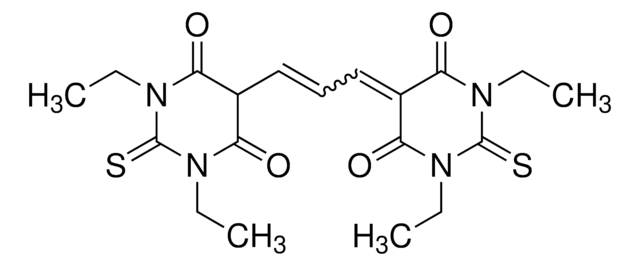
DISBAC2(3), Voltage Sensitive Probe

≥98% (HPLC)

Sinónimos:

5-[3-(1,3-Diethylhexahydro-4,6-dioxo-2-thioxo-5-pyrimidinyl)-2-propen-1-ylidene]-1,3-diethyldihydro-2-thioxo-4,6(1H,5H)-pyrimidinedione, Bis(1,3-diethylthiobarbituric acid)trimethine oxonol

Iniciar sesión para ver los precios por organización y contrato.

Seleccione un Tamaño


Acerca de este artículo

Fórmula empírica (notación de Hill):
C19H24N4O4S2
Número CAS:
Peso molecular:
436.55
UNSPSC Code:
12352108
NACRES:
NA.32
PubChem Substance ID:
EC Number:
256-325-5
Beilstein/REAXYS Number:
1232950
MDL number:
Servicio técnico
¿Necesita ayuda? Nuestro equipo de científicos experimentados está aquí para ayudarle.
Permítanos ayudarle
Servicio técnico
¿Necesita ayuda? Nuestro equipo de científicos experimentados está aquí para ayudarle.
Permítanos ayudarle

Quality Level

assay

≥98% (HPLC)

fluorescence

λex 535 nm; λem 560 nm in DMSO

suitability

complies for Infrared spectrum

storage temp.

−20°C

SMILES string

CCN1C(=O)C(\C=C\C=C2\C(=O)N(CC)C(=S)N(CC)C2=O)C(=O)N(CC)C1=S

InChI

1S/C19H24N4O4S2/c1-5-20-14(24)12(15(25)21(6-2)18(20)28)10-9-11-13-16(26)22(7-3)19(29)23(8-4)17(13)27/h9-12H,5-8H2,1-4H3/b10-9+

InChI key

VJYNRXFXHKIGLT-MDZDMXLPSA-N

Application

DISBAC2(3), Voltage Sensitive Probe is used for single-cell fluorescence imaging of transmembrane conductance and potential change.

Clase de almacenamiento

11 - Combustible Solids

wgk

WGK 3

flash_point_f

Not applicable

flash_point_c

Not applicable


Elija entre una de las versiones más recientes:

Certificados de análisis (COA)

Lot/Batch Number

¿No ve la versión correcta?

Si necesita una versión concreta, puede buscar un certificado específico por el número de lote.

¿Ya tiene este producto?

Encuentre la documentación para los productos que ha comprado recientemente en la Biblioteca de documentos.

Visite la Librería de documentos

Alexander S Tatikolov et al.
Biophysical chemistry, 107(1), 33-49 (2004-02-12)
Non-covalent interactions between polymethine dyes of various types (cationic and anionic thiacarbocyanines as well as anionic oxonols and tetracyanopolymethines) and human serum albumin (HSA) were studied by means of absorption, fluorescence and circular dichroism (CD) spectroscopies. Complexation with the protein
In situ study of the membrane potential in microvascular endothelial cells using a fluorescent probe.
K Miao et al.
Microvascular research, 48(1), 135-142 (1994-07-01)
S Amoroso et al.
Biochimica et biophysica acta, 1239(1), 67-73 (1995-10-04)
In this study the effect of the A1 agonist 2-chloro-N6-cyclopentyladenosine (CCPA) on bis(1,3-diethylthiobarbituric acid)trimethine oxonol (bisoxonol)-monitored membrane potential in cerebrocortical nerve endings was evaluated. CCPA (30, 100 and 300 microM) caused a dose-dependent decrease of high K(+)- and veratridine-induced membrane
N Minami et al.
Journal of neural transmission. General section, 97(1), 65-72 (1994-01-01)
Effects of cyclic AMP on membrane potentials were examined by measuring the changes of bis-oxonol fluorescence in bovine adrenal medullary chromaffin cells. 8-Bromo cyclic AMP (8Br-cAMP) or forskolin caused a gradual and long lasting increase of the fluorescence intensity. The
S Bouhdid et al.
Journal of applied microbiology, 109(4), 1139-1149 (2010-05-12)
To study cellular damage induced by Cinnamomum verum essential oil in Pseudomonas aeruginosa ATCC 27853 and Staphylococcus aureus ATCC 29213. The effect of cinnamon bark essential oil on these two strains was evaluated by plate counts, potassium leakage, flow cytometry

Número de artículo de comercio global

SKUGTIN
44977-1MG04061823367226

Nuestro equipo de científicos tiene experiencia en todas las áreas de investigación: Ciencias de la vida, Ciencia de los materiales, Síntesis química, Cromatografía, Analítica y muchas otras.

Póngase en contacto con el Servicio técnico