
AB9232

Anti-Potassium Channel EAG-1 Antibody
Chemicon®, from rabbit
Sinónimos:
Kv10.1
Seleccione un Tamaño
| Tamaño de envase | SKU | Disponibilidad | Precio |
|---|---|---|---|
| 200 μL | Póngase en contacto con nuestro Servicio de Atención al Cliente para disponibilidad | 652,00 € |
Acerca de este artículo
652,00 €
biological source
rabbit
Quality Segment
conjugate
unconjugated
antibody form
affinity purified immunoglobulin
antibody product type
primary antibodies
clone
polyclonal
purified by
affinity chromatography
species reactivity
rat
manufacturer/tradename
Chemicon®
technique(s)
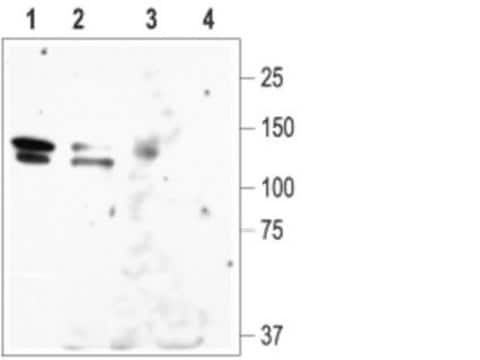
western blot: suitable
NCBI accession no.
UniProt accession no.
shipped in
wet ice
target post-translational modification
unmodified
Gene Information
rat ... Kcnh1(65198)
Immunogen
Application
Neuroscience
Ion Channels & Transporters
Dilutions should be made using a carrier protein such as BSA (1-3%)
Optimal working dilutions must be determined by the end user.
SUGGESTED WESTERN BLOT PROTOCOL
1. Mix the samples (organ membranes: 50 μg/lane; transfected cells: 500,000 cells/lane) with sample-buffer X 2, and heat 10 min at 70°C.
2. 5-50 μL applied to Minigel lane (0.75-1.5 mm width) and run at standard conditions. (60 mA for 2 1.5 mm Minigel gels, 1.4 h). It is suggested that you run 5-15% acrylamide (37.5:1 acrylamide:bisacrysmide) minigel (1.5 mm width) at 30 mA/gel ~1-1.5 hours.
3. Transfer in semi-dry system under standard conditions (3 h 100 mA for two minigel gels)
4. Stain the transferred bands with Chemicon BLOT-FastStain (Catalog Number 2076).
5. Destain with deionized water.
6. Block with 5% non-fat milk (Marvel or Carnation) in PBS, and 0.025 % sodium azide, overnight at 2-8°C. The non-fat milk should be dissolved freshly, centrifuged 10,000 rpm for 10 min, and filtered through glass filter (Gelman Acrodisc).
7. Incubation with first antibody 2 h at room temperature or overnight at 4°C in blocking solution. The antibody preparation should be centrifuged before use (10,000 g 5 min.). Optimal working dilutions and incubation time will need to be determined by the end user.
8. Wash 4 x 10 min. with PBS-0.1% tween 20. From this stage, azide should be omitted.
9. Incubation with the secondary antibody (HRP-conjugated goat anti-rabbit antibody, for example Chemicon Catalog Number AP132P, diluted appropriately) 1 h at room temperature.
10. Wash 4 x 10 min. with PBS-0.1% tween 20.
11. Perform ECL with commercial kits (Chemilucent, Chemicon Catalog Number 2600).
Biochem/physiol Actions
Physical form
Preparation Note
Analysis Note
Included free of charge with the antibody is 40 μg of control antigen. The stock solution of the antigen can be made up using 100 μL of sterile distilled water. For negative control, preincubate 1 μg of peptide with 1 μg of antibody for one hour at room temperature. Optimal concentrations must be determined by the end user.
Other Notes
Legal Information
Disclaimer
1 of 1
Este artículo | |||
|---|---|---|---|
| biological source rabbit | biological source rabbit | biological source mouse | biological source rabbit |
| antibody form affinity purified immunoglobulin | antibody form affinity purified immunoglobulin | antibody form purified immunoglobulin | antibody form affinity isolated antibody |
| Quality Level 100 | Quality Level 100 | Quality Level 100 | Quality Level 100 |
| conjugate unconjugated | conjugate unconjugated | conjugate unconjugated | conjugate unconjugated |
| technique(s) western blot: suitable | technique(s) immunohistochemistry: suitable, immunoprecipitation (IP): suitable, western blot: suitable | technique(s) immunocytochemistry: suitable, western blot: suitable | technique(s) immunofluorescence: 0.25-2 μg/mL (ICC-IF), immunohistochemistry: 1:500 - 1:1000 |
| UniProt accession no. | UniProt accession no. | UniProt accession no. | UniProt accession no. - |
Still not finding the right product?
Pruebe nuestra Herramienta de selección de productos para limitar sus opciones
hcodes
pcodes
Hazard Classifications
Aquatic Chronic 3
Clase de almacenamiento
11 - Combustible Solids
wgk
WGK 3
Certificados de análisis (COA)
Busque Certificados de análisis (COA) introduciendo el número de lote del producto. Los números de lote se encuentran en la etiqueta del producto después de las palabras «Lot» o «Batch»
¿Ya tiene este producto?
Encuentre la documentación para los productos que ha comprado recientemente en la Biblioteca de documentos.
Número de artículo de comercio global
| SKU | GTIN |
|---|---|
| AB9232-200UL | 04053252508363 |