Saltar al contenido
Merck

Saltar a

36-002

Anti-phospho-SGK Antibody

serum, Upstate®

Iniciar sesión para ver los precios por organización y contrato.

Acerca de este artículo

UNSPSC Code:
12352203
NACRES:
NA.41
eCl@ss:
32160702
Clone:
polyclonal
Species reactivity:
human
Application:
WB
Citations:
11


biological source

rabbit

Quality Level

antibody form

serum

antibody product type

primary antibodies

clone

polyclonal

species reactivity

human

manufacturer/tradename

Upstate®

technique(s)

western blot: suitable

isotype

IgG

NCBI accession no.

UniProt accession no.

shipped in

dry ice

target post-translational modification

phosphorylation (pSer422/pThr256)

Gene Information

human ... SGK1(6446)

General description

48 kDa

Immunogen

peptide corresponding to amino acids surrounding Ser255/Thr256 of human SGK1.

Application

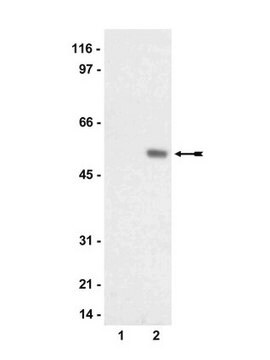
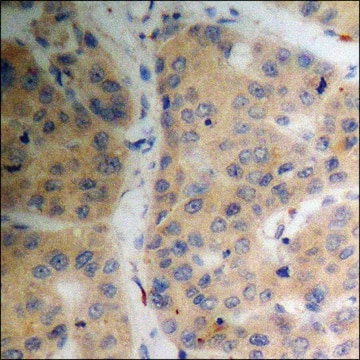
Anti-phospho-SGK Antibody is an antibody against phospho-SGK for use in WB.
Not recommended for use with cell lysates.
Research Category
Signaling
Research Sub Category
PI3K, Akt, & mTOR Signaling

Biochem/physiol Actions

Recognizes phospho-SGK.

Physical form

UnPurified whole rabbit antiSerum containing 30% glycerol and 0.035% sodium azide.
Unpurified

Preparation Note

Maintain for 2 years at -20°C from date of shipment. Aliquot to avoid repeated freezing and thawing. For maximum recovery of product, centrifuge the original vial after thawing and prior to removing the cap.

Analysis Note

Control
PDK activated SGK samples
routinely evaluated by immunoblot detected phospho-SGK after phosphorylation of unactive SGK1 (Catalog # 14-332) with PDK1 (Catalog # 14-280)

Other Notes

Concentration: Please refer to the Certificate of Analysis for the lot-specific concentration.

Legal Information

UPSTATE is a registered trademark of Merck KGaA, Darmstadt, Germany

Disclaimer

Unless otherwise stated in our catalog or other company documentation accompanying the product(s), our products are intended for research use only and are not to be used for any other purpose, which includes but is not limited to, unauthorized commercial uses, in vitro diagnostic uses, ex vivo or in vivo therapeutic uses or any type of consumption or application to humans or animals.

Comparar elementos similares

Ver comparación completa

Mostrar Diferencias

1 of 1

Este artículo
07-315SAB4504066SAB4503834
biological source

rabbit

biological source

rabbit

biological source

rabbit

biological source

rabbit

Quality Level

100

Quality Level

100

Quality Level

100

Quality Level

100

antibody form

serum

antibody form

affinity purified immunoglobulin

antibody form

affinity isolated antibody

antibody form

affinity isolated antibody

species reactivity

human

species reactivity

human, rat

species reactivity

human, rat, mouse

species reactivity

rat, human, mouse

technique(s)

western blot: suitable

technique(s)

immunoprecipitation (IP): suitable, western blot: suitable

technique(s)

ELISA: 1:10000, western blot: 1:500-1:1000

technique(s)

ELISA: 1:40000, immunohistochemistry: 1:50-1:100, western blot: 1:500-1:1000

clone

polyclonal

clone

polyclonal

clone

polyclonal

clone

polyclonal


Still not finding the right product?

Pruebe nuestra Herramienta de selección de productos para limitar sus opciones


Clase de almacenamiento

10 - Combustible liquids

wgk

WGK 1


Certificados de análisis (COA)

Busque Certificados de análisis (COA) introduciendo el número de lote del producto. Los números de lote se encuentran en la etiqueta del producto después de las palabras «Lot» o «Batch»

¿Ya tiene este producto?

Encuentre la documentación para los productos que ha comprado recientemente en la Biblioteca de documentos.

Visite la Librería de documentos


Jian-Bang Xu et al.
Signal transduction and targeted therapy, 9(1), 74-74 (2024-03-26)
Severe acute respiratory syndrome coronavirus 2 (SARS-CoV-2) infection disrupts the epithelial barrier and triggers airway inflammation. The envelope (E) protein, a core virulence structural component of coronaviruses, may play a role in this process. Pathogens could interfere with transepithelial Cl-
J Park et al.
The EMBO journal, 18(11), 3024-3033 (1999-06-05)
Serum and glucocorticoid-inducible kinase (SGK) is a novel member of the serine/threonine protein kinase family that is transcriptionally regulated. In this study, we have investigated the regulatory mechanisms that control SGK activity. We have established a peptide kinase assay for
Yi-Lin Zhang et al.
Mucosal immunology, 11(4), 1149-1157 (2018-03-17)
Airway epithelial cells harbor the capacity of active Cl- transepithelial transport and play critical roles in modulating innate immunity. However, whether intracellular Cl- accumulation contributes to relentless airway inflammation remains largely unclear. This study showed that, in airway epithelial cells


Número de artículo de comercio global

SKUGTIN
36-00204053252287800

Preguntas

Revisiones

Sin puntuación

Filtros activos