Saltar al contenido
Merck

Saltar a

P4354

Monoclonal Anti-p19INK4d antibody produced in mouse

clone DCS-100, ascites fluid

Sinónimos:

Anti-INK4D, Anti-p19, Anti-p19-INK4D

Iniciar sesión para ver los precios por organización y contrato.

Acerca de este artículo

UNSPSC Code:
12352203
NACRES:
NA.41
MDL number:
Conjugate:
unconjugated
Clone:
DCS-100, monoclonal
Application:
ARR, ICC, IHC (p), IP, WB
Citations:
3


biological source

mouse

conjugate

unconjugated

antibody form

ascites fluid

antibody product type

primary antibodies

clone

DCS-100, monoclonal

mol wt

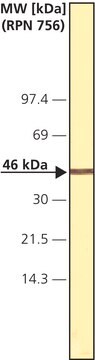
antigen 19 kDa

contains

15 mM sodium azide

species reactivity

human

technique(s)

immunocytochemistry: suitable, immunohistochemistry (formalin-fixed, paraffin-embedded sections): suitable, immunoprecipitation (IP): suitable, microarray: suitable, western blot: 1:1,000 using a cultured human tumor cell line extract

isotype

IgG1

UniProt accession no.

shipped in

dry ice

storage temp.

−20°C

target post-translational modification

unmodified

Gene Information

human ... CDKN2D(1032)

General description

Cyclin dependent kinase inhibitor 2D (CDKN2D), also referred to as p19INK4d, is part of the inhibitors of cyclin-dependent kinases (INK4) family. It consists of 166 amino acids and five ankyrin-like repeats that aid in protein-protein interactions. The gene encoding this protein is localized on human chromosome 19p13.

Immunogen

recombinant human p19INK4d.

Application

Monoclonal Anti-p19INK4d antibody produced in mouse has been used in microarray.

Biochem/physiol Actions

Cyclin dependent kinase inhibitor 2D (CDKN2D) functions as a modulator of the cell cycle and has a role in DNA damage response. It acts as a chromatin accessibility factor. The protein associates with cyclin-dependent kinase 4 and 6 and inhibits their kinase activity.
Shows no cross-reactivity with other closely related Cdk inhibitors, such as p15INK4b, p16INK4a and p18INK4c.

Disclaimer

Unless otherwise stated in our catalog or other company documentation accompanying the product(s), our products are intended for research use only and are not to be used for any other purpose, which includes but is not limited to, unauthorized commercial uses, in vitro diagnostic uses, ex vivo or in vivo therapeutic uses or any type of consumption or application to humans or animals.

Comparar elementos similares

Ver comparación completa

Mostrar Diferencias

1 of 1

Este artículo
C7464C7089SAB1405602
antibody form

ascites fluid

antibody form

ascites fluid

antibody form

ascites fluid

antibody form

purified immunoglobulin

Gene Information

human ... CDKN2D(1032)

Gene Information

human ... CCND1(595)
mouse ... Ccnd1(12443)
rat ... Ccnd1(58919)

Gene Information

human ... CDK7(1022)

Gene Information

human ... CDKN2B(1030)

conjugate

unconjugated

conjugate

unconjugated

conjugate

unconjugated

conjugate

unconjugated

biological source

mouse

biological source

mouse

biological source

mouse

biological source

mouse

species reactivity

human

species reactivity

rat, mouse, human, monkey

species reactivity

human

species reactivity

human

clone

DCS-100, monoclonal

clone

DCS-6, monoclonal

clone

MO-1.1, monoclonal

clone

polyclonal


Still not finding the right product?

Pruebe nuestra Herramienta de selección de productos para limitar sus opciones


Clase de almacenamiento

10 - Combustible liquids

wgk

WGK 3

flash_point_f

Not applicable

flash_point_c

Not applicable


Elija entre una de las versiones más recientes:

Certificados de análisis (COA)

Lot/Batch Number

¿No ve la versión correcta?

Si necesita una versión concreta, puede buscar un certificado específico por el número de lote.

¿Ya tiene este producto?

Encuentre la documentación para los productos que ha comprado recientemente en la Biblioteca de documentos.

Visite la Librería de documentos


Contenido relacionado


Further intracellular proteins and signaling pathways regulated by angiotensin-(1?7) in human endothelial cells
Christian Meinert
Data in Brief (2017)
Nuclear translocation of p19INK4d in response to oxidative DNA damage promotes chromatin relaxation.
Anna F
Cancer Biology & Therapy (2013)
Nuclear translocation of p19INK4d in response to oxidative DNA damage promotes chromatin relaxation.
Sonzogni SV
Molecular and Cellular Biochemistry (2015)


Número de artículo de comercio global

SKUGTIN
P4354-.2ML04061837868320

Preguntas

Revisiones

Sin puntuación

Filtros activos