Saltar al contenido
Merck

Saltar a

K0253

Keratin from human epidermis

aqueous solution

Iniciar sesión para ver los precios por organización y contrato.

Seleccione un Tamaño

Cambiar Vistas
Tamaño de envaseSKUDisponibilidadPrecio

Acerca de este artículo

Número CAS:
UNSPSC Code:
12352202
NACRES:
NA.61
MDL number:
Form:
urea solution
Assay:
≥90% (SDS-PAGE)
Biological source:
human epidermis
Para consultas sobre este producto K0253, póngase en contacto con su oficina o distribuidor locales de Merck. Póngase en contacto con el Servicio técnico
Servicio técnico
¿Necesita ayuda? Nuestro equipo de científicos experimentados está aquí para ayudarle.
Permítanos ayudarle


biological source

human epidermis

Quality Level

assay

≥90% (SDS-PAGE)

form

urea solution

technique(s)

ELISA: suitable

UniProt accession no.

storage temp.

2-8°C

Gene Information

human ... KRT1(3848)

General description

Keratins are characteristic intermediate filament proteins of the epithelia. In human, keratin is classified into type I and type II. About 54 genes encodes for the keratin protein. The keratin 1 (KRT1) gene is mapped to human chromosome 12q13.13. It is the primary component of hair, skin and nails.

Application

Keratin from human epidermis has been used:
  • as an analyte and a cross-reactant in the antibody-immobilized chip for testing selectivity coefficients[1]
  • as a standard in extracellular matrix (ECM) protein in in vitro protein degradation assays.[2]
  • asa a standard in enzyme linked immunosorbent assay (ELISA)

Biochem/physiol Actions

Keratins are important for the mechanical stability and integrity of epithelial cells and tissues. Some keratins also have regulatory functions and are involved in intracellular signaling pathways, e.g. protection from stress, wound healing, and apoptosis.[3] This diverse group of cytoskeletal scaffolding proteins form intermediate filament networks which provide structural support to keratinocytes that maintain the integrity of the skin. Expression of keratin genes is usually regulated by differentiation of the epidermal cells within the stratifying squamous epithelium.[4]

Physical form

Solution in 8 M urea, 50 mM Tris, 0.1 M β-mercaptoethanol and 0.1% sodium azide, pH 8.4

Comparar elementos similares

Ver comparación completa

Mostrar Diferencias

1 of 1

Este artículo
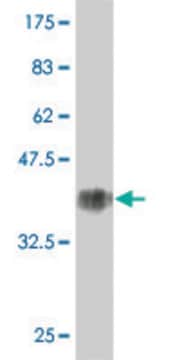
WH0003848M1SAB4501653SAB5500125
assay

≥90% (SDS-PAGE)

assay

-

assay

-

assay

-

biological source

human epidermis

biological source

mouse

biological source

rabbit

biological source

rabbit

technique(s)

ELISA: suitable

technique(s)

indirect ELISA: suitable, western blot: 1-5 μg/mL

technique(s)

ELISA: 1:40000, immunofluorescence: 1:100-1:500, immunohistochemistry: 1:50-1:100, western blot: 1:500-1:1000

technique(s)

flow cytometry: 1:100, immunoblotting: 1:25, immunohistochemistry: 1:100

form

urea solution

form

buffered aqueous solution

form

buffered aqueous solution

form

-

storage temp.

2-8°C

storage temp.

−20°C

storage temp.

−20°C

storage temp.

2-8°C

UniProt accession no.

P04264

UniProt accession no.

P04264

UniProt accession no.

P05787

UniProt accession no.

Q04695


pictograms

Exclamation mark

signalword

Warning

hcodes

Hazard Classifications

Skin Sens. 1

Clase de almacenamiento

10 - Combustible liquids

wgk

WGK 3

flash_point_f

Not applicable

flash_point_c

Not applicable


Elija entre una de las versiones más recientes:

Certificados de análisis (COA)

Lot/Batch Number

¿No ve la versión correcta?

Si necesita una versión concreta, puede buscar un certificado específico por el número de lote.

¿Ya tiene este producto?

Encuentre la documentación para los productos que ha comprado recientemente en la Biblioteca de documentos.

Visite la Librería de documentos


Christopher J Day et al.
PLoS neglected tropical diseases, 15(2), e0009136-e0009136 (2021-02-26)
Mycobacterium ulcerans is the causative agent of the chronic, necrotizing skin disease Buruli ulcer. Modes of transmission and molecular mechanisms involved in the establishment of M. ulcerans infections are poorly understood. Interactions with host glycans are often crucial in bacterial
Christian Mozet et al.
Anticancer research, 33(6), 2415-2424 (2013-06-12)
The hedgehog signaling pathway (HH) is involved in tumorigenesis in a variety of human malignancies. In head and neck squamous cell carcinomas (HNSCC), Hh overexpression was associated with poor prognosis. Therefore, we analyzed the effect of Hh signaling blockade with
Comparison of biomarkers in exhaled breath condensate and bronchoalveolar lavage
Jackson AS, et al.
American Journal of Respiratory and Critical Care Medicine, 175(3), 222-227 (2007)


Número de artículo de comercio global

SKUGTIN
K0253-1MG04061826675557
K0253-5MG04061833262931
K0253-10MG04061833262924

Preguntas

  1. I need to ask about the supplied volume of this product. Also, can this product be used for fungal experimental studies as keratin is prepared in urea that might be toxic for cells?

    1 respuesta
    1. The volume of K0253 keratin derived from human epidermis is influenced by both the pack size and the lot-specific concentration. Here's a sample CofA for reference, which can be pulled from our website.
      https://www.sigmaaldrich.com/certificates/sapfs/PROD/sap/certificate_pdfs/COFA/Q14/K0253-BULKSLCQ7891.pdf

      Also, keratin can be used for fungal experimental studies, but the presence of urea in its preparation may pose a concern depending on the concentration used. Urea can be cytotoxic at higher concentrations, potentially affecting fungal growth and experimental outcomes. To mitigate this, researchers often dialyze or extensively wash keratin preparations to remove residual urea. It is advisable to test the cytotoxicity of the prepared keratin on fungal cells before proceeding with experiments. Alternative keratin extraction methods that avoid urea may also be considered if cell viability is a major concern.
      K0253 is referenced in the study "Microbial Degradation of Native Keratin in Batch Fermentation".
      https://scialert.net/fulltext/fulltextpdf.php?pdf=ansinet/pjbs/1999/627-634.pdf

      ¿Le ha resultado útil?

Revisiones

Sin puntuación

Filtros activos