Saltar al contenido
Merck

Saltar a

F6796

Anti-Fibroblast Growth Factor Receptor-2, Extracellular antibody produced in rabbit

affinity isolated antibody, buffered aqueous solution

Sinónimos:

Anti-FGFR-2

Iniciar sesión para ver los precios por organización y contrato.

Seleccione un Tamaño

Cambiar Vistas
Tamaño de envaseSKUDisponibilidadPrecio

Acerca de este artículo

UNSPSC Code:
51111800
NACRES:
NA.41
MDL number:
Conjugate:
unconjugated
Clone:
polyclonal
Application:
IHC (p), WB
Citations:
11
En este momento no podemos mostrarle ni los precios ni la disponibilidad
Servicio técnico
¿Necesita ayuda? Nuestro equipo de científicos experimentados está aquí para ayudarle.
Permítanos ayudarle

biological source

rabbit

Quality Level

conjugate

unconjugated

antibody form

affinity isolated antibody

antibody product type

primary antibodies

clone

polyclonal

form

buffered aqueous solution

mol wt

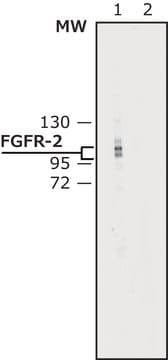
antigen 115-125 kDa (doublet)

species reactivity

human

packaging

antibody small pack of 25 μL

Categorías relacionadas

Comparar elementos similares

Ver comparación completa

Mostrar Diferencias

1 of 1

Este artículo
F0300F5421SAB4500889
biological source

rabbit

biological source

rabbit

biological source

rabbit

biological source

rabbit

antibody form

affinity isolated antibody

antibody form

affinity isolated antibody

antibody form

affinity isolated antibody

antibody form

affinity isolated antibody

Quality Level

200

Quality Level

200

Quality Level

200

Quality Level

100

conjugate

unconjugated

conjugate

unconjugated

conjugate

unconjugated

conjugate

unconjugated

form

buffered aqueous solution

form

buffered aqueous solution

form

buffered aqueous solution

form

buffered aqueous solution

mol wt

antigen 115-125 kDa (doublet)

mol wt

antigen 115-125 kDa (doublet)

mol wt

antigen 110-120 kDa

mol wt

antigen 92 kDa

General description

Fibroblast growth factors (FGFs) belongs to the large tyrosine kinase family of growth factor receptors (17-38kDa). The FGF family consists of at least seventeen members designated FGF-1 through FGF-17 that bind to high affinity FGF receptors (FGFRs). Soluble, secreted or possibly cleaved forms of FGFR-1 and FGFR-2 have also been found in body fluids. They are glycosylated 110-150 kDa proteins that are constructed of an extracellular ligand binding region with either two, or typically three, immunoglobulin (Ig)-like domains and an eight amino acid "acidic box", a transmembrane region and a cytoplasmic split tyrosine kinase domain that is activated following ligand binding and receptor dimerization. The ligand binding site of all FGFRs is confined to the extracellular Ig-like domains 2 and 3.

Immunogen

synthetic peptide corresponding to amino acids 362-374 of the extracellular region of human FGFR-2 (Bek).

Application

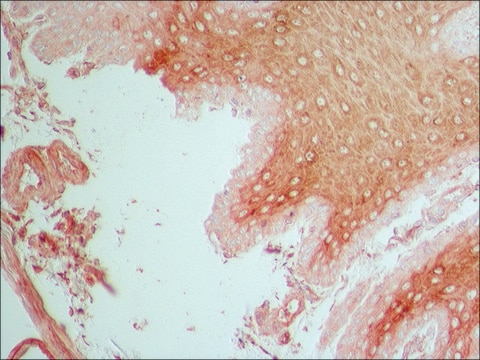
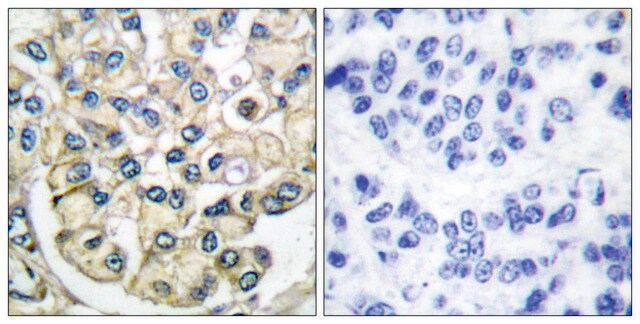
Anti-Fibroblast Growth Factor Receptor-2, Extracellular antibody produced in rabbit has been used in immunoprecipitation and immunoblotting.

Biochem/physiol Actions

Fibroblast growth factors (FGFs) are potent physiological regulators normal development, wound healing and repair, angiogenesis, a variety of neurotrophic activities, in hematopoiesis as well as in tissue remodeling and maintenance. FGFRs exhibit overlapping recognition and redundant specificity. Signal transduction by FGFRs requires dimerization or oligomerization and autophosphorylation of the receptors through their tyrosine kinase domain. Subsequent association with cytoplasmic signaling molecules leads to DNA synthesis or differentiation. The signaling and biological responses elicited by distinct FGFRs substantially differ. FGFR-2 is highly expressed in developing human tissues including the brain (preferentially in glial cells), choroid plexus, skin, lung, kidney and bone. It may be found in several anchorage-dependent cells, such as normal and malignant breast cancer cells.
The antibody detects human FGFR-2 (bek) in extracts of transfected cells.
The antibody specifically reacts with human FGFR-2; no reaction with FGFR-1 or FGFR-3 is detected.

Physical form

Solution in 0.01 M phosphate buffered saline,
pH 7.4, containing 1% bovine serum albumin and 15 mM sodium azide

Preparation Note

Affinity isolated on a peptide-agarose column.

Disclaimer

Unless otherwise stated in our catalog or other company documentation accompanying the product(s), our products are intended for research use only and are not to be used for any other purpose, which includes but is not limited to, unauthorized commercial uses, in vitro diagnostic uses, ex vivo or in vivo therapeutic uses or any type of consumption or application to humans or animals.

¿No encuentra el producto adecuado?  

Pruebe nuestro Herramienta de selección de productos.

Clase de almacenamiento

10 - Combustible liquids

wgk

WGK 2

flash_point_f

Not applicable

flash_point_c

Not applicable

ppe

Eyeshields, Gloves, multi-purpose combination respirator cartridge (US)


Elija entre una de las versiones más recientes:

Certificados de análisis (COA)

Lot/Batch Number

¿No ve la versión correcta?

Si necesita una versión concreta, puede buscar un certificado específico por el número de lote.

¿Ya tiene este producto?

Encuentre la documentación para los productos que ha comprado recientemente en la Biblioteca de documentos.

Visite la Librería de documentos

Fibroblast growth factor 23 reduces expression of type IIa Na+/Pi co-transporter by signaling through a receptor functionally distinct from the known FGFRs in opossum kidney cells
Yan X, et al.
Genes Cells, 10(5), 489-502 (2005)
Ternary complex formation of EphA4, FGFR and FRS2$\alpha$ plays an important role in the proliferation of embryonic neural stem/progenitor cells
Sawada T, et al.
Genes Cells, 15(3), 297-311 (2010)
D Givol et al.
FASEB journal : official publication of the Federation of American Societies for Experimental Biology, 6(15), 3362-3369 (1992-12-01)
Since 1989, the receptors for fibroblast growth factors (FGFs) were cloned and characterized as a subgroup of the family of receptor tyrosine kinases. Four FGF receptor genes were identified, all of which encode membrane-bound glycoproteins containing three immunoglobulin (Ig) -like
Sergiy Klid et al.
Stem cell research & therapy, 12(1), 608-608 (2021-12-22)
An environment of gestational diabetes mellitus (GDM) can modify the phenotype of stem cell populations differentially according to their placental localization, which can be useful to study the consequences for the fetus. We sought to explore the effect of intrauterine
S E Hughes
The journal of histochemistry and cytochemistry : official journal of the Histochemistry Society, 45(7), 1005-1019 (1997-07-01)
This report describes a systematic analysis of the expression of the fibroblast growth factor receptor (FGFR) multigene family (FGFR1, FGFR2, FGFR3, and FGFR4) in archival serial sections of normal human adult tissues representing the major organ systems, using immunohistochemical techniques.

Contenido relacionado

Instructions

Número de artículo de comercio global

SKUGTIN
F6796-.2ML04061838105332

Preguntas

Revisiones

Sin puntuación

Filtros activos

Nuestro equipo de científicos tiene experiencia en todas las áreas de investigación: Ciencias de la vida, Ciencia de los materiales, Síntesis química, Cromatografía, Analítica y muchas otras.

Póngase en contacto con el Servicio técnico