
C8271

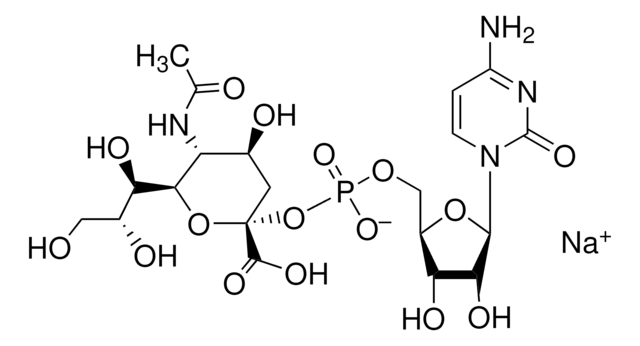
Cytidine-5′-monophospho-N-acetylneuraminic acid sodium salt
≥85% (HPLC), synthetic (organic), powder
Sinónimos:
CMP-NAN, CMP-NANA, CMP-Neu5Ac, CMP-Sialic acid
Seleccione un Tamaño
| Tamaño de envase | SKU | Disponibilidad | Precio |
|---|---|---|---|
| 1 mg | Póngase en contacto con nuestro Servicio de Atención al Cliente para disponibilidad | 88,20 € | |
| 5 mg | Póngase en contacto con nuestro Servicio de Atención al Cliente para disponibilidad | 378,00 € | |
| 25 mg | Póngase en contacto con nuestro Servicio de Atención al Cliente para disponibilidad | 1180,00 € |
Acerca de este artículo
88,20 €
Nombre del producto
Cytidine-5′-monophospho-N-acetylneuraminic acid sodium salt, ≥85% (HPLC)
biological source
synthetic (organic)
Quality Segment
assay
≥85% (HPLC)
form
powder
solubility
water: 50 mg/mL, clear, colorless
storage temp.
−20°C
SMILES string
[Na+].CC(=O)N[C@@H]1[C@@H](O)C[C@@](O[C@@H]1[C@H](O)[C@H](O)CO)(OP([O-])(=O)OC[C@H]2O[C@H]([C@H](O)[C@@H]2O)N3C=CC(N)=NC3=O)C(O)=O
InChI
1S/C20H31N4O16P.Na/c1-7(26)22-12-8(27)4-20(18(32)33,39-16(12)13(29)9(28)5-25)40-41(35,36)37-6-10-14(30)15(31)17(38-10)24-3-2-11(21)23-19(24)34;/h2-3,8-10,12-17,25,27-31H,4-6H2,1H3,(H,22,26)(H,32,33)(H,35,36)(H2,21,23,34);/q;+1/p-1/t8-,9+,10+,12+,13+,14+,15+,16?,17+,20+;/m0./s1
InChI key
VFRHSOGUONIUOR-CTFMUGKASA-M
General description
Application
- as a standard in high-performance anion-exchange chromatography with pulsed amperometric detection (HPAEC-PAD) for nucleotide sugar analysis in Joubert syndrome type 10 (JBTS10) patient cells and control skin fibroblasts[1],
- As a substrate for the enzymatic sialylation of G2 glycoforms[2], resialylation assay[3][4][5],
- in in-vitro sialyltransferase assay[6]
Biochem/physiol Actions
Preparation Note
CMP-NAN is very acid-labile.
1 of 1
Este artículo | |||
|---|---|---|---|
| biological source synthetic (organic) | biological source synthetic | biological source synthetic | biological source synthetic (organic) |
| Quality Level 200 | Quality Level 200 | Quality Level 100 | Quality Level 200 |
| assay ≥85% (HPLC) | assay ≥95% (HPLC) | assay ≥99.0% (HPLC) | assay ≥96% (HPLC) |
| form powder | form powder | form powder | form powder |
| storage temp. −20°C | storage temp. −20°C | storage temp. 2-8°C | storage temp. −20°C |
| solubility water: 50 mg/mL, clear, colorless | solubility water: 50 mg/mL, clear, colorless | solubility - | solubility H2O: 100 mg/mL |


Clase de almacenamiento
11 - Combustible Solids
wgk
WGK 3
flash_point_f
Not applicable
flash_point_c
Not applicable
Elija entre una de las versiones más recientes:
¿Ya tiene este producto?
Encuentre la documentación para los productos que ha comprado recientemente en la Biblioteca de documentos.
Artículos
Understand sialic acid structure, function, signaling, and modifications. Easily find products for sialic acid research.
LC-MS/MS method quantifies similar polar nucleotide activated sugars using Supel™ Carbon LC column for simultaneous analysis.
Enzymatic glycosyltransferase specificity challenges the one enzyme-one linkage concept.
Contenido relacionado
Explore tools for glycosyltransferase synthesis and modification of glycans, such as glycosyltransferases and nucleotide sugar donors.
Glycobiology and Glycoproteomics Brochure
Número de artículo de comercio global
| SKU | GTIN |
|---|---|
| C8271-1MG | 04061833522011 |
| C8271-5MG | 04061833522035 |
| C8271-25MG | 04061833522028 |