Saltar al contenido
Merck

Saltar a

A4200

Monoclonal Anti-γ-Adaptin antibody produced in mouse

clone 100/3, ascites fluid

Sinónimos:

Anti-AP-1

Iniciar sesión para ver los precios por organización y contrato.

Seleccione un Tamaño

Cambiar Vistas
Tamaño de envaseSKUDisponibilidadPrecio
0.2 mL
Póngase en contacto con nuestro Servicio de Atención al Cliente para disponibilidad
569,00 €
483,65 €

Acerca de este artículo

UNSPSC Code:
12352203
NACRES:
NA.41
MDL number:
Conjugate:
unconjugated
Clone:
100/3, monoclonal
Application:
EM, IP, WB
Citations:
70

483,65 €

Precio de catálogo569,00 €Ahorre 15 %
Promoción solo por Internet

Póngase en contacto con nuestro Servicio de Atención al Cliente para disponibilidad

Solicite una orden a granel
Servicio técnico
¿Necesita ayuda? Nuestro equipo de científicos experimentados está aquí para ayudarle.
Permítanos ayudarle


biological source

mouse

Quality Level

conjugate

unconjugated

antibody form

ascites fluid

antibody product type

primary antibodies

clone

100/3, monoclonal

mol wt

antigen 104 kDa

contains

15 mM sodium azide

species reactivity

bovine, human, monkey

should not react with

mouse, rat

technique(s)

electron microscopy: suitable, immunoprecipitation (IP): suitable, western blot: 1:100 using bovine brain extract

isotype

IgG2b

UniProt accession no.

shipped in

dry ice

storage temp.

−20°C

target post-translational modification

unmodified

Gene Information

human ... AP1G1(164)
mouse ... Ap1g1(11765)
rat ... Ap1g1(171494)

General description

Clathrin-coated vesicle populations contain the adaptor complexes AP-1 and AP-2, also known as HA-I (HA1) adaptor and HA-II (HA2) adaptor or Assemble Protein 1 (AP1) and Assemble Protein 2 (AP2), respectively. Clathrin-coated membranes at or originating from the plasma membrane contain the AP-2 adaptor, while the AP-1 adaptor appears to be largely restricted to clathrin-coated membranes of the trans-Golgi network. Both the Golgi-associated AP-1 adaptor and the plasma-membrane associated AP-2 adaptor are heterotetrameric protein complexes. AP-1 adaptor consists of four subunits termed b1 (formerly b′, 110 kDa), g (100 kDa), m1 (47 kDa), and s1 (20 kDa). b1 and g subunits (b1 and g adaptins) from neuronal sources behave in standard SDS-PAGE like 115 kDa and 104 kDa polypeptides, respectively.

Immunogen

AP-1 adaptor from bovine brain.

Application

Applications in which this antibody has been used successfully, and the associated peer-reviewed papers, are given below.
Immuno-electron microscopy (1 paper)
Immunofluorescence (1 paper)
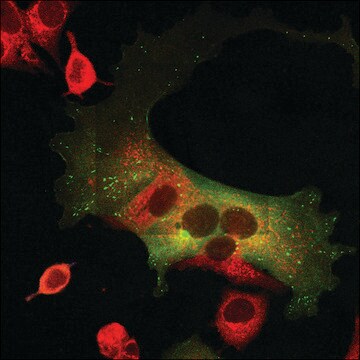
Immunofluorescence of Hela cells was performed using monoclonal anti-AP1 (clone 100/3) as the primary antibody.
In immuno­fluorescence using MDBK cells, human heart fibroblasts, and African green monkey kidney cells (Vero), the binding of antibody appears to be largely confined to the trans-Golgi network. The antibody has been used for studies on the effects of Brefeldin A, a substance causing rapid redistribution of coat proteins associated with the clathrin-coated vesicles that bud from the trans-Golgi network. The antibody is also useful for the immunoaffinity purification of the Golgi adaptor complex AP-1.
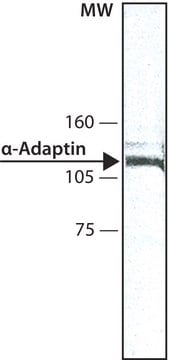
Mouse monoclonal anti-gamma-adaptin antibody can be used for western blot (1:100, using bovine brain extract), immunoprecipitation and electron microscopy applications.

Biochem/physiol Actions

Mouse monoclonal clone 100/3 anti-g-Adaptin antibody reacts in immunoblotting with the 104 kDa polypeptide of the Golgi adaptor complex AP-1. It reacts with polypeptides of ~100 kDa in bovine liver, human heart fibroblasts, and Madin-Darby bovine kidney cultured cells (MDBK), but not with any components in the 110-115 kDa range from these sources or from neuroblastoma or astrocytes. This suggests that the 110 and 115 kDa polypeptides may be specific variants occurring only in some cell types of brain. The antibody does not recognize the γ-subunit in rodents (rat and mouse).

Physical form

The product is provided as ascites fluid with 0.1% sodium azide as a preservative.

Disclaimer

Unless otherwise stated in our catalog or other company documentation accompanying the product(s), our products are intended for research use only and are not to be used for any other purpose, which includes but is not limited to, unauthorized commercial uses, in vitro diagnostic uses, ex vivo or in vivo therapeutic uses or any type of consumption or application to humans or animals.

Comparar elementos similares

Ver comparación completa

Mostrar Diferencias

1 of 1

Este artículo
G2404WH0011278M1A4325
Gene Information

human ... AP1G1(164)
mouse ... Ap1g1(11765)
rat ... Ap1g1(171494)

Gene Information

human ... FTCD(10841)
mouse ... Ftcd(14317)
rat ... Ftcd(89833)

Gene Information

human ... KLF12(11278)

Gene Information

human ... AP2A1(160)
rat ... Ap2a1(308578)

conjugate

unconjugated

conjugate

unconjugated

conjugate

unconjugated

conjugate

unconjugated

clone

100/3, monoclonal

clone

monoclonal

clone

3E4, monoclonal

clone

100/2, monoclonal

antibody form

ascites fluid

antibody form

ascites fluid

antibody form

purified immunoglobulin

antibody form

ascites fluid

species reactivity

bovine, human, monkey

species reactivity

human, bovine, mouse, pig, canine, kangaroo rat, hamster, monkey, rat

species reactivity

human

species reactivity

bovine, human, rat

biological source

mouse

biological source

mouse

biological source

mouse

biological source

mouse


Still not finding the right product?

Pruebe nuestra Herramienta de selección de productos para limitar sus opciones


Clase de almacenamiento

13 - Non Combustible Solids

wgk

WGK 1

flash_point_f

Not applicable

flash_point_c

Not applicable


Elija entre una de las versiones más recientes:

Certificados de análisis (COA)

Lot/Batch Number

¿No ve la versión correcta?

Si necesita una versión concreta, puede buscar un certificado específico por el número de lote.

¿Ya tiene este producto?

Encuentre la documentación para los productos que ha comprado recientemente en la Biblioteca de documentos.

Visite la Librería de documentos


Contenido relacionado


Brogan Yarzabek et al.
eLife, 7 (2018-07-11)
The highly polymorphic human leukocyte antigen (HLA) class I molecules present peptide antigens to CD8+ T cells, inducing immunity against infections and cancers. Quality control mediated by peptide loading complex (PLC) components is expected to ensure the cell surface expression
Jorge Cancino et al.
Molecular biology of the cell, 18(12), 4872-4884 (2007-09-21)
The epithelial-specific adaptor AP1B sorts basolateral plasma membrane (PM) proteins in both biosynthetic and recycling routes, but the site where it carries out this function remains incompletely defined. Here, we have investigated this topic in Fischer rat thyroid (FRT) epithelial
Etienne Sauvageau et al.
Scientific reports, 7(1), 7148-7148 (2017-08-05)
AP-1 is a clathrin adaptor recruited to the trans-Golgi Network where it can interact with specific signals found in the cytosolic tail of cargo proteins to incorporate them into clathrin-coated vesicles for trafficking. The small G protein Arf1 regulates the


Número de artículo de comercio global

SKUGTIN
A4200-.2ML04061838102256

Preguntas

Revisiones

Sin puntuación

Filtros activos