
A0384

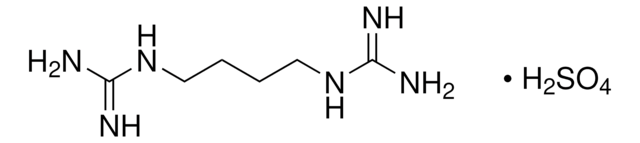
Arcaine sulfate salt
Sinónimos:
1,4-Diguanidinobutane sulfate salt
Seleccione un Tamaño
| Tamaño de envase | SKU | Disponibilidad | Precio |
|---|---|---|---|
| 50 mg | Póngase en contacto con nuestro Servicio de Atención al Cliente para disponibilidad | 108,00 € |
Acerca de este artículo
108,00 €
biological source
synthetic (organic)
Quality Level
assay
≥98% (TLC)
form
powder
mp
>280 °C
solubility
1 M NaOH: 50 mg/mL, clear to slightly hazy, colorless to faintly yellow
SMILES string
OS(O)(=O)=O.NC(=N)NCCCCNC(N)=N
InChI
1S/C6H16N6.H2O4S/c7-5(8)11-3-1-2-4-12-6(9)10;1-5(2,3)4/h1-4H2,(H4,7,8,11)(H4,9,10,12);(H2,1,2,3,4)
InChI key
RWTGFMPOODRXIM-UHFFFAOYSA-N
Gene Information
human ... GRIN1(2902), GRIN2A(2903), GRIN2B(2904), GRIN2C(2905), GRIN2D(2906), GRINA(2907)
Application
- to evaluate its effects on the acquisition of electrical kindling of the amygdala[1]
- to compare its effects with agmatine and MK801 on NMDA- or glutamate-induced neuronal damage[2]
- to study its effects on cell-free translation of synthetic polynucleotide[3]
Biochem/physiol Actions
1 of 1
Este artículo | |||
|---|---|---|---|
| assay ≥98% (TLC) | assay ≥98% (TLC) | assay ≥97% | assay ≥98% (TLC) |
| form powder | form powder | form powder | form powder |
| Quality Level 200 | Quality Level 200 | Quality Level 100 | Quality Level 200 |
| solubility 1 M NaOH: 50 mg/mL, clear to slightly hazy, colorless to faintly yellow | solubility water: 49.00-51.00 mg/mL, clear to very slightly hazy, colorless to faintly yellow | solubility H2O: 50 mg/mL, ethanol: insoluble | solubility acetic acid: 10 mg/mL, clear, colorless to faintly yellow |
| mp >280 °C | mp - | mp 234-238 °C (lit.) | mp 204 °C |
| biological source synthetic (organic) | biological source - | biological source - | biological source - |


Clase de almacenamiento
11 - Combustible Solids
wgk
WGK 3
flash_point_f
Not applicable
flash_point_c
Not applicable
ppe
Eyeshields, Gloves, type N95 (US)
Elija entre una de las versiones más recientes:
¿Ya tiene este producto?
Encuentre la documentación para los productos que ha comprado recientemente en la Biblioteca de documentos.
Número de artículo de comercio global
| SKU | GTIN |
|---|---|
| A0384-50MG | 04061832088501 |