



Products ending in 4, 5, or 6 are concentrates, while those ending in 7, 8, or 0 are ready to use or prediluted.
393A-1

Adipophilin Rabbit Polyclonal Antibody
Iniciar sesión para ver los precios por organización y contrato.
Seleccione un Tamaño
Cambiar Vistas
| A ustedes/SKU | Disponibilidad | Precio |
|---|
Acerca de este artículo
NACRES:
NA.41
UNSPSC Code:
12352203
Conjugate:
unconjugated
Clone:
polyclonal
Application:
IHC (p)
Citations:
4
En este momento no podemos mostrarle ni los precios ni la disponibilidad
Servicio técnico
¿Necesita ayuda? Nuestro equipo de científicos experimentados está aquí para ayudarle.
Permítanos ayudarlebiological source
rabbit
conjugate
unconjugated
antibody form
Ig fraction of antiserum
antibody product type
primary antibodies
clone
polyclonal
description
For In Vitro Diagnostic Use in Select Regions (See Chart)
form
buffered aqueous solution
species reactivity
human
packaging
vial of 0.1 mL concentrate (393A-14), vial of 0.5 mL concentrate (393A-15), bottle of 1.0 mL predilute (393A-17), vial of 1.0 mL concentrate (393A-16), bottle of 7.0 mL predilute (393A-18)
manufacturer/tradename
Cell Marque®
technique(s)
immunohistochemistry (formalin-fixed, paraffin-embedded sections): 1:25-1:100
control
sebaceous neoplasms (intracytoplasmic lipid droplet)
shipped in
wet ice
storage temp.
2-8°C
visualization
membranous
Gene Information
human ... PLIN2(123)
General description
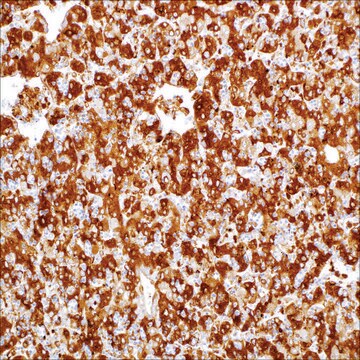
Sebaceous carcinoma is a relatively uncommon cutaneous malignancy and mimics other malignant neoplasms, such as basal and squamous cell carcinomas, and benign processes, such as chalazions and blepharitis, sometimes resulting in delayed diagnosis and suboptimal treatment.[1]Adipophilin is present in milk fat globule membranes and on the surface of lipid droplets in various normal cell types. Recently, it has been reported that adipophilin was expressed in 16 of 16 (100%) sebaceous adenomas with a specific pattern: membranous with strong uptake at the periphery of intracytoplasmic lipid vacuoles.[2]
Of 25 sebaceous carcinomas, 23 (92%) were also labeled with a similar pattern. Additionally, in cases of poorly differentiated sebaceous carcinoma (n=11), in which sebaceous differentiation could not have been reliably interpreted in H&E sections, adipophilin highlighted the sebocytes with a strong membranous labeling of intracytoplasmic lipid droplets in 9 of 11 cases (82%). Moreover, 10 of 10 (100%) xanthelasmas, 9 of 10 (90%) xanthogranulomas, 6 of 6 (100%) xanthomas, and 9 of 13 (63%) metastatic renal cell carcinomas were also weakly-to- moderately positive for adipophilin.[2] Expression of adipophilin with a membranous pattern of staining was not seen in any of the other clear cell lesions of the skin, including basal and squamous cell carcinomas, trichilemmomas, clear cell hidradenomas, or balloon cell nevi. Interestingly, a nonspecific granular uptake of anti-adipophilin was seen in adjacent macrophages, keratohyalin granules of epithelial squamous cells, and some tumor cells. Therefore, this anti-adipophilin is suitable for immunostaining formalin-fixed, paraffin-embedded tissue and is helpful in the identification of intracytoplasmic lipids, as seen in sebaceous lesions. It is especially helpful in identifying intracytoplasmic lipid vesicles in poorly differentiated sebaceous carcinomas in challenging cases such as small periocular biopsy specimens.
Of 25 sebaceous carcinomas, 23 (92%) were also labeled with a similar pattern. Additionally, in cases of poorly differentiated sebaceous carcinoma (n=11), in which sebaceous differentiation could not have been reliably interpreted in H&E sections, adipophilin highlighted the sebocytes with a strong membranous labeling of intracytoplasmic lipid droplets in 9 of 11 cases (82%). Moreover, 10 of 10 (100%) xanthelasmas, 9 of 10 (90%) xanthogranulomas, 6 of 6 (100%) xanthomas, and 9 of 13 (63%) metastatic renal cell carcinomas were also weakly-to- moderately positive for adipophilin.[2] Expression of adipophilin with a membranous pattern of staining was not seen in any of the other clear cell lesions of the skin, including basal and squamous cell carcinomas, trichilemmomas, clear cell hidradenomas, or balloon cell nevi. Interestingly, a nonspecific granular uptake of anti-adipophilin was seen in adjacent macrophages, keratohyalin granules of epithelial squamous cells, and some tumor cells. Therefore, this anti-adipophilin is suitable for immunostaining formalin-fixed, paraffin-embedded tissue and is helpful in the identification of intracytoplasmic lipids, as seen in sebaceous lesions. It is especially helpful in identifying intracytoplasmic lipid vesicles in poorly differentiated sebaceous carcinomas in challenging cases such as small periocular biopsy specimens.
Physical form
Solution in Tris Buffer, pH 7.3-7.7, with 1% BSA and <0.1% Sodium Azide
Preparation Note
Download the IFU specific to your product lot and formatNote: This requires a keycode which can be found on your packaging or product label.
Analysis Note
 IVD |  IVD |  IVD |  RUO |
Other Notes
Adipophilin Positive Control Slides, Product No. 393S, are available for immunohistochemistry (formalin-fixed, paraffin-embedded sections).
For Technical Service please contact: 800-665-7284 or email: [email protected]
Legal Information
Cell Marque is a registered trademark of Merck KGaA, Darmstadt, Germany
1 of 1
Este artículo | |||
|---|---|---|---|
| conjugate unconjugated | conjugate unconjugated | conjugate unconjugated | conjugate unconjugated |
| clone polyclonal | clone polyclonal | clone polyclonal | clone polyclonal |
| species reactivity human | species reactivity human | species reactivity human | species reactivity human |
| antibody form Ig fraction of antiserum | antibody form Ig fraction of antiserum | antibody form Ig fraction of antiserum | antibody form Ig fraction of antiserum |
| biological source rabbit | biological source rabbit | biological source rabbit | biological source rabbit |
| form buffered aqueous solution | form buffered aqueous solution | form buffered aqueous solution | form buffered aqueous solution |
Still not finding the right product?
Pruebe nuestra Herramienta de selección de productos para limitar sus opciones
Elija entre una de las versiones más recientes:
¿Ya tiene este producto?
Encuentre la documentación para los productos que ha comprado recientemente en la Biblioteca de documentos.
-
How can a concentrate product be distinguished from a predilute?
1 respuesta-
¿Le ha resultado útil?
-