
34019

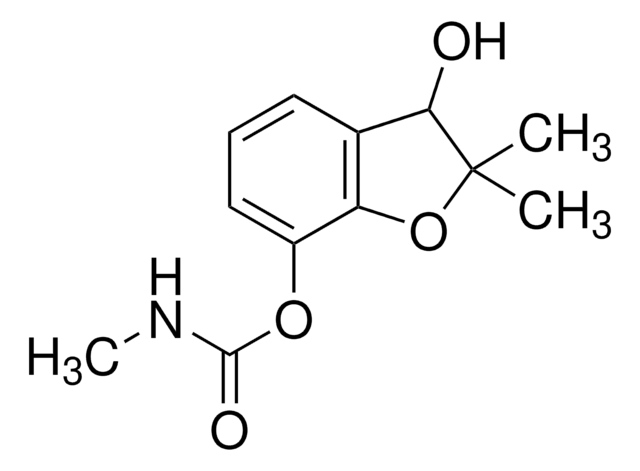
Carbofuran-d3
PESTANAL®, analytical standard
Sinónimos:
2,3-Dihydro-2,2-dimethyl-7-benzofuranol N-methylcarbamate-d3
Seleccione un Tamaño
| Tamaño de envase | SKU | Disponibilidad | Precio |
|---|---|---|---|
| 10 mg | Póngase en contacto con nuestro Servicio de Atención al Cliente para disponibilidad | 447,00 € |
Acerca de este artículo
447,00 €
grade
analytical standard
Quality Segment
product line
PESTANAL®
shelf life
limited shelf life, expiry date on the label
technique(s)
HPLC: suitable, gas chromatography (GC): suitable
application(s)
agriculture
environmental
format
neat
mass shift
M+3
SMILES string
[2H]C([2H])([2H])NC(=O)Oc1cccc2CC(C)(C)Oc12
InChI
1S/C12H15NO3/c1-12(2)7-8-5-4-6-9(10(8)16-12)15-11(14)13-3/h4-6H,7H2,1-3H3,(H,13,14)/i3D3
InChI key
DUEPRVBVGDRKAG-HPRDVNIFSA-N
General description
Application
- Natural water samples using solid phase extraction (SPE) and polar organic chemical integrative samplers (POCIS) combined with liquid chromatography coupled to tandem mass spectrometry.
- Surface waters samples using high-performance liquid chromatography with electrospray ionization-tandem mass spectrometry.
Legal Information
1 of 1
Este artículo | |||
|---|---|---|---|
| format neat | format neat | format neat | format neat |
| technique(s) HPLC: suitable, gas chromatography (GC): suitable | technique(s) - | technique(s) HPLC: suitable, NMR: suitable, gas chromatography (GC): suitable | technique(s) HPLC: suitable, gas chromatography (GC): suitable |
| grade analytical standard | grade analytical standard | grade analytical standard | grade analytical standard |
| product line PESTANAL® | product line PESTANAL® | product line PESTANAL® | product line PESTANAL® |
| Quality Level 100 | Quality Level 100 | Quality Level 100 | Quality Level 100 |
| application(s) agriculture | application(s) - | application(s) agriculture | application(s) agriculture |




signalword
Danger
hcodes
Hazard Classifications
Acute Tox. 1 Oral - Acute Tox. 2 Inhalation - Acute Tox. 3 Dermal - Aquatic Acute 1 - Aquatic Chronic 1
Clase de almacenamiento
6.1A - Combustible acute toxic Cat. 1 and 2 / very toxic hazardous materials
wgk
WGK 3
flash_point_f
Not applicable
flash_point_c
Not applicable
ppe
Eyeshields, Faceshields, Gloves, type P3 (EN 143) respirator cartridges
Elija entre una de las versiones más recientes:
¿Ya tiene este producto?
Encuentre la documentación para los productos que ha comprado recientemente en la Biblioteca de documentos.
Número de artículo de comercio global
| SKU | GTIN |
|---|---|
| 34019-10MG-R | 04061826752951 |