Saltar al contenido
Merck

Saltar a

MABS2155

Anti-Fibrin Antibody

clone 59D8

Sinónimos:

Fibrinogen beta chain

Iniciar sesión para ver los precios por organización y contrato.

Seleccione un Tamaño

Cambiar Vistas
A ustedes/SKUDisponibilidadPrecio
25 μg
Póngase en contacto con nuestro Servicio de Atención al Cliente para disponibilidad
148,00 €
100 μg

Envío estimado HOYdesdeMerck Chemicals and LS SA

377,00 €

Acerca de este artículo

UNSPSC Code:
12352203
NACRES:
NA.41
eCl@ss:
32160702
Clone:
monoclonal
Species reactivity:
mouse, human
Application:
IF, IHC, RIA, WB, inhibition assay
Citations:
-

148,00 €


Póngase en contacto con nuestro Servicio de Atención al Cliente para disponibilidad

Solicite una orden a granel
Servicio técnico
¿Necesita ayuda? Nuestro equipo de científicos experimentados está aquí para ayudarle.
Permítanos ayudarle


biological source

mouse

clone

monoclonal

species reactivity

mouse, human

technique(s)

immunofluorescence: suitable, immunohistochemistry: suitable, inhibition assay: suitable (peptide), radioimmunoassay: suitable, western blot: suitable

General description

Fibrinogen beta chain (UniProt: P02675) is encoded by the FGB gene (Gene ID: 2244) in human. Fibrinogen beta chain is synthesized with a signal peptide (aa 1-30), which is subsequently cleaved off to product the mature protein that is further cleaved by thrombin to produce fibrinopeptide B (aa 31-44) and fibrinogen beta chain (45-491). Conversion of fibrinogen to fibrin is triggered by thrombin, which cleaves fibrinopeptides A and B from alpha and beta chains, and thus exposes the N-terminal polymerization sites responsible for the formation of the soft clot. The soft clot is converted into the hard clot by factor XIIIA which catalyzes the epsilon-(gamma-glutamyl)lysine cross-linking between gamma chains (stronger) and between alpha chains (weaker) of different monomers. Fibrin monomers spontaneously aggregate into an insoluble gel, which is then covalently stabilized by Factor XIIIa. Fibrin is shown to retain about 98% of the original covalent structure of fibrinogen. Fibrin clot can be broken down by plasmin by cleave between residues 152-153 and 163-164. This monoclonal antibody (clone 59D8) binds to fibrin even in the presence of human fibrinogen at the concentration found in plasma. (Ref.: Hui, KY., et al. (1983). Science. 222 (4628); 1129-1132).

Immunogen

KLH-conjugated synthetic heptapeptide (GHRPLDK) derived from the N-terminal region of the beta chain of human fibrinogen.

Application

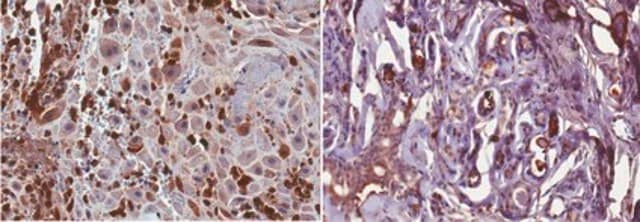
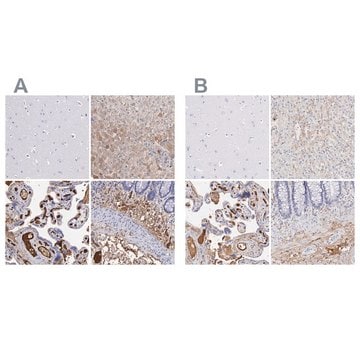
Anti-Fibrin, clone 59D8, Cat. No. MABS2155, is a mouse monoclonal antibody that detects fibrin and has been tested for use in Immunofluorescence, Immunohistochemistry, Peptide Inhibition Assay, Radioimmunoassay, and Western Blotting.
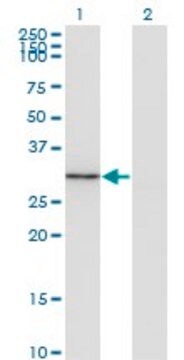
Western Blotting Analysis: 1 ug/mL from a representative lot detected Fibrin in human liver tissue lysates.

Immunofluorescence Analysis: A representative lot detected Fibrin in Immunofluorescence applicaitons (Thalji, N.K., et. al. (2016). Nat Me

Analysis Note

Evaluated by Western Blotting in mouse liver tissue lysate.

Western Blotting Analysis: 1 ug/mL of this antibody detected Fibrin in mouse liver tissue lysates.

Other Notes

Unless otherwise stated in our catalog or other company documentation accompanying the product(s), our products are intended for research use only and are not to be used for any other purpose, which includes but is not limited to, unauthorized commercial

Comparar elementos similares

Ver comparación completa

Mostrar Diferencias

1 of 1

Este artículo
MABS1217HPA001900WH0002267M1
species reactivity

mouse, human

species reactivity

human

species reactivity

human

species reactivity

human

biological source

mouse

biological source

mouse

biological source

rabbit

biological source

mouse

clone

monoclonal

clone

3D12.1, monoclonal

clone

polyclonal

clone

2A4, monoclonal

technique(s)

immunofluorescence: suitable, inhibition assay: suitable (peptide), western blot: suitable, immunohistochemistry: suitable, radioimmunoassay: suitable

technique(s)

immunohistochemistry: suitable, western blot: suitable

technique(s)

immunoblotting: 0.04-0.4 μg/mL, immunofluorescence: 0.25-2 μg/mL, immunohistochemistry: 1:2500-1:5000

technique(s)

immunoprecipitation (IP): suitable, indirect ELISA: suitable, western blot: 1-5 μg/mL


Certificados de análisis (COA)

Busque Certificados de análisis (COA) introduciendo el número de lote del producto. Los números de lote se encuentran en la etiqueta del producto después de las palabras «Lot» o «Batch»

¿Ya tiene este producto?

Encuentre la documentación para los productos que ha comprado recientemente en la Biblioteca de documentos.

Visite la Librería de documentos


Preguntas

Revisiones

Sin puntuación

Filtros activos