
MABE645

Anti-acetyl-Histone H3 (Lys9) Antibody, clone RM161
clone RM161, from rabbit
Sinónimos:
Histone H3.3, Histone H3
Seleccione un Tamaño
| Tamaño de envase | SKU | Disponibilidad | Precio |
|---|---|---|---|
| 100 μg | Póngase en contacto con nuestro Servicio de Atención al Cliente para disponibilidad | 426,00 € |
Acerca de este artículo
426,00 €
biological source
rabbit
Quality Level
antibody form
purified antibody
antibody product type
primary antibodies
clone
RM161, monoclonal
species reactivity
human
technique(s)
multiplexing: suitable, western blot: suitable
isotype
IgG
UniProt accession no.
shipped in
wet ice
target post-translational modification
acetylation (Lys9)
Gene Information
human ... H3F3B(3021)
General description
Immunogen
Application
Biochem/physiol Actions
Physical form
Analysis Note
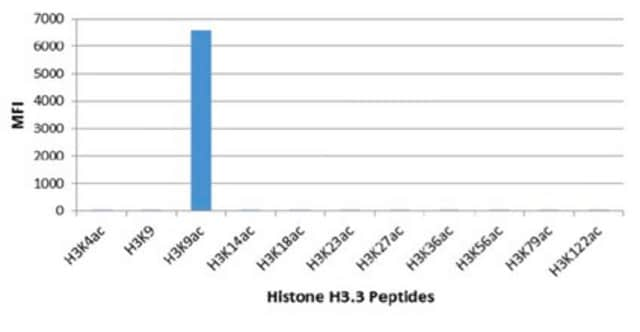
Western Blotting Analysis (WB): 0.25 μg/mL of this antibody detected acetyl-Histone H3 (Lys9) in sodium butyrate treated HeLa acid extract.
Other Notes
1 of 1
Este artículo | |||
|---|---|---|---|
| Gene Information human ... H3F3B(3021) | Gene Information human ... H3F3B(3021) | Gene Information human ... H3F3B(3021) | Gene Information human ... H3F3B(3021) |
| clone RM161, monoclonal | clone RM172, monoclonal | clone RM140, monoclonal | clone RM147, monoclonal |
| antibody form purified antibody | antibody form purified antibody | antibody form - | antibody form purified antibody |
| species reactivity human | species reactivity human | species reactivity human | species reactivity human |
| biological source rabbit | biological source rabbit | biological source rabbit | biological source rabbit |
| Quality Level 100 | Quality Level 100 | Quality Level 100 | Quality Level 100 |


Still not finding the right product?
Pruebe nuestra Herramienta de selección de productos para limitar sus opciones
Clase de almacenamiento
12 - Non Combustible Liquids
wgk
WGK 2
flash_point_f
does not flash
flash_point_c
does not flash
Certificados de análisis (COA)
Busque Certificados de análisis (COA) introduciendo el número de lote del producto. Los números de lote se encuentran en la etiqueta del producto después de las palabras «Lot» o «Batch»
¿Ya tiene este producto?
Encuentre la documentación para los productos que ha comprado recientemente en la Biblioteca de documentos.
Contenido relacionado
A major focus of breast cancer research is to understand the mechanisms responsible for disease progression and drug resistance. Toward that end, it has been found that approximately two thirds of all human breast carcinomas overexpress the Estrogen Receptor α (ERα) protein and it remains the primary pharmacological target for endocrine therapy1,2. The normal cellular function of ERα is as a transcription factor that mediates a wide variety of physiological processes, many of which are dependent upon phosphorylation of the receptor at specific amino acid residues3,4. Indeed, ERα is known to be phosphorylated at a multitude of different sites, yet how these all correlate to disease remains unclear5. Here, we interrogated multiple sites of ERα for phosphorylation status by screening an extensive panel of different breast cancer patient samples and other non-breast cancer tissue microarray (TMA) slide samples to determine their relevance to disease.
Número de artículo de comercio global
| SKU | GTIN |
|---|---|
| MABE645 | 04055977181463 |