Saltar al contenido
Merck

Saltar a

ABS2250

Anti-phospho ULK1(Ser746)

Iniciar sesión para ver los precios por organización y contrato.

Seleccione un Tamaño

Cambiar Vistas
Tamaño de envaseSKUDisponibilidadPrecio

Acerca de este artículo

NACRES:
NA.41
UNSPSC Code:
12352203
Conjugate:
unconjugated
Clone:
polyclonal
Application:
IF, IP, WB
Citations:
-
En este momento no podemos mostrarle ni los precios ni la disponibilidad
Servicio técnico
¿Necesita ayuda? Nuestro equipo de científicos experimentados está aquí para ayudarle.
Permítanos ayudarle


biological source

rabbit

Quality Level

conjugate

unconjugated

antibody form

purified antibody

antibody product type

primary antibodies

clone

polyclonal

mol wt

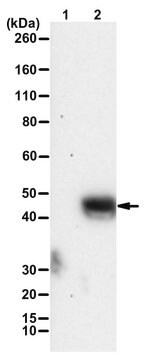
calculated mol wt 112.46 kDa, observed mol wt ~42 kDa

purified by

affinity chromatography

species reactivity

mouse

packaging

antibody small pack of 100 μg

technique(s)

immunofluorescence: suitable, immunoprecipitation (IP): suitable, western blot: suitable

isotype

IgG

epitope sequence

C-terminal half

Protein ID accession no.

UniProt accession no.

shipped in

2-8°C

target post-translational modification

phosphorylation (pSer746)

General description

Serine/threonine-protein kinase ULK1 (UniProt: O70405; also known as EC:2.7.11.1, Serine/threonine-protein kinase Unc51.1, Unc-51-like kinase 1) is encoded by the Ulk1 gene (Gene ID: 22241) in murine species. ULK-1 is a cytosolic serine/threonine protein kinase that is localized in cytosol and preautophagosomal structures. Under condition of starvation, it is localized to punctate structures primarily representing the isolation membrane that sequesters a portion of the cytoplasm resulting in the formation of an autophagosome. Its protein kinase domain is localized to amino acids 16-278. It is involved in autophagy in response to starvation and acts upstream of PI3-kinase (PIK3C3) to regulate the formation of autophagophores, the precursors of autophagosomes. It acts both as a downstream effector and a negative regulator of mTORC1 via interaction with Raptor. ULK1 contains multiple phosphorylation sites, and their phosphorylation status is reported to regulate canonical autophagy. Under unstimulated conditions, it is phosphorylated at serine 637 and 757 by mTOR complex that leads to its inactivation. ULK1 is activated via phosphorylation by AMPK and also acts as a negative regulator of AMPK through phosphorylation of the AMPK subunits PRKAA1, PRKAB2 and PRKAG1. Despite its similarity with ULK2 in its enzymatic domain, there are major differences in their autophagy-related interactors and their post-translational and transcriptional regulators. ULK1 undergoes phosphorylation at serine 746 by receptor interacting protein kinase 3 (RIPK3) during genotoxic stress-induced alternative autophagy and this phosphorylated form is shown to localize exclusively on the Golgi and is essential for alternative autophagy, but not canonical autophagy. (Ref.: Torii, S., et al. (2020). Nat. Commun. 11: 1754).

Immunogen

KLH-conjugated linear peptide corresponding to 16 amino acids surrounding phosphoserine 746 of mouse ULK-1.

Application

Quality Control Testing

Evaluated by Western blotting with constructs of ULK-1 phosphorylated on Serine 746.

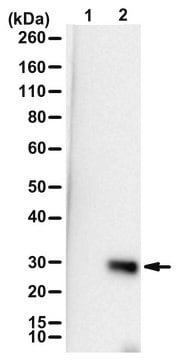
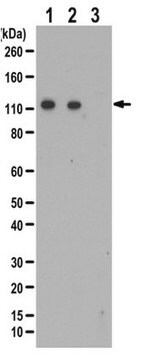
Western Blotting Analysis (WB): A 1:1,000 dilution of this antibody detected MBP-tagged ULK1 construct phosphorylated on serine 746, but not in non-phosphorylated construct.

Tested Applications

Western Blotting Analysis: A 1:1,000 dilution from a representative lot detected ULK1 phosphorylated on serine 746.

Immunoprecipitation Analysis: A representative lot immunoprecipitated phospho ULK1(Ser746) in Immunoprecipitation applications (Satoru Torii, et al. (2020). Nat. Commun. 11(1):1754).

Immunofluorescence Analysis: A representative lot detected phospho ULK1(Ser746) in Immunofluorescence applications (Satoru Torii, et al. (2020). Nat. Commun. 11(1):1754).

Note: Actual optimal working dilutions must be determined by end user as specimens, and experimental conditions may vary with the end user
Anti-phospho ULK1(Ser746), Cat. No. ABS2250, is a rabbit polyclonal antibody that detects ULK1 phosphorylated on serine 746 and is tested for use in Immunofluorescence, Immunoprecipitation, and Western Blotting.

Biochem/physiol Actions

This rabbit polyclonal antibody detects ULK-1 phosphorylated on serine 746.

Physical form

Purified rabbit polyclonal antibody in buffer containing PBS with 0.09% sodium azide

Preparation Note

Recommend storage at +2°C to +8°C. For long term storage antibodies can be kept at -20°C. Avoid repeated freeze-thaws.

Other Notes

Concentration: Please refer to the Certificate of Analysis for the lot-specific concentration.

Disclaimer

Unless otherwise stated in our catalog or other company documentation accompanying the product(s), our products are intended for research use only and are not to be used for any other purpose, which includes but is not limited to, unauthorized commercial uses, in vitro diagnostic uses, ex vivo or in vivo therapeutic uses or any type of consumption or application to humans or animals.

Comparar elementos similares

Ver comparación completa

Mostrar Diferencias

1 of 1

Este artículo
ABS2206ABC213SAB5701940
biological source

rabbit

biological source

rabbit

biological source

rabbit

biological source

rabbit

conjugate

unconjugated

conjugate

unconjugated

conjugate

-

conjugate

-

Quality Level

200

Quality Level

200

Quality Level

100

Quality Level

100

antibody form

purified antibody

antibody form

purified antibody

antibody form

affinity isolated antibody

antibody form

-

clone

polyclonal

clone

polyclonal

clone

polyclonal

clone

polyclonal

species reactivity

mouse

species reactivity

human

species reactivity

human

species reactivity

mouse, human


Still not finding the right product?

Pruebe nuestra Herramienta de selección de productos para limitar sus opciones


Clase de almacenamiento

12 - Non Combustible Liquids

wgk

WGK 2

flash_point_f

Not applicable

flash_point_c

Not applicable


Certificados de análisis (COA)

Busque Certificados de análisis (COA) introduciendo el número de lote del producto. Los números de lote se encuentran en la etiqueta del producto después de las palabras «Lot» o «Batch»

¿Ya tiene este producto?

Encuentre la documentación para los productos que ha comprado recientemente en la Biblioteca de documentos.

Visite la Librería de documentos


Número de artículo de comercio global

SKUGTIN
ABS2250-100UG04065267027623
ABS2250-25UG04065267027630

Preguntas

Revisiones

Sin puntuación

Filtros activos