Saltar al contenido
Merck

Saltar a

ABC451

Anti-Dihydropyrimidine dehydrogenase/DPYD Antibody

from rabbit, purified by affinity chromatography

Sinónimos:

Dihydropyrimidine dehydrogenase [NADP(+)], DHPDHase, DPD, Dihydrothymine dehydrogenase, Dihydrouracil dehydrogenase, DPYD

Iniciar sesión para ver los precios por organización y contrato.

Seleccione un Tamaño

Cambiar Vistas
Tamaño de envaseSKUDisponibilidadPrecio

Acerca de este artículo

UNSPSC Code:
12352203
NACRES:
NA.41
eCl@ss:
32160702
Conjugate:
unconjugated
Clone:
polyclonal
Application:
IHC, WB
Citations:
2
En este momento no podemos mostrarle ni los precios ni la disponibilidad
Servicio técnico
¿Necesita ayuda? Nuestro equipo de científicos experimentados está aquí para ayudarle.
Permítanos ayudarle

biological source

rabbit

Quality Level

conjugate

unconjugated

antibody form

affinity isolated antibody

antibody product type

primary antibodies

clone

polyclonal

purified by

affinity chromatography

species reactivity

human

species reactivity (predicted by homology)

bovine (based on 100% sequence homology), primate (based on 100% sequence homology), horse (based on 100% sequence homology), porcine (based on 100% sequence homology)

technique(s)

immunohistochemistry: suitable, western blot: suitable

Comparar elementos similares

Ver comparación completa

Mostrar Diferencias

1 of 1

Este artículo
ST1672ABC138MABS1145
conjugate

unconjugated

conjugate

-

conjugate

unconjugated

conjugate

unconjugated

biological source

rabbit

biological source

mouse

biological source

rabbit

biological source

mouse

antibody form

affinity isolated antibody

antibody form

purified antibody

antibody form

affinity isolated antibody

antibody form

purified immunoglobulin

Quality Level

100

Quality Level

100

Quality Level

100

Quality Level

100

UniProt accession no.

Q12882

UniProt accession no.

-

UniProt accession no.

Q02127

UniProt accession no.

O43175

shipped in

wet ice

shipped in

wet ice

shipped in

wet ice

shipped in

dry ice

General description

DPYD is an important enzyme involved in pyrimidine base degradation and catabolism. DPYD catalyzes the reduction of uracil and thymine and also is a critical enzyme in the degradation of the chemotherapeutic drug 5-fluoruracil. DPYD is expressed in most cells and has highest activity in the liver and monocytes. Mutations in DPYD give rise to a range of symptoms and syndromes in patients ranging from no symptoms to highly convulsive and mental retardation caused by excessive amounts of uracil or thymine present in the blood. Because of its ability to degrade 5-fluorouracil, DPYD is studied as a cancer marker and a measure of therapeutic effects in many cancers. Recent research also shows that DPYD levels in the liver are regulated via microRNA interactions and an offer a new opportunity for modulation of this critical enzyme in health and disease.
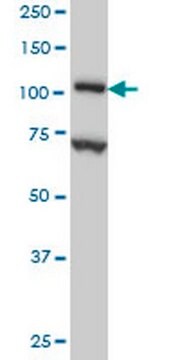
~110 kDa observed. Uncharacterized band at ~47 kDa may be observed in some lysates.

Immunogen

Epitope: Near N-terminus
KLH-conjugated linear peptide corresponding to human Dihydropyrimidine dehydrogenase/DPYD near the N-terminus.

Application

Research Category
Apoptosis & Cancer
Research Sub Category
Apoptosis - Additional
This Anti-Dihydropyrimidine dehydrogenase/DPYD Antibody is validated for use in Western Blotting and Immunohistochemistry for the detection of Dihydropyrimidine dehydrogenase/DPYD.
Western Blotting Analysis: 2.0 µg/mL from a representative lot detected Dihydropyrimidine dehydrogenase/DPYD in 10 µg of human liver tissue lysate.
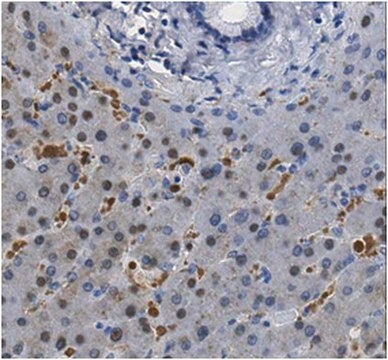
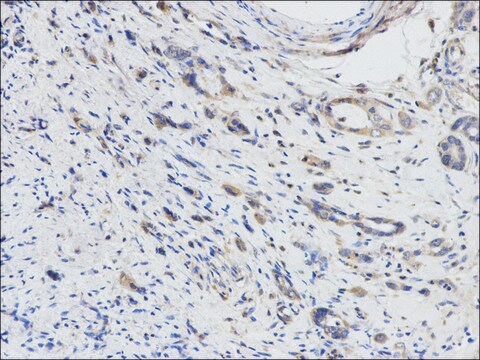
Immunohistochemistry Analysis: A 1:50 dilution from a representative lot detected Dihydropyrimidine dehydrogenase/DPYD in human liver tissue.

Physical form

Affinity purified
Purified rabbit polyclonal in buffer containing 0.1 M Tris-Glycine (pH 7.4), 150 mM NaCl with 0.05% sodium azide.

Preparation Note

Stable for 1 year at 2-8°C from date of receipt.

Analysis Note

Evaluated by Western Blotting in human small intestine tissue lysate.

Western Blotting Analysis: 2.0 µg/mL of this antibody detected Dihydropyrimidine dehydrogenase/DPYD in 10 µg of human small intestine tissue lysate.

Other Notes

Concentration: Please refer to lot specific datasheet.

Disclaimer

Unless otherwise stated in our catalog or other company documentation accompanying the product(s), our products are intended for research use only and are not to be used for any other purpose, which includes but is not limited to, unauthorized commercial uses, in vitro diagnostic uses, ex vivo or in vivo therapeutic uses or any type of consumption or application to humans or animals.

¿No encuentra el producto adecuado?  

Pruebe nuestro Herramienta de selección de productos.

Clase de almacenamiento

12 - Non Combustible Liquids

wgk

WGK 1

flash_point_f

Not applicable

flash_point_c

Not applicable


Certificados de análisis (COA)

Busque Certificados de análisis (COA) introduciendo el número de lote del producto. Los números de lote se encuentran en la etiqueta del producto después de las palabras «Lot» o «Batch»

¿Ya tiene este producto?

Encuentre la documentación para los productos que ha comprado recientemente en la Biblioteca de documentos.

Visite la Librería de documentos

Masaaki Murakawa et al.
Oncology letters, 14(2), 1505-1511 (2017-08-10)
The predictive roles of dihydropyrimidine dehydrogenase (DPD) in patients who undergo curative resection and adjuvant chemotherapy with S-1, which is the oral 5-fluorouracil prodrug tegafur combined with oteracil and gimeracil, remain unclear. In the present study, the clinical data from
Eiji Hishinuma et al.
Frontiers in pharmacology, 13, 930470-930470 (2022-07-06)
Dihydropyrimidine dehydrogenase (DPD), encoded by the DPYD gene, is the rate-limiting enzyme in 5-fluorouracil (5-FU) degradation. In Caucasians, four DPYD risk variants are recognized to be responsible for interindividual variations in the development of 5-FU toxicity. However, these risk variants

Número de artículo de comercio global

SKUGTIN
ABC45104055977109191

Preguntas

Revisiones

Sin puntuación

Filtros activos

Nuestro equipo de científicos tiene experiencia en todas las áreas de investigación: Ciencias de la vida, Ciencia de los materiales, Síntesis química, Cromatografía, Analítica y muchas otras.

Póngase en contacto con el Servicio técnico