
17-601

ChIPAb+ Sp1 - ChIP Validated Antibody and Primer Set
from rabbit
Sinónimos:
Transcription factor Sp1, TSFP1
Seleccione un Tamaño
| Tamaño de envase | SKU | Disponibilidad | Precio |
|---|---|---|---|
| 25 assays | Póngase en contacto con nuestro Servicio de Atención al Cliente para disponibilidad | 558,00 € |
Acerca de este artículo
558,00 €
biological source
rabbit
Quality Level
clone
polyclonal
species reactivity
rat, human, mouse
manufacturer/tradename
ChIPAb+, Upstate®
technique(s)
ChIP: suitable, western blot: suitable
NCBI accession no.
UniProt accession no.
shipped in
dry ice
General description
The qPCR primers included flank the Sp1 binding site in human DHFR promoter.
Immunogen
Application
Epigenetics & Nuclear Function
Chromatin Biology
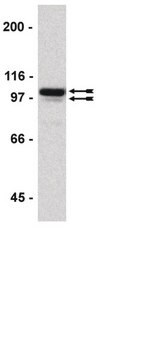
HeLa nuclear extract was resolved by electrophoresis, transferred to nitrocellulose and probed with anti-Sp1 (0.2 μg/mL). Proteins were visualized using a goat anti-rabbit secondary antibody conjugated to HRP and a chemiluminescence detection system (Please see figures).
Biochem/physiol Actions
Packaging
Physical form
Normal Rabbit IgG. One vial containing 125 μg of normal rabbit IgG in 125 μL. Store at -20°C.
ChIP primers DHFR. 1 vial containing 75 μL of 5 μM of each control primer specific for human dihydrofolate reductase (DHFR) promoter. Store at -20°C.
FOR: TCG CCT GCA CAA ATA GGG AC
REV: AGA ACG CGC GGT CAA GTT T
Preparation Note
Analysis Note
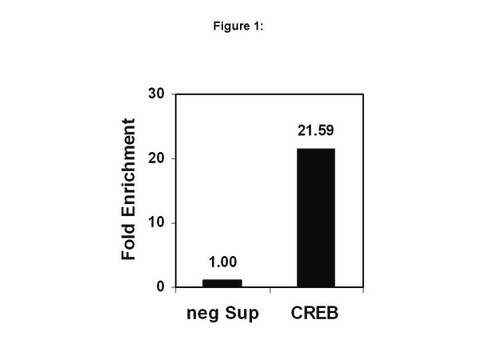
Sonicated chromatin prepared from 1 x 10⁶ HeLa cells was subjected to chromatin immunoprecipitation using 4 μg of either the negative control antibody, Rabbit Normal IgG or Rabbit Anti-Sp1 and the Magna ChIPTM A kit (Cat.# 17-610) Rapid Protocol (2 hour IP). Successful enrichment of Sp1 associated DNA fragments was verified by qPCR using ChIP Primers DHFR flanking the human DHFR promoter that contains a Sp1 binding site (Please see figures).
Please refer to the EZ-Magna ChIP A (Cat.# 17-408)
or EZ-ChIP (Cat.# 17-371) kit protocols for
experimental details.
Includes negative control rabbit IgG and control primers specific for human dihydrofolate reductase (DHFR) promoter.
Legal Information
Disclaimer
1 of 1
Este artículo | |||
|---|---|---|---|
| species reactivity rat, human, mouse | species reactivity mouse, rat, human | species reactivity rat, Saccharomyces cerevisiae, mouse, human | species reactivity human |
| clone polyclonal | clone NL904, monoclonal | clone monoclonal | clone monoclonal |
| biological source rabbit | biological source rabbit | biological source mouse | biological source mouse |
| shipped in dry ice | shipped in dry ice | shipped in dry ice | shipped in dry ice |
| technique(s) ChIP: suitable, western blot: suitable | technique(s) ChIP: suitable, western blot: suitable | technique(s) ChIP: suitable, immunofluorescence: suitable, immunoprecipitation (IP): suitable | technique(s) ChIP: suitable, immunocytochemistry: suitable, western blot: suitable |
| UniProt accession no. | UniProt accession no. | UniProt accession no. | UniProt accession no. |
Clase de almacenamiento
10 - Combustible liquids
wgk
WGK 2
Certificados de análisis (COA)
Busque Certificados de análisis (COA) introduciendo el número de lote del producto. Los números de lote se encuentran en la etiqueta del producto después de las palabras «Lot» o «Batch»
¿Ya tiene este producto?
Encuentre la documentación para los productos que ha comprado recientemente en la Biblioteca de documentos.
Contenido relacionado
Signaling Product Guide: Antibodies, small molecule inhibitors, kits, assays and proteins for signaling research.
"Epigenetics describes heritable changes in gene expression caused by non-genetic mechanisms instead of by alterations in DNA sequence. These changes can be cell- or tissue-specific, and can be passed on to multiple generations. Epigenetic regulation enriches DNAbased information, allowing a cell to vary its response across diverse biological and environmental contexts. Although epigenetic mechanisms are primarily centered in the nucleus, these mechanisms can be induced by environmental signals such as hormones, nutrients, stress, and cellular damage, pointing to the involvement of cytoplasmic and extracellular factors in epigenetic regulation."
Epigenetics describes heritable changes in gene expression caused by non-genetic mechanisms. Epigenetic regulation allows a cell to vary its response based on its biological and environmental contexts. Epigenetic changes can effect transcriptional and post-transcriptional regulation via mechanisms such as histone modification, chromatin and nucleosome remodeling, DNA methylation, and small and non-coding RNA-mediated regulation. These mechanisms, in cooperation with transcription factors and other nucleic acid-binding proteins, regulate gene expression. Epigenetic mechanisms of gene regulation impacts diverse areas of research—from agriculture to human health. Common epigenetic assays such as chromatin immunoprecipitation (ChIP) and RNA immunoprecipitation (RIP) rely on high quality antibodies that recognize specific epigenetic modifications for accurate results. EMD Millipore offers over 100 ChIPAb+™ and RIPAb+™ validated antibody kits that are quality tested on ChIP/RIP assays and are conveniently provided with control qPCR primers and negative control antibodies to ensure first time ChIP/RIP success.
Número de artículo de comercio global
| SKU | GTIN |
|---|---|
| 17-601 | 04053252733192 |