Saltar al contenido
Merck

Saltar a

06-702

Anti-phospho-Smad1 (Ser463/465) Antibody

Upstate®, from rabbit

Iniciar sesión para ver los precios por organización y contrato.

Acerca de este artículo

UNSPSC Code:
12352203
NACRES:
NA.41
eCl@ss:
32160702
Clone:
polyclonal
Species reactivity:
human, Xenopus, rat, mouse
Application:
WB
Citations:
29


biological source

rabbit

Quality Level

antibody form

purified immunoglobulin

antibody product type

primary antibodies

clone

polyclonal

species reactivity

human, Xenopus, rat, mouse

manufacturer/tradename

Upstate®

technique(s)

western blot: suitable

isotype

IgG

NCBI accession no.

UniProt accession no.

shipped in

dry ice

target post-translational modification

phosphorylation (pSer463/pSer465)

Gene Information

human ... SMAD1(4086)

General description

65 kDa
Smad proteins, the mammalian homologs of the Drosophila Mothers against dpp (Mad), function downstream of TGF-β receptor Serine/Threonine kinases and undergo serine phosphorylation in response to receptor activation. Following BMP (bone morphogenic protein) or TGF-β binding to the targeted surface receptors, Smad1 (also designated Madr1 or JV4-1) becomes phosphorylated at Ser 463 and Ser 465. Activated Smad1 associates with Smad4 and translocates to the nucleus, where the Smad1/Smad4 complex recruits DNA-binding proteins to activate specific gene transcription. BMP binding induces phosphorylation of Smad1, which enhances the binding of Smad1 to CBP to stimulate Smad1-dependent transcription. In addition, ALK1 and ALK2 specifically phosphorylate Smad1 on residues located in the MH2 domain and induces Smad1-dependent pathways.

Immunogen

peptide corresponding to (CGGSPHNPISpSVpSGG) corresponding to amino acids 455-465 of human Smad1 protein

Application

Detect phospho-Smad1 (Ser463/465) with Anti-phospho-Smad1 (Ser463/465) Antibody (Rabbit Polyclonal Antibody), that has been shown to work in WB.

Biochem/physiol Actions

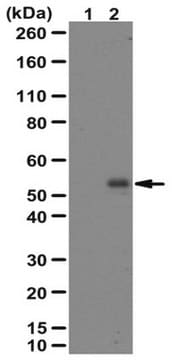
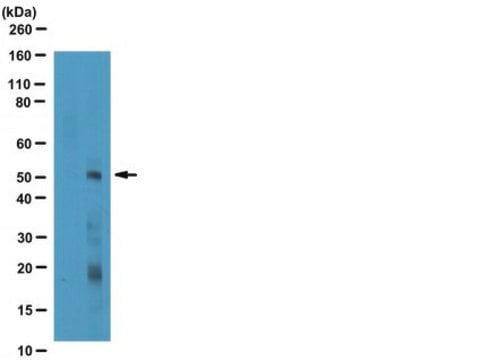
Recognizes the dual serine phosphorylated Smad1 (Ser463/465).

Physical form

Format: Purified

Analysis Note

Control
BMP-4-treated HeLa or NIH/3T3 cells
routinely evaluated by immunoblot on RIPA lysates from P19 (mouse embryonal carcinoma) cells treated with BMP4

Other Notes

Concentration: Please refer to the Certificate of Analysis for the lot-specific concentration.

Legal Information

UPSTATE is a registered trademark of Merck KGaA, Darmstadt, Germany

Comparar elementos similares

Ver comparación completa

Mostrar Diferencias

1 of 1

Este artículo
AB3849-I07-138904-953
clone

polyclonal

clone

polyclonal

clone

polyclonal

clone

A5S, monoclonal

biological source

rabbit

biological source

rabbit

biological source

rabbit

biological source

rabbit

antibody form

purified immunoglobulin

antibody form

affinity isolated antibody

antibody form

unpurified

antibody form

culture supernatant

species reactivity

human, Xenopus, rat, mouse

species reactivity

human

species reactivity

mouse, mink

species reactivity

human, zebrafish, mouse, canine

technique(s)

western blot: suitable

technique(s)

western blot: suitable

technique(s)

western blot: suitable

technique(s)

western blot: suitable

shipped in

dry ice

shipped in

wet ice

shipped in

wet ice

shipped in

dry ice


Still not finding the right product?

Pruebe nuestra Herramienta de selección de productos para limitar sus opciones


Clase de almacenamiento

10 - Combustible liquids

wgk

WGK 1


Certificados de análisis (COA)

Busque Certificados de análisis (COA) introduciendo el número de lote del producto. Los números de lote se encuentran en la etiqueta del producto después de las palabras «Lot» o «Batch»

¿Ya tiene este producto?

Encuentre la documentación para los productos que ha comprado recientemente en la Biblioteca de documentos.

Visite la Librería de documentos


Mallappa Anitha et al.
American journal of physiology. Gastrointestinal and liver physiology, 298(3), G375-G383 (2009-12-17)
The bone morphogenetic protein (BMP) family is a class of transforming growth factor (TGF-beta) superfamily molecules that have been implicated in neuronal differentiation. We studied the effects of BMP2 and glial cell line-derived neurotrophic factor (GDNF) on inducing differentiation of
Signal transduction. Mad about SMADs.
J Wrana et al.
Nature, 388(6637), 28-29 (1997-07-03)
BMP signaling dynamics in embryonic orofacial tissue.
Partha Mukhopadhyay,Cynthia L Webb,Dennis R Warner,Robert M Greene,M Michele Pisano
Journal of Cellular Physiology null


Preguntas

Revisiones

Sin puntuación

Filtros activos