Saltar al contenido
Merck

Saltar a

05-443

Anti-VEGF Antibody, clone JH

clone JH, Upstate®, from mouse

Sinónimos:

Vascular permeability factor, vascular endothelial growth factor, vascular endothelial growth factor A, vascular endothelial growth factor isoform VEGF165

Iniciar sesión para ver los precios por organización y contrato.

Acerca de este artículo

UNSPSC Code:
12352203
NACRES:
NA.41
eCl@ss:
32160702


biological source

mouse

Quality Level

antibody form

purified immunoglobulin

antibody product type

primary antibodies

clone

JH, monoclonal

species reactivity

rat, mouse, rabbit, human

manufacturer/tradename

Upstate®

technique(s)

immunohistochemistry: suitable (paraffin)

isotype

IgG1κ

suitability

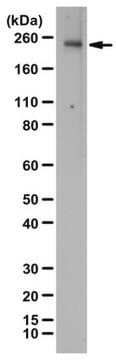
not suitable for Western blot

NCBI accession no.

UniProt accession no.

shipped in

dry ice

target post-translational modification

unmodified

Gene Information

human ... VEGFA(7422)

General description

34-54 kDa isoforms
The Flt gene family of receptor tyrosine kinases includes Flt-1, KDR/Flk-1, Flt-3, and Flt-4. They encode receptors for VEGF, characterized by seven Ig-loops within their extracellular domain and a split kinase domain within the cytoplasmic domain. VEGF is an important angiogenic factor of many solid tumors and is also involved in the differentiation of endothelial cells. Flt-1 (Fms-like tyrosine kinase, VEGF-R1) is expressed on endothelial cells and on the common precursors of endothelial and hematopoietic stem cells. KDR (Flk-1, VEGF-R2) is the principal receptor involved in VEGF signaling. KDR is expressed on endothelial cells and stimulates angiogenesis, but is also expressed on bone marrow cells, and is thought to play a role in driving the proliferation of most or all leukemic cells. Flt3 is a class III receptor tyrosine kinase that is closely related to c-Kit and c-Fms. It is expressed in primitive hematopoietic cells and its ligand exerts proliferative effects on these cells in co-operation with other cytokines. Flt3 is also expressed the placenta, testis, spleen, thymus, bone marrow, brain and in cerebellar Purkinje cells. The VEGF receptors stimulate the Ras-MAP kinase pathway, suggesting that it signals as a conventional receptor tyrosine kinase.

Immunogen

Recombinant human VEGF121. Clone JH121

Application

Immunohistochemistry: This lot of antibody detected VEGF in formalin fixed, paraffin embedded, human.tissues, using a 1:50 dilution incubated overnight at 4°C.

Immunoprecipitation: 2 µg of this antibody has been reported to immunoprecipitate VEGF from 1 mg of protein lysate.
Research Category
Signaling
Research Sub Category
Growth Factors & Receptors
This Anti-VEGF Antibody, clone JH is validated for use in IH(P) for the detection of VEGF.

Biochem/physiol Actions

Other species not tested.
Recognizes 34-54 kDa isoforms of Vascular Endothelial Growth Factor/Vascular Permeability Factor (VEGF/VPF).

Physical form

Format: Purified
Protein G Chromatography
Purified mouse monoclonal IgG1k in buffer containing 10 mM PBS, pH 7.4.

Preparation Note

Stable for 1 year at from date of receipt.

Analysis Note

Biological Blockade: Incubation of HUVEC cells with 5 µg/mL of a previous lot and 5 ng/mL of VEGF (Catalog # 01-185) has shown growth inhibition of 20-70%.
Control
Expressed in most tissue, including Pancreas, Kidney, Adenocarcinoma.

Other Notes

Concentration: Please refer to the Certificate of Analysis for the lot-specific concentration.

Legal Information

UPSTATE is a registered trademark of Merck KGaA, Darmstadt, Germany

Disclaimer

Unless otherwise stated in our catalog or other company documentation accompanying the product(s), our products are intended for research use only and are not to be used for any other purpose, which includes but is not limited to, unauthorized commercial uses, in vitro diagnostic uses, ex vivo or in vivo therapeutic uses or any type of consumption or application to humans or animals.

Comparar elementos similares

Ver comparación completa

Mostrar Diferencias

1 of 1

Este artículo
07-716-I07-72205-1116
shipped in

dry ice

shipped in

wet ice

shipped in

dry ice

shipped in

wet ice

manufacturer/tradename

Upstate®

manufacturer/tradename

-

manufacturer/tradename

Upstate®

manufacturer/tradename

-

biological source

mouse

biological source

rabbit

biological source

rabbit

biological source

mouse

NCBI accession no.

NM_003376

NCBI accession no.

-

NCBI accession no.

NM_002253.2

NCBI accession no.

NP_033531.3

Quality Level

400

Quality Level

100

Quality Level

100

Quality Level

100

target post-translational modification

unmodified

target post-translational modification

unmodified

target post-translational modification

phosphorylation (pTyr1054)

target post-translational modification

unmodified


Still not finding the right product?

Pruebe nuestra Herramienta de selección de productos para limitar sus opciones


Clase de almacenamiento

12 - Non Combustible Liquids

wgk

WGK 2

flash_point_f

Not applicable

flash_point_c

Not applicable


Certificados de análisis (COA)

Busque Certificados de análisis (COA) introduciendo el número de lote del producto. Los números de lote se encuentran en la etiqueta del producto después de las palabras «Lot» o «Batch»

¿Ya tiene este producto?

Encuentre la documentación para los productos que ha comprado recientemente en la Biblioteca de documentos.

Visite la Librería de documentos


C C Tassou et al.
Journal of food protection, 67(1), 193-198 (2004-01-14)
The effect of prestorage treatments, such as immersion in a sorbate solution (5%, wt/vol), heating (60 degrees C, 1 min), and a combination of the two treatments, and the subsequent storage in air or under modified atmosphere packaging (MAP; 40%
Ulrich Sure et al.
Neurosurgery, 55(3), 663-669 (2004-09-01)
In previous studies, we documented a marked neoangiogenesis and endothelial proliferation in cerebral arteriovenous malformations (AVMs) that were embolized before surgery compared with those that were not embolized. We hypothesized that embolization caused a local hypoxia that promotes neoangiogenesis as
Hypoxic induction of human vascular endothelial growth factor expression through c-Src activation.
Mukhopadhyay, D, et al.
Nature, 375, 577-581 (1995)


Preguntas

Revisiones

Sin puntuación

Filtros activos