Accéder au contenu
Merck

Passer à

MABE333

Anti-N-Myc Antibody, clone NCM II 100

clone NCM II 100, from mouse

Synonyme(s) :

N-myc proto-oncogene protein, Class E basic helix-loop-helix protein 37, bHLHe37

Se connecter pour consulter les tarifs organisationnels et contractuels.

Sélectionner une taille de conditionnement

Changer de vue
ConditionnementRéférenceDisponibilitéPrix
100 μg
Vérifier la disponibilité des articles du panier
443,00 €

A propos de cet article

UNSPSC Code:
12352203
NACRES:
NA.41
eCl@ss:
32160702
Conjugate:
unconjugated
Clone:
NCM II 100, monoclonal
Application:
ICC, IP, WB
Citations:
5

443,00 €


Vérifier la disponibilité des articles du panier

Service technique
Besoin d'aide ? Notre équipe de scientifiques expérimentés est là pour vous.
Laissez-nous vous aider


biological source

mouse

Quality Level

conjugate

unconjugated

antibody form

purified immunoglobulin

antibody product type

primary antibodies

clone

NCM II 100, monoclonal

species reactivity

human

technique(s)

immunocytochemistry: suitable, immunoprecipitation (IP): suitable, western blot: suitable

isotype

IgG1κ

NCBI accession no.

UniProt accession no.

shipped in

wet ice

target post-translational modification

unmodified

Gene Information

human ... MYCN(4613)

General description

The v-myc oncogene, initially identified in the MC29 avian retrovirus, causes myelocytomas, carcinomas, sarcomas and lymphomas, and belongs to a family of oncogenes conserved throughout evolution. In humans the family consists of five genes: c-myc, N-myc, R-myc, L-myc and B-myc. Amplification of the N-myc gene has been found in human neuroblastomas and cell lines. The extent of N-myc amplification correlates well with the stage of neuroblastoma disease. Immunological studies have shown that the human N-myc gene gives rise to at least two nuclear phosphoproteins that exhibit relatively short (30 min) half lives in vivo and exhibit DNA binding properties in vitro.
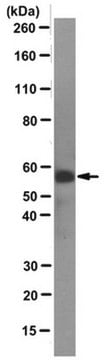
~55 kDa observed. Uniprot describes a molecular weight at ~50 kDa Uniprot states that this protein may be phosphorylated.

Immunogen

Recombinant protein corresponding to human N-Myc.

Application

Immunofluorescence Analysis: A representative lot from an independent laboratory detected N-Myc in IMR5 cells (Ikegaki, N., et al. (1986). 83(16):5929-5933.).

Immunoprecipitation Analysis: A representative lot from an independent laboratory immunoprecipitated N-Myc in IP (Brondyk, W. H., et al. (1991). 6(7):1269-1276.).
Research Category
Epigenetics & Nuclear Function
Research Sub Category
Transcription Factors
Use Anti-N-Myc Antibody, clone NCM II 100 (mouse monoclonal antibody) validated in WB, IP, ICC to detect N-Myc also known as N-myc proto-oncogene protein, Class E basic helix-loop-helix protein 37, bHLHe37.

Physical form

Format: Purified
Protein G Purified
Purified mouse monoclonal IgG1κ in buffer containing 0.1 M Tris-Glycine (pH 7.4), 150 mM NaCl with 0.05% sodium azide.

Preparation Note

Stable for 1 year at 2-8°C from date of receipt.

Analysis Note

Control
IMR-32 cell lysate
Evaluated by Western Blot in IMR-32 cell lysate.

Western Blot Analysis: 0.5 µg/mL of this antibody detected N-Myc in 10 µg of IMR-32 cell lysate.

Other Notes

Concentration: Please refer to the Certificate of Analysis for the lot-specific concentration.

Disclaimer

Unless otherwise stated in our catalog or other company documentation accompanying the product(s), our products are intended for research use only and are not to be used for any other purpose, which includes but is not limited to, unauthorized commercial uses, in vitro diagnostic uses, ex vivo or in vivo therapeutic uses or any type of consumption or application to humans or animals.

Comparer avec des articles similaires

Voir la comparaison complète

Montrer les différences

1 of 1

Cet article
SAB1409334SAB5700642MABE282
biological source

mouse

biological source

mouse

biological source

rabbit

biological source

mouse

species reactivity

human

species reactivity

human

species reactivity

mouse, human, rat

species reactivity

human

Gene Information

human ... MYCN(4613)

Gene Information

human ... MYCN(4613)

Gene Information

human ... MYCN(4613)

Gene Information

human ... MYC(4609)

antibody form

purified immunoglobulin

antibody form

purified immunoglobulin

antibody form

affinity isolated antibody

antibody form

purified immunoglobulin

clone

NCM II 100, monoclonal

clone

polyclonal

clone

polyclonal

clone

9E10, monoclonal

conjugate

unconjugated

conjugate

unconjugated

conjugate

unconjugated

conjugate

-


Still not finding the right product?

Essayez notre Outil de sélection de produits pour affiner vos choix.


Classe de stockage

12 - Non Combustible Liquids

wgk

WGK 1

flash_point_f

Not applicable

flash_point_c

Not applicable


Certificats d'analyse (COA)

Recherchez un Certificats d'analyse (COA) en saisissant le numéro de lot du produit. Les numéros de lot figurent sur l'étiquette du produit après les mots "Lot" ou "Batch".

Déjà en possession de ce produit ?

Retrouvez la documentation relative aux produits que vous avez récemment achetés dans la Bibliothèque de documents.

Consulter la Bibliothèque de documents


Contenu apparenté

New Products: Antibodies, Assays, Small Molecules, Inhibitors, and Proteins


Felix Schmitt-Hoffner et al.
Journal of clinical oncology : official journal of the American Society of Clinical Oncology, 39(29), 3217-3228 (2021-06-11)
Clinical outcomes of patients with neuroblastoma range from spontaneous tumor regression to fatality. Hence, understanding the mechanisms that cause tumor progression is crucial for the treatment of patients. In this study, we show that FOXR2 activation identifies a subset of
Annie Beaudry et al.
Scientific reports, 13(1), 16443-16443 (2023-10-01)
Neuroblastoma, the most common type of pediatric extracranial solid tumor, causes 10% of childhood cancer deaths. Despite intensive multimodal treatment, the outcomes of high-risk neuroblastoma remain poor. We urgently need to develop new therapies with safe long-term toxicity profiles for
Patrick Sin-Chan et al.
Cancer cell, 36(1), 51-67 (2019-07-10)
Embryonal tumors with multilayered rosettes (ETMRs) are highly lethal infant brain cancers with characteristic amplification of Chr19q13.41 miRNA cluster (C19MC) and enrichment of pluripotency factor LIN28A. Here we investigated C19MC oncogenic mechanisms and discovered a C19MC-LIN28A-MYCN circuit fueled by multiple


Numéro d'article de commerce international

RéférenceGTIN
MABE33304053252691577

Questions

Évaluations

Aucune valeur de notation

Filtres actifs