
ABE69

Anti-PTIP Antibody
from chicken, purified by affinity chromatography
Synonyme(s) :
PAX interacting (with transcription-activation domain) protein 1, PAX transactivation activation domain-interacting protein, protein encoded by CAG trinucleotide repeats, PAX transcription activation domain interacting protein 1 like
A propos de cet article
biological source
chicken
Quality Level
conjugate
unconjugated
antibody form
affinity isolated antibody
antibody product type
primary antibodies
clone
polyclonal
purified by
affinity chromatography
species reactivity
rat, mouse, human
technique(s)
immunofluorescence: suitable, immunohistochemistry: suitable, western blot: suitable
NCBI accession no.
UniProt accession no.
shipped in
wet ice
target post-translational modification
unmodified
Gene Information
human ... PAXIP1(22976)
General description
Other isoforms may be observed in some lysates.
Immunogen
Application
Immunofluorescence Analysis: A represenative lot was used by an independent laboratory in IF (Lechner, M., et al. (2000).
Epigenetics & Nuclear Function
Chromatin Biology
Physical form
Preparation Note
Analysis Note
A431 cell lysate
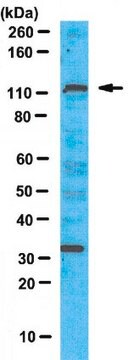
Western Blot Analysis: A 1:1,000 dilution of this antibody detected PTIP in 10 µg of A431 cell lysate.
Disclaimer
1 of 1
Cet article | |||
|---|---|---|---|
| Quality Level 100 | Quality Level - | Quality Level 100 | Quality Level 100 |
| biological source chicken | biological source rabbit | biological source rabbit | biological source rabbit |
| conjugate unconjugated | conjugate unconjugated | conjugate unconjugated | conjugate unconjugated |
| antibody form affinity isolated antibody | antibody form affinity isolated antibody | antibody form affinity isolated antibody | antibody form affinity isolated antibody |
| technique(s) immunofluorescence: suitable, western blot: suitable, immunohistochemistry: suitable | technique(s) western blot: suitable | technique(s) immunoblotting: 0.04-0.4 μg/mL, immunohistochemistry: 1:20-1:50 | technique(s) ChIP: suitable (ChIP-seq), immunoprecipitation (IP): suitable, western blot: suitable |
| Gene Information human ... PAXIP1(22976) | Gene Information human ... PAXIP1(22976) | Gene Information human ... PAXIP1(22976) | Gene Information human ... PAXIP1(22976) |

Still not finding the right product?
Essayez notre Outil de sélection de produits pour affiner vos choix.
Classe de stockage
12 - Non Combustible Liquids
wgk
WGK 1
flash_point_f
Not applicable
flash_point_c
Not applicable
Certificats d'analyse (COA)
Recherchez un Certificats d'analyse (COA) en saisissant le numéro de lot du produit. Les numéros de lot figurent sur l'étiquette du produit après les mots "Lot" ou "Batch".
Déjà en possession de ce produit ?
Retrouvez la documentation relative aux produits que vous avez récemment achetés dans la Bibliothèque de documents.
Contenu apparenté
Numéro d'article de commerce international
| Référence | GTIN |
|---|---|
| ABE69 | 04053252413117 |