Accéder au contenu
Merck

Passer à

09-403

Anti-TKS5 (SH3 #1) Antibody

from rabbit

Synonyme(s) :

Adaptor protein TKS5, Five SH3 domain-containing protein, SH3 and PX domains 2A, SH3 multiple domains 1, SH3 multiple domains protein 1, five SH3 domains

Se connecter pour consulter les tarifs organisationnels et contractuels.

Sélectionner une taille de conditionnement

Changer de vue
ConditionnementRéférenceDisponibilitéPrix
100 μg
Vérifier la disponibilité des articles du panier
478,00 €

A propos de cet article

UNSPSC Code:
12352203
NACRES:
NA.41
eCl@ss:
32160702
Conjugate:
unconjugated
Clone:
polyclonal
Application:
ICC, IP, WB
Citations:
6

478,00 €


Vérifier la disponibilité des articles du panier

Demander une commande groupée
Service technique
Besoin d'aide ? Notre équipe de scientifiques expérimentés est là pour vous.
Laissez-nous vous aider


biological source

rabbit

Quality Level

conjugate

unconjugated

antibody form

purified antibody

antibody product type

primary antibodies

clone

polyclonal

species reactivity

mouse, human

technique(s)

immunocytochemistry: suitable, immunoprecipitation (IP): suitable, western blot: suitable

NCBI accession no.

UniProt accession no.

shipped in

wet ice

target post-translational modification

unmodified

Gene Information

human ... SH3PXD2A(9644)
mouse ... Sh3Pxd2A(14218)

General description

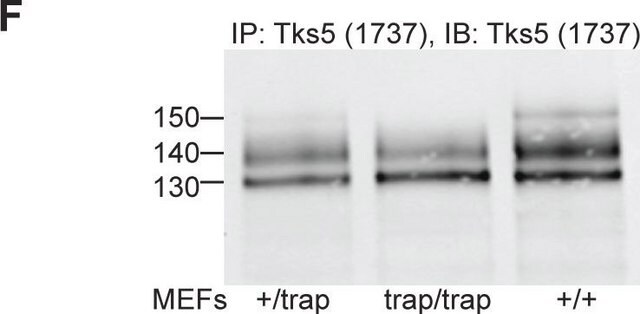
130-150 kDa Uncharacterized bands(s) may be observed in some cell lysates.
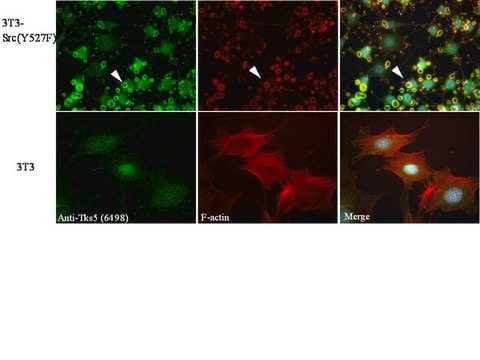
Tks5 (previously known as Fish), is a large scaffolding protein with one amino-terminal PX domain and five SH3 domains. It is cytoplasmic in normal fibroblasts. In Src-transformed cells, Tks5 localizes to podosomes. The coexpression of Tks5 and constitutively active Src in epithelial cancer cells resulted in the appearance of podosomes/invadopodia. Cells with reduced Tks5 expression are poorly invasive through matrigel. Tks5 is expressed and localized to podosomes/invadopodia in some invasive human cancer cell lines and tumor tissue, particularly breast cancers and melanomas. Thus, Tks5 appears to be required for podosome/invadopodia formation and for invasion of some cancer cells.

Immunogen

Epitope: 166-225 aa
Recombinant Protein, aa: 166-225. Homology: Human, Dog, Horse, Rat, Cow (100%, 60/60); Chicken (93%, 56/60)

Application

Anti-TKS5 (SH3 #1) Antibody detects level of TKS5 (SH3 #1) & has been published & validated for use in WB, IC & IP.
Research Category
Cell Structure
Research Sub Category
Cytoskeletal Signaling
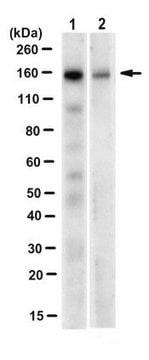
Western Blot Analysis: Antibody detected TKS5 in 20 μg of NIH-3T3 (100% confluent) lysate.

Biochem/physiol Actions

Other homologies: Human, Canine, Equine, Rat, and Bovine (100% sequence homology), Chicken (93% sequence homology)

Physical form

Format: Purified
Protein A purified
Purified in 0.1M Tris-Glycine (pH7.4) 150mM NaCl with 0.05% NaN3.

Preparation Note

Maintain at 2-8°C in undiluted aliquots for up to 1 year after date of receipt.

Analysis Note

Control
Western Blot::
NIH-3T3 (100% confluent) lysate
Immunocytochemistry:
Mouse 3T3-Src(Y527F) cells
Routinely evaluated by Western Blot on NIH-3T3 (100% confluent) lysate.

Other Notes

Concentration: Please refer to the Certificate of Analysis for the lot-specific concentration.

Disclaimer

Unless otherwise stated in our catalog or other company documentation accompanying the product(s), our products are intended for research use only and are not to be used for any other purpose, which includes but is not limited to, unauthorized commercial uses, in vitro diagnostic uses, ex vivo or in vivo therapeutic uses or any type of consumption or application to humans or animals.

Comparer avec des articles similaires

Voir la comparaison complète

Montrer les différences

1 of 1

Cet article
09-268MABT336MABT337
species reactivity

mouse, human

species reactivity

mouse, human

species reactivity

human

species reactivity

human

clone

polyclonal

clone

polyclonal

clone

13H6.3, monoclonal

clone

9H2.1, monoclonal

conjugate

unconjugated

conjugate

unconjugated

conjugate

unconjugated

conjugate

unconjugated

antibody form

purified antibody

antibody form

purified antibody

antibody form

purified antibody

antibody form

purified immunoglobulin

biological source

rabbit

biological source

rabbit

biological source

mouse

biological source

mouse

shipped in

wet ice

shipped in

wet ice

shipped in

ambient

shipped in

ambient


Still not finding the right product?

Essayez notre Outil de sélection de produits pour affiner vos choix.


Classe de stockage

12 - Non Combustible Liquids

wgk

WGK 1

flash_point_f

Not applicable

flash_point_c

Not applicable


Certificats d'analyse (COA)

Recherchez un Certificats d'analyse (COA) en saisissant le numéro de lot du produit. Les numéros de lot figurent sur l'étiquette du produit après les mots "Lot" ou "Batch".

Déjà en possession de ce produit ?

Retrouvez la documentation relative aux produits que vous avez récemment achetés dans la Bibliothèque de documents.

Consulter la Bibliothèque de documents


Contenu apparenté

QCM™ Gelatin Invadopodia Assays provide optimized materials and protocols to enable reproducible analysis of invadopodia in invasive tumor cells (Catalog No. ECM670 for green fluorescence, Catalogue No. ECM671 for red fluorescence). Reagents are provided for coating glass culture surfaces with fluorescent matrix and for colocalizing the actin cytoskeleton and nuclei with invadopodial degradation sites. This assay may also be used for assessing the activity of inhibitors and promoters of invadopodia formation and function. Furthermore, different cell types and individual cells in heterogeneous populations may be analyzed for invasive potential. Finally, the assay kits provide troubleshooting suggestions, recommendations for coating on multiple substrate formats, and example studies in several assay systems (e.g., various cell types, time-course studies, degradation modulation).


Samuel J Ghilardi et al.
Molecular biology of the cell, 32(18), 1707-1723 (2021-07-01)
Interactions between the actin cytoskeleton and the plasma membrane are important in many eukaryotic cellular processes. During these processes, actin structures deform the cell membrane outward by applying forces parallel to the fiber's major axis (as in migration) or they
Karla C Williams et al.
Oncogene, 38(19), 3598-3615 (2019-01-18)
Invadopodia are cell protrusions that mediate cancer cell extravasation but the microenvironmental cues and signaling factors that induce invadopodia formation during extravasation remain unclear. Using intravital imaging and loss of function experiments, we determined invadopodia contain receptors involved in chemotaxis
Nawal Bendris et al.
Journal of cell science, 129(14), 2804-2816 (2016-06-10)
The ability of cancer cells to degrade the extracellular matrix and invade interstitial tissues contributes to their metastatic potential. We recently showed that overexpression of sorting nexin 9 (SNX9) leads to increased cell invasion and metastasis in animal models, which


Numéro d'article de commerce international

RéférenceGTIN
09-40304053252620867

Questions

Évaluations

Aucune valeur de notation

Filtres actifs