


If this product has an expiration or retest date, it will be shown on the Certificate of Analysis (COA, CofA). If there is no retest or expiration date listed on the product's COA, we do not have suitable stability data to determine a shelf life. For these products, the only date on the COA will be the release date; a retest, expiration, or use-by-date will not be displayed.
For all products, we recommend handling per defined conditions as printed in our product literature and website product descriptions. We recommend that products should be routinely inspected by customers to ensure they perform as expected.
For products without retest or expiration dates, our standard warranty of 1 year from the date of shipment is applicable.
For more information, please refer to the Product Dating Information document: https://www.sigmaaldrich.com/deepweb/assets/sigmaaldrich/marketing/global/documents/418/501/product-dating-information-06-25-mk.pdf
69372

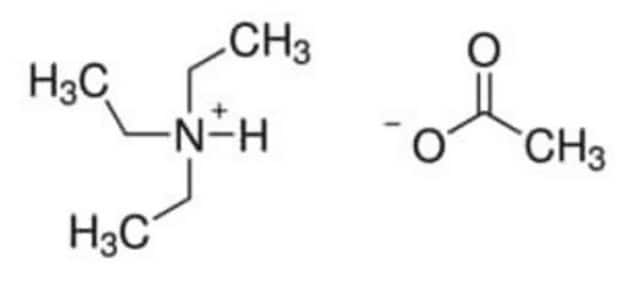
Triethylammonium acetate buffer
suitable for HPLC, 0.98-1.02 M
Synonim(y):
TAA Buffer Solution
Wybierz wielkość
780,00 zł
2540,00 zł
780,00 zł
Informacje o tej pozycji
Przejdź do
form
liquid
shelf life
limited shelf life, expiry date on the label
concentration
0.98-1.02 M
technique(s)
HPLC: suitable
color
colorless
pH
6.9-7.1
solubility
water: soluble at 60 °C
density
1.002 g/cm3 at 20 °C
λ
neat
UV absorption
λ: 260 nm Amax: ≤0.025, λ: 280 nm Amax: ≤0.030
storage temp.
2-8°C
Quality Level
Szukasz podobnych produktów? Odwiedź Przewodnik dotyczący porównywania produktów
Powiązane kategorie
1 of 4
Ta pozycja | |||
|---|---|---|---|
| technique(s) HPLC: suitable | technique(s) electrophoresis: suitable | technique(s) HPLC: suitable | technique(s) - |
| concentration 0.98-1.02 M | concentration 1 M, ~1.0 M in H2O | concentration 0.95-1.05 M | concentration ~1.0 M in H2O |
| Quality Level 100 | Quality Level 200 | Quality Level - | Quality Level 200 |
| form liquid | form liquid | form liquid | form liquid |
| storage temp. 2-8°C | storage temp. 2-8°C | storage temp. 2-8°C | storage temp. 2-8°C |
| pH 6.9-7.1 | pH 7.0 | pH - | pH 8.4-8.6 (25 °C) |
General description
Application
related product
Klasa składowania
12 - Non Combustible Liquids
wgk
WGK 3
flash_point_f
Not applicable
flash_point_c
Not applicable
Wybierz jedną z najnowszych wersji:
Masz już ten produkt?
Dokumenty związane z niedawno zakupionymi produktami zostały zamieszczone w Bibliotece dokumentów.
Protokoły
Rozdzielenie chlorowodorku pirydoksyny (B6), wzorzec analityczny; chlorowodorek tiaminy (B1), wzorzec analityczny
HPLC Analysis of Polyphenols in Nero d'Avola Red Wine on Discovery® HS C18 (UV 280 nm)
Protocol for HPLC Analysis of Bromelain on TSKgel® BioAssist® S vs. Competitive S Column
HPLC Analysis of Immunoglobulin G (IgG) on Zenix® SEC-150 versus Zenix® SEC-300, Effect of Pore Size on Resolution
-
How can I determine the shelf life / expiration / retest date of this product?
1 answer-
Helpful?
-
-
How is shipping temperature determined? And how is it related to the product storage temperature?
1 answer-
Products may be shipped at a different temperature than the recommended long-term storage temperature. If the product quality is sensitive to short-term exposure to conditions other than the recommended long-term storage, it will be shipped on wet or dry-ice. If the product quality is NOT affected by short-term exposure to conditions other than the recommended long-term storage, it will be shipped at ambient temperature. As shipping routes are configured for minimum transit times, shipping at ambient temperature helps control shipping costs for our customers. For more information, please refer to the Storage and Transport Conditions document: https://www.sigmaaldrich.com/deepweb/assets/sigmaaldrich/marketing/global/documents/316/622/storage-transport-conditions-mk.pdf
Helpful?
-
Active Filters
Nasz zespół naukowców ma doświadczenie we wszystkich obszarach badań, w tym w naukach przyrodniczych, materiałoznawstwie, syntezie chemicznej, chromatografii, analityce i wielu innych dziedzinach.
Skontaktuj się z zespołem ds. pomocy technicznej