Skip to Content
Merck

Skip To

O100

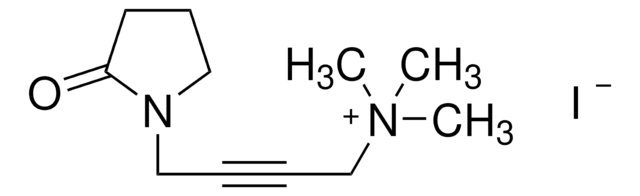
Oxotremorine M

muscarinic acetylcholine receptor agonist, solid

Synonym(s):

N,N,N,-Trimethyl-4-(2-oxo-1-pyrrolidinyl)-2-butyn-1-ammonium iodide, Oxotremorine methiodide

Sign In to View Organizational & Contract Pricing.

Select a Size

Change View
Pack SizeSKUAvailabilityPrice

About This Item

Empirical Formula (Hill Notation):
C11H19IN2O
CAS Number:
Molecular Weight:
322.19
UNSPSC Code:
12352200
PubChem Substance ID:
NACRES:
NA.77
MDL number:
Form:
solid
Quality level:
Pricing and availability is not currently available.
Technical Service
Need help? Our team of experienced scientists is here for you.
Let Us Assist


Product Name

Oxotremorine M, solid

form

solid

Quality Level

color

white

solubility

H2O: 24 mg/mL, ethanol: 4.6 mg/mL

storage temp.

2-8°C

SMILES string

[I-].C[N+](C)(C)CC#CCN1CCCC1=O

InChI

1S/C11H19N2O.HI/c1-13(2,3)10-5-4-8-12-9-6-7-11(12)14;/h6-10H2,1-3H3;1H/q+1;/p-1

InChI key

VVLMSCJCXMBGDI-UHFFFAOYSA-M

Application

Oxotremorine M has been used as a muscarinic acetylcholine receptor (mAchR) agonist:
  • to study its acute effects on the movement of Caenorhabditis elegans[1]
  • to treat hippocampal neurons for studying fibroblast growth factor receptor 1 (FGFR1) phosphorylation
  • to induce bladder overactivity in rats[2]

Biochem/physiol Actions

Oxotremorine M is a nonselective muscarinic acetylcholine receptor agonist.[3]

Features and Benefits

This compound is a featured product for Neuroscience research. Click here to discover more featured Neuroscience products. Learn more about bioactive small molecules for other areas of research at sigma.com/discover-bsm.
This compound is featured on the Acetylcholine Receptors (Muscarinic) and Acetylcholine Receptors (Nicotinic) pages of the Handbook of Receptor Classification and Signal Transduction. To browse other handbook pages, click here.

Compare Similar Items

View Full Comparison

Show Differences

1 of 1

This Item
T9778SML0790G0544
form

solid

form

solid

form

powder

form

solid

Quality Level

200

Quality Level

100

Quality Level

100

Quality Level

100

storage temp.

2-8°C

storage temp.

2-8°C

storage temp.

2-8°C

storage temp.

2-8°C

solubility

H2O: 24 mg/mL, ethanol: 4.6 mg/mL

solubility

45% (w/v) aq 2-hydroxypropyl-β-cyclodextrin: 4.3 mg/mL, ethanol: 5.6 mg/mL, H2O: insoluble

solubility

H2O: 5 mg/mL, clear (warmed)

solubility

DMSO: soluble >5 mg/mL at 60 °C

color

white

color

white

color

white to beige

color

white

Gene Information

human ... CHRM1(1128), CHRM2(1129), CHRM3(1131), CHRM4(1132), CHRM5(1133)

Gene Information

human ... CHRM3(1131), CHRM4(1132)

Gene Information

-

Gene Information

rat ... Htr1a(24473)


pictograms

Skull and crossbones

signalword

Danger

Hazard Classifications

Acute Tox. 1 Inhalation - Acute Tox. 2 Dermal - Acute Tox. 2 Oral

Storage Class

6.1A - Combustible acute toxic Cat. 1 and 2 / very toxic hazardous materials

wgk

WGK 3

flash_point_f

Not applicable

flash_point_c

Not applicable

ppe

Eyeshields, Gloves, type N95 (US)


Choose from one of the most recent versions:

Certificates of Analysis (COA)

Lot/Batch Number

Don't see the Right Version?

If you require a particular version, you can look up a specific certificate by the Lot or Batch number.

Already Own This Product?

Find documentation for the products that you have recently purchased in the Document Library.

Visit the Document Library


Detection of Fibroblast Growth Factor Receptor 1 (FGFR1) Transactivation by Muscarinic Acetylcholine Receptors (mAChRs) in Primary Neuronal Hippocampal Cultures Through Use of Biochemical and Morphological Approaches
"Reference Module in Food Science, 57-70 (2018)
David R Thomas et al.
Neuropharmacology, 58(8), 1206-1214 (2010-03-09)
N-desmethylclozapine (NDMC) has been reported to display partial agonism at the human recombinant and rat native M(1) mAChR, a property suggested to contribute to the clinical efficacy of clozapine. However, the profile of action of NDMC at the human native
Li Hu et al.
Scientific reports, 10(1), 17581-17581 (2020-10-18)
SPARC-deficient mice have been shown to exhibit impaired glucose tolerance and insulin secretion, but the underlying mechanism remains unknown. Here, we showed that SPARC enhanced the promoting effect of Muscarinic receptor agonist oxotremorine-M on insulin secretion in cultured mouse islets.


Global Trade Item Number

SKUGTIN
O100-500MG04061838065063
O100-100MG04061834212690

Questions

Reviews

No rating value

Active Filters